
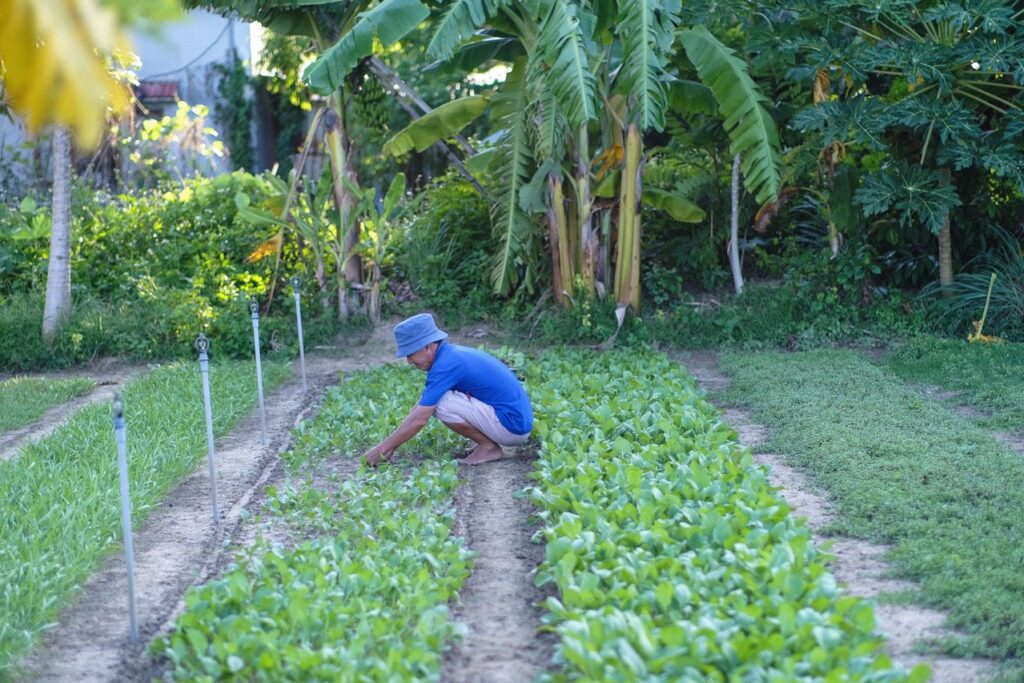
Intercropping means growing two or more crops in the same garden bed at the same time.
Done well, it can help you make better use of limited space by combining plants that occupy different heights, grow at different speeds, or use the bed differently.
For a Malaysian home gardener with only one or two raised beds, this can be extremely useful.
You might grow brinjal as the main crop, add quick-growing leafy vegetables while the brinjal is still small, and use the back of the bed for a climbing crop on a trellis.
The goal is not to squeeze as many plants as possible into one space.
The goal is to make several crops share the bed without competing so heavily that all of them perform worse.
Intercropping Is Not the Same as Overcrowding
This is the first distinction to understand.
Putting twenty different plants into one raised bed does not automatically make it productive.
Every crop still needs enough:
light,
water,
root space,
nutrients,
and airflow.
If plants are packed too closely, you may end up with smaller harvests, more fungal disease, and greater pest pressure.
Good intercropping is planned.
Overcrowding is simply too many plants fighting for the same resources.
Think About the Final Size of Each Plant
One of the easiest mistakes is planning around seedling size.
A young brinjal may only be 15 cm tall when you transplant it.
Several weeks later, it can occupy a large section of the bed.
A young cucumber vine may look tiny before it begins climbing rapidly across the trellis.
When intercropping, always ask:
How much space will this plant need later?
Temporary crops can use open space while the main plant is young, but they should be harvested before the main crop needs that space.
Combine Fast Crops with Slow Crops
This is one of the most practical forms of intercropping.
Suppose you transplant young chilli or brinjal plants into a raised bed.
They may take weeks to fill the space around them.
Instead of leaving all that soil empty, you can sow a quick crop such as bayam or sawi between them.
The leafy vegetables grow quickly.
You harvest them.
Then the chilli or brinjal expands into the newly opened space.
The two crops share the bed temporarily rather than competing throughout their entire life cycles.
Use Height to Your Advantage
Plants do not all need to occupy the same vertical layer.
A garden bed can sometimes support:
a taller crop,
a medium crop,
and a low-growing crop.
For example, you might train long beans upward at the back of a bed while growing lower leafy vegetables in front.
The key is sunlight.
Place taller crops where they will not permanently block the smaller plants.
In many Malaysian homes, observing the direction of morning and afternoon sun before planting can make a big difference.
Use Trellises to Free Up Ground Space
Vertical crops are especially valuable in small gardens.
Cucumbers, long beans, bitter gourd, and other climbers can be trained upward rather than allowed to spread across the whole bed.
This leaves more soil surface available for another crop.
However, the vine’s roots still occupy the bed.
A trellised cucumber may look like it is using only vertical space, but below ground it still competes for water and nutrients.
Do not treat the area beneath a trellis as completely free.
Match Crops with Different Growth Speeds
Different growth rates can reduce competition.
For example:
sawi may finish quickly,
okra grows taller and continues longer,
while chilli may remain productive for months.
If all three are placed correctly, they can use the bed at different stages.
The fast crop leaves first.
The medium crop expands next.
The long-term crop remains.
This creates a changing garden rather than a bed where every plant reaches maximum size at once.
Root Depth Can Matter Too
Different crops may explore the soil differently.
Some plants produce relatively shallow root systems.
Others send roots deeper.
In theory, combining plants with different rooting habits can reduce direct competition.
But do not rely too heavily on this idea.
Roots do not stay inside neat underground zones.
They spread wherever moisture, oxygen, and nutrients are available.
Intercropping can improve space use, but every plant still affects the others.
A Practical Chilli Bed Example
Suppose you have a raised bed with several chilli plants spaced correctly for their mature size.
While the chillies are young, sow a small quantity of bayam between them.
The bayam grows quickly and can be harvested before the chilli canopy becomes large.
Later, leave the chillies to occupy the bed more fully.
This works because the leafy crop is temporary.
If you kept replanting dense bayam around mature chilli plants, competition and airflow problems could eventually increase.
Intercropping should change as the bed develops.
A Brinjal and Leafy Vegetable Combination
Brinjal can also work well with quick leafy crops during establishment.
Space the brinjal according to mature size.
Then use the gaps temporarily for a crop such as sawi.
Once the brinjal grows larger, harvest the sawi and stop replanting it in areas where the brinjal canopy has closed.
This gives you an extra early harvest without permanently sacrificing brinjal space.
What About Long Beans?
Long beans are useful because they grow vertically.
Plant them along a sturdy trellis, ideally where their foliage will not heavily shade the rest of the bed.
You can use lower spaces for short-duration vegetables while the vines establish.
As the beans become larger and more productive, monitor shading and airflow.
If the lower crop begins stretching weakly toward light, the bed is becoming too crowded.
Be Careful Combining Large Crops
Some combinations simply demand too much.
Pumpkin, cucumber, brinjal, tomato, and chilli may all be productive crops, but packing several mature plants together can create major competition.
Large cucurbits such as pumpkin can quickly dominate a small raised bed.
Their leaves shade surrounding plants, while their vines spread far beyond the original planting point.
If you want to intercrop with vigorous plants, give them a clear role and enough room.
Do not assume every empty patch needs another vegetable.
Intercropping Can Improve Harvest Timing
One advantage is that the bed does not produce just one crop at one time.
You may harvest leafy vegetables first.
Beans next.
Then chillies or brinjal continue producing later.
This creates several harvest windows from the same bed.
Combined with succession planting, intercropping can make a small edible garden much more useful.
Intercropping and Succession Planting Are Different
These two ideas are related but not identical.
Intercropping means growing more than one crop in the same space at the same time.
Succession planting means arranging crops to follow one another over time.
You can combine both.
For example, grow young chilli and sawi together.
Harvest the sawi.
Then later plant another suitable crop once enough space becomes available.
The bed is being used both simultaneously and sequentially.
Does Intercropping Reduce Pest Problems?
Sometimes a more diverse bed may make it harder for certain pests to move through a uniform block of one crop.
Flowering herbs and suitable companion plants may also attract beneficial insects.
However, do not treat intercropping as guaranteed pest control.
A caterpillar that likes sawi can still find sawi in a mixed bed.
Aphids can still attack chilli.
Some plant combinations may even create denser foliage that makes inspection harder.
Use intercropping as a space-management strategy first, not as a miracle pesticide.
Do Not Assume Every “Companion Planting” Claim Is Proven
Gardening advice online often claims that one plant will magically protect another.
Some combinations have practical advantages, such as different growth habits or flowering plants supporting beneficial insects.
Other claims are based mostly on tradition or anecdote.
For Project HARVEST gardeners, a better rule is:
pair plants because their space, timing, light, and water needs are compatible.
If there is an additional pest-management benefit, treat that as a bonus rather than the only reason for the combination.
Watering Becomes More Important
A mixed bed may use water faster than a single-crop bed.
Large fruiting plants, leafy vegetables, and climbers all draw moisture from the same soil.
Check moisture more carefully as the bed fills.
Do not automatically increase watering without checking, especially during Malaysia’s rainy weeks.
The goal is consistent moisture without permanently waterlogging the root zone.
Mulch can help reduce evaporation, but keep it away from direct contact with sensitive stems where rot could become an issue.
Fertiliser Needs Can Become More Complicated
Different crops have different nutrient demands.
Leafy vegetables often respond strongly to nitrogen.
Fruiting crops need balanced nutrition across their growth stages.
When several crops share one bed, avoid trying to heavily fertilise each plant independently without thinking about the whole root zone.
Over-fertilising one crop can affect everything growing nearby.
Build good soil first, then fertilise responsibly according to the overall planting.
Airflow Still Matters in Malaysia
This deserves special attention in our humid climate.
Dense foliage can stay wet longer after rain.
That can increase the conditions that favour some fungal and bacterial diseases.
Leave enough space for air to move through the bed.
Prune only where appropriate for the crop.
Train vines neatly.
Remove badly diseased material.
If you can barely see the soil because every centimetre is packed with stems and leaves, you may have crossed from intercropping into overcrowding.
Harvest the Temporary Crop on Time
A temporary intercrop should leave before it becomes a competitor.
If you planted sawi between young brinjal plants, harvest the sawi once the brinjal starts expanding.
Do not keep the leafy crop for another month simply because it still looks healthy.
The whole system depends on timing.
One crop gets the space early.
The next crop gets it later.
Start with Two Crops, Not Six
If you are new to intercropping, keep it simple.
Try one main crop plus one secondary crop.
For example:
chilli + bayam,
brinjal + sawi,
long beans + a low leafy crop,
or okra + a short-duration vegetable.
Observe:
how much light each receives,
how quickly the bed dries,
whether growth slows,
and whether harvesting remains convenient.
Once that works, you can try more complex combinations.
Make Sure You Can Still Reach Everything
A productive bed should also be easy to maintain.
If you need to step over cucumber vines just to reach your chilli plants, the layout is not working.
Leave access for:
harvesting,
pest inspection,
pruning,
watering,
and removing old plants.
This matters especially for raised beds positioned against walls or fences.
Plan maintenance access before the plants fill the space.
A Simple Intercropping Layout
Imagine a rectangular raised bed.
At the back, install a trellis and grow long beans.
In the middle, place several brinjal plants at appropriate spacing.
Between the young brinjal plants, grow a short-duration leafy crop.
At the front, keep a few lower herbs where they receive enough light.
As the brinjal expands, harvest and remove the temporary leafy vegetables.
If the bean canopy becomes too dense, manage it so the lower crops still receive adequate light.
This creates several layers of production without trying to make every plant permanent.
Review the Bed After Every Cycle
Once a crop finishes, ask:
Did any plant become badly shaded?
Was watering difficult?
Did disease increase?
Which crop dominated the roots or canopy?
Was the extra harvest worth the extra work?
Use those answers to improve the next combination.
Intercropping is not a fixed recipe.
The best combinations are discovered by observing how particular crops behave in your own garden.
At the end of the day, intercropping can help Malaysian home gardeners produce more from a limited space, but the secret is not simply adding more plants. Combine crops that differ in height, growth speed, harvest timing, and space requirements, then remove temporary crops before competition becomes severe. When planned carefully, one raised bed can provide several different harvests across the same period without becoming an overcrowded jungle.
Already growing two or more crops in the same raised bed? Tag @projectharvest.my on Instagram and show us your intercropping combinations, from chillies with leafy vegetables to beans climbing above shorter crops. Tell us what worked, what became too crowded, or what you are planning to try next — your real Malaysian garden examples may help other home gardeners use their limited space more intelligently.