
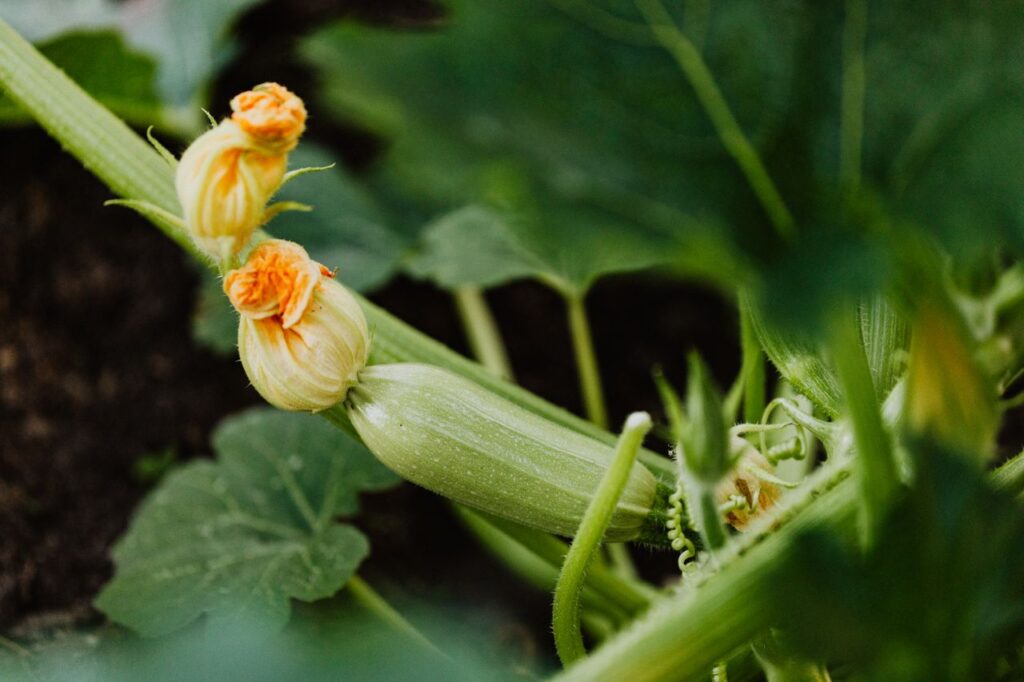
The easiest way to tell male and female flowers apart on crops such as cucumber, pumpkin, bitter gourd, and many other gourds is to look directly behind the flower.
A male flower normally sits on a relatively thin stem.
A female flower has a swollen structure immediately behind the petals that often looks like a tiny version of the future fruit.
That swollen structure is the ovary.
If pollination succeeds, the ovary can continue developing into the cucumber, pumpkin, or gourd you eventually harvest.
Once you learn to look behind the flower instead of only at the petals, identifying male and female blooms becomes much easier.
Why Do Some Vegetable Plants Have Male and Female Flowers?
Plants use several different flowering systems.
Many cucurbit crops — including cucumbers, pumpkins, squash, bitter gourds, bottle gourds, and related plants — commonly produce separate male and female flowers on the same plant.
A plant with separate male and female flowers on the same individual is described as monoecious.
The male flower produces pollen.
The female flower contains the ovary where fruit can develop after successful pollination.
Pollen must move from a male flower to a receptive female flower for normal fruit development in varieties that require pollination.
Not Every Vegetable Has Separate Male and Female Flowers
This distinction is important.
Chillies, tomatoes, and brinjal do not normally produce separate male flowers and female flowers in the same way cucumbers and pumpkins do.
Their individual flowers generally contain both male and female reproductive structures.
These are sometimes called perfect or bisexual flowers.
So you should not look for “male tomato flowers” and “female tomato flowers” using the tiny-fruit method.
The male-versus-female distinction is particularly useful when dealing with cucurbits.
The Easiest Sign: Look Behind the Flower
When you see a yellow cucumber, pumpkin, or gourd flower, gently inspect where the flower joins the stem.
Male Flower
Behind a male flower, you will usually see a relatively narrow flower stalk.
There is no swollen miniature fruit immediately underneath the petals.
Female Flower
Behind a female flower, there is a noticeable swollen ovary.
On cucumber, it may already look like a tiny cucumber.
On pumpkin, it resembles a miniature round pumpkin.
On bitter gourd, it may look like a very small bitter gourd.
This is by far the easiest identification method for home gardeners.
The “Tiny Fruit” Is Actually the Ovary
Gardeners often call the swelling beneath a female flower a baby fruit.
That is understandable because it often looks exactly like one.
Botanically, however, it is the flower’s ovary.
It is present before successful pollination.
If pollination occurs and fertilisation succeeds, that ovary normally enlarges into fruit.
If pollination fails, it may remain small, turn yellow, shrivel, and eventually fall.
This is why seeing a tiny cucumber behind a flower does not yet guarantee that you will harvest a cucumber.
You Can Also Look Inside the Flower
There is another way to tell them apart.
Inside a male flower, you will find the stamens, which produce and carry pollen.
Inside a female flower, you will see the stigma, the receptive structure that pollen needs to reach.
On many cucurbits, the stigma looks divided into several lobes in the centre of the flower.
For beginners, though, looking behind the petals for the ovary is usually much easier than trying to identify the internal flower structures.
Why Are There So Many Male Flowers?
A common concern is:
“My pumpkin is flowering, but every flower looks male.”
This can be completely normal.
Many cucurbits produce a flush of male flowers before they begin producing significant numbers of female flowers.
The plant may still be establishing itself.
Male flowers also help ensure pollen is available once female flowers begin opening.
Do not pull out a healthy pumpkin or cucumber plant simply because the first several flowers are male.
Give it time.
Male Flowers Do Not Turn Into Female Flowers
A male flower remains male.
It does not later transform into a female flower.
The plant produces separate new flowers.
So if today’s pumpkin flower has no swollen ovary behind it, it will not become tomorrow’s pumpkin.
Its role is pollen production.
The fruit-producing flowers will appear separately.
What Happens to Male Flowers After They Open?
Male flowers usually have a short life.
They open, make pollen available, and then wilt and fall.
That is normal.
Seeing fallen male flowers underneath a cucumber or pumpkin vine is not a sign that the plant is failing.
The important question is whether female flowers eventually appear and receive successful pollination.
What Happens to Female Flowers?
A female flower usually opens for a limited period when its stigma is receptive to pollen.
If pollen reaches it successfully and conditions are suitable, the ovary should begin expanding after the flower fades.
If pollination fails, you may see:
the flower closing,
the tiny ovary staying small,
yellowing,
shrivelling,
and eventual dropping.
This is particularly common when pollinator activity is low or weather interferes with flowering.
Bees Often Do the Work for You
In outdoor home gardens, bees and other pollinating insects frequently move pollen between flowers.
They visit male flowers for pollen and then transfer some of it to female flowers.
For many gardeners, no manual intervention is needed.
Supporting a garden with flowering plants and avoiding unnecessary insecticide use around open blooms can help pollinating insects.
If a pesticide treatment is genuinely needed, always follow the product label carefully and pay particular attention to instructions concerning bees and flowering crops.
Heavy Rain Can Disrupt Pollination
Malaysia’s weather can sometimes complicate things.
During repeated heavy rain:
pollinating insects may be less active,
flowers may become physically damaged,
and the short pollination window may pass without enough pollen reaching a female flower.
If several female flowers fail during a particularly wet period, watch the next flowering cycle before assuming something is wrong with the plant.
Fruit set may improve naturally once conditions become more favourable.
Very Hot Weather Can Affect Flowering Too
Heat stress can influence flower production and fruit set.
A plant on a hot balcony or beside a heat-reflecting concrete wall may experience harsher conditions than the general weather report suggests.
If the vine repeatedly produces flowers but little fruit, consider:
heat,
watering consistency,
pollinator activity,
and overall plant health.
Do not immediately assume the plant needs more fertiliser.
Can You Hand-Pollinate Female Flowers?
Yes.
Hand pollination can be useful for small home gardens, particularly when female flowers repeatedly fail to set fruit.
The basic idea is simple.
Use pollen from a freshly opened male flower and transfer it to the stigma inside a freshly opened female flower.
Some gardeners remove the male flower’s petals and gently touch the pollen-bearing centre directly onto the female stigma.
Others use a small clean brush.
Morning is often a practical time because many cucurbit flowers are freshly open then.
How Many Male Flowers Do You Need?
You do not need a one-to-one number of male and female flowers.
One healthy male flower may provide enough pollen for more than one female flower, depending on pollen availability and the crop.
The problem is usually not having “too many” males.
The concern is when female flowers appear but there are no suitable male flowers or pollination is repeatedly unsuccessful.
Should You Remove Male Flowers?
Usually, no.
Male flowers are useful pollen sources.
Removing them unnecessarily can reduce the amount of pollen available for female flowers.
There may be culinary uses for edible flowers of some species, but if your main goal is fruit production, leave enough healthy male flowers for pollination.
Female Flowers Can Appear Later as the Plant Matures
A young cucumber or pumpkin vine may initially prioritise vegetative growth and male flowering.
As it becomes larger and growing conditions are suitable, female flowers may become more common.
The exact balance varies according to:
species,
variety,
plant age,
temperature,
nutrition,
and other environmental conditions.
This is why comparing your vine with another gardener’s plant of a different variety can sometimes be misleading.
Excess Nitrogen Can Affect the Balance
Very heavy nitrogen fertilisation can encourage lush vegetative growth.
Plants may produce impressive vines and leaves without giving the fruit production you expected.
That does not mean nitrogen directly “turns flowers male” in every situation.
Flower sex expression in cucurbits is influenced by a combination of genetics, plant hormones, and environmental conditions.
The practical lesson is simpler:
avoid over-fertilising in an attempt to force fruiting.
Healthy, balanced growth is the goal.
Do Not Confuse an Unpollinated Female Flower with Fruit Disease
A tiny cucumber that turns yellow and drops soon after flowering is often blamed on disease or nutrient deficiency.
Sometimes the explanation is much simpler:
the female flower was not adequately pollinated.
Look at when the failure occurs.
If the tiny ovary never begins sustained enlargement after flowering, pollination should be one of the first things you consider.
If larger established fruits later develop spots, rot, distortion, or other symptoms, the cause may be different.
A Quick Identification Test
When you find a flower on a cucumber, pumpkin, or gourd, ask:
Is there a swollen miniature fruit behind the flower?
If yes, it is a female flower.
If no, and the flower is sitting on a thin stalk, it is most likely male.
Then, if you want to look closer:
male = pollen-producing stamens inside,
female = receptive stigma and ovary.
Once you have compared the two side by side, you will probably recognise them instantly in future.
Why Learning the Difference Matters
Knowing male and female flowers helps you diagnose several common garden questions.
For example:
“Why does my pumpkin have flowers but no pumpkins?”
“Why does the tiny cucumber keep turning yellow?”
“Why are all the flowers falling?”
“Should I hand-pollinate?”
“Why are there so many male flowers?”
Instead of guessing, you can inspect the plant and understand which stage of reproduction is actually happening.
Observe the Vine for Several Days
Do not judge a cucurbit plant from one morning.
Flowers come and go quickly.
Check the vine regularly.
You may notice:
male flowers first,
then both male and female flowers,
then tiny successfully pollinated fruits beginning to expand.
That sequence is much easier to understand when you observe the plant across several flowering days.
At the end of the day, telling male and female flowers apart is easiest when you look behind the petals. On cucumbers, pumpkins, bitter gourds, and many related vegetables, the female flower carries a swollen ovary that looks like a miniature version of the future fruit, while the male flower sits on a simpler, thinner stalk. Once you recognise that difference, flower drop, failed fruit set, and hand pollination become much easier to understand — and you can stop worrying every time a perfectly normal male flower falls from the vine.
Growing cucumber, pumpkin, bitter gourd, or another cucurbit at home? Tag @projectharvest.my on Instagram and show us your male and female flowers, your first tiny ovary, or the moment a successfully pollinated fruit begins to grow. We would love to see Malaysian gardeners learning to read what their flowers are telling them before the harvest even begins.