
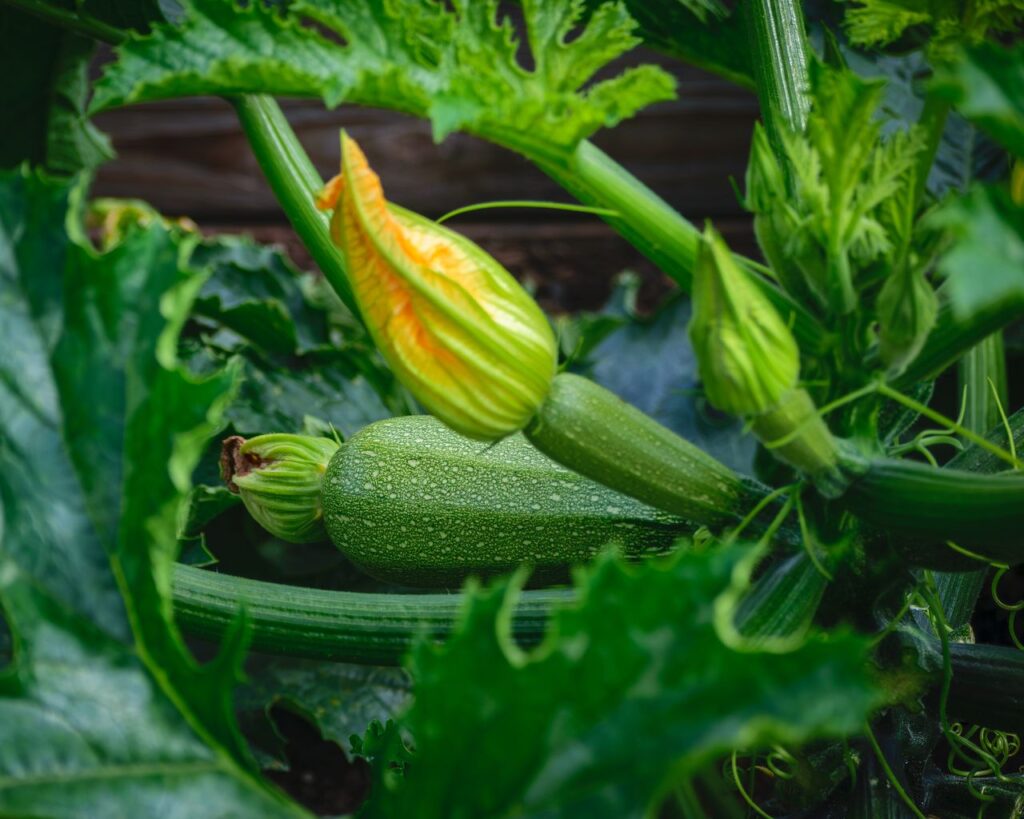
Hand-pollination is a simple way to manually move pollen from a male flower to a female flower when cucumbers, pumpkins, bitter gourds, bottle gourds, and related crops are flowering but failing to set fruit reliably.
Normally, bees and other pollinating insects do this work.
But in a small Malaysian home garden, pollinator visits can sometimes be inconsistent, especially during periods of heavy rain, strong wind, or poor flowering synchronisation.
Hand-pollination does not replace healthy growing conditions, but it can help when female flowers are opening and pollination appears to be the missing step.
First, Make Sure You Have Both Male and Female Flowers
Before attempting hand-pollination, identify the flowers correctly.
On many cucurbits, male and female flowers are separate.
A male flower usually grows on a relatively thin stalk and has no swollen structure behind the petals.
A female flower has a visible ovary behind the petals.
This ovary often looks like a miniature version of the future fruit.
On a cucumber, it resembles a tiny cucumber.
On a pumpkin, it looks like a tiny pumpkin.
On bitter gourd, it resembles a miniature bitter gourd.
Only the female flower can develop into fruit.
Why Hand-Pollination Sometimes Helps
If female flowers are opening but the immature fruits repeatedly yellow, shrivel, and drop soon afterwards, inadequate pollination may be one possible cause.
This can happen when:
pollinator activity is low,
heavy rain limits insect movement,
male and female flowers are not opening together,
the garden has very few flowering plants,
or the crop is growing in a more enclosed balcony or urban space.
However, poor fruit set can also come from heat stress, water stress, disease, nutrient imbalance, or other problems.
Hand-pollination helps only when pollen transfer is part of the problem.
Morning Is Usually the Best Time
For many cucurbits, flowers are freshly open in the morning.
This is often the easiest time to find:
fresh pollen on male flowers,
and receptive female flowers.
Check the plants early rather than waiting until the flowers are already closing or wilting.
Exactly how long a flower stays receptive varies with crop, variety, and conditions, so work with flowers that have opened recently.
Method 1: Use the Male Flower Directly
This is one of the easiest methods for pumpkins, cucumbers, and many gourds.
First, find a freshly opened male flower.
Cut or gently remove it from the plant.
Then carefully peel back or remove the petals so the pollen-bearing centre is exposed.
You should see yellowish pollen on the male reproductive structure.
Next, find a freshly opened female flower.
Gently touch the pollen-bearing part of the male flower onto the stigma in the centre of the female flower.
Make contact across the stigma rather than touching only one tiny point.
That is usually enough.
Method 2: Use a Small Clean Brush
If you prefer not to remove the male flower, use a small clean, dry artist’s brush or similar soft tool.
Gently brush the pollen-bearing structures inside the male flower.
Then transfer that pollen onto the stigma of the female flower.
You should be able to see some pollen on the brush and female flower.
This method can be useful when:
male flowers are limited,
you want to pollinate several female flowers,
or the flower shape makes direct contact awkward.
Keep the brush dry and clean.
Use Fresh Pollen
Freshly opened male flowers are generally the best pollen source.
An old flower that has been exposed to rain or is already closing may provide less usable pollen.
If possible, choose a healthy male flower from the same plant or another compatible plant of the same species.
For home gardeners, the simplest approach is usually to use flowers from the same crop type growing nearby.
Do Not Assume Every Gourd Can Pollinate Every Other Gourd
This is important.
“Cucurbits” includes many different species.
A pumpkin, cucumber, bitter gourd, and bottle gourd are not automatically compatible simply because all of them are commonly called gourds or belong to the same broad plant family.
For reliable fruit production, transfer pollen between compatible flowers of the same species or known compatible variety group.
If your aim is simply to get a cucumber fruit, use cucumber pollen.
If you are pollinating bitter gourd, use bitter gourd pollen.
How Much Pollen Do You Need?
You do not need to cover the flower in an enormous amount of pollen.
The aim is to make good contact between fresh pollen and the receptive stigma.
One healthy male flower may provide enough pollen to pollinate more than one female flower, depending on the amount available.
But when male flowers are plentiful, using one fresh male flower for one or a few females keeps the process simple.
What Does Successful Pollination Look Like?
You will not know immediately.
The flower will eventually close and wilt whether pollination succeeds or not.
Over the following days, watch the ovary behind the female flower.
If pollination was successful, it should generally continue enlarging.
If pollination failed, the ovary may:
stop growing,
turn pale or yellow,
shrivel,
and eventually fall.
Remember that pollination is only one part of fruit development.
A successfully pollinated fruit can still fail later because of severe plant stress, disease, damage, or unsuitable growing conditions.
Cucumbers Can Be Slightly Different
Many traditional cucumber varieties produce separate male and female flowers and rely on pollen transfer.
However, some modern cucumber varieties can produce fruit without pollination.
These are called parthenocarpic varieties.
They are often used in protected cultivation.
If your cucumber variety is parthenocarpic, hand-pollination may be unnecessary and in some cases can affect fruit quality depending on the cultivar.
Check the seed packet or variety information before assuming every cucumber needs manual pollination.
Pumpkins Are Excellent for Learning
Pumpkin flowers are large, which makes male and female flowers easy to identify and handle.
This makes pumpkins one of the easiest crops for learning hand-pollination.
The female flower has a very obvious swelling behind it.
The male flower usually has a long thin stalk.
The large reproductive structures inside are also easy to reach.
If you have never hand-pollinated before, pumpkin is a very practical crop to practise on.
Bitter Gourd Can Also Be Hand-Pollinated
Bitter gourd produces separate male and female flowers.
The female flower carries a small developing bitter gourd behind the petals.
If pollinator visits seem low and female flowers repeatedly fail, hand-pollination can be attempted using fresh bitter-gourd pollen.
Because the flowers are smaller than pumpkin flowers, using a small soft brush may sometimes be easier than handling the male flower directly.
Bottle Gourds and Other Gourds
The same general principle applies to many gourds:
identify the male flower,
collect fresh pollen,
find a receptive female flower,
and transfer the pollen gently.
However, flower timing can vary between species.
Some gourd flowers may open later in the day or evening rather than early morning.
Observe your own plants instead of assuming every cucurbit follows exactly the same schedule.
What If You Only Have Female Flowers?
You need compatible pollen.
If there are no male flowers open, there is nothing to transfer.
Do not try to use pollen from an unrelated vegetable.
Wait for male flowers to open.
In some cases, the balance of male and female flowers changes as the plant develops.
Weather and variety can influence flowering patterns too.
What If You Only Have Male Flowers?
This is extremely common, particularly early in the life of cucumbers, pumpkins, and other cucurbits.
Male flowers may appear first.
Do not panic.
Do not remove the plant.
Do not pour extra fertiliser on it in an attempt to force female flowers immediately.
Allow the vine to establish and continue monitoring.
Female flowers may appear later.
Should You Pollinate the Same Female Flower More Than Once?
Usually, one careful pollination with plenty of fresh compatible pollen is enough.
You do not need to repeatedly disturb the flower throughout the day.
The important factors are:
fresh pollen,
a receptive female flower,
and good contact.
Once completed, leave the flower alone and monitor fruit development.
Avoid Hand-Pollinating Wet Flowers
If the flower is soaked after heavy rain, pollen transfer may be less effective.
Wet pollen can clump or wash away.
If possible, work with relatively dry freshly opened flowers.
During Malaysia’s rainy periods, this can mean checking flowers early when there is a break in the rain or using plants growing in a protected but well-lit location.
Do Not Damage the Stigma
The stigma inside the female flower is delicate.
You are transferring pollen, not scrubbing the flower.
Use gentle contact.
A soft brush or the exposed male flower should be enough.
Rough handling can damage the flower you are trying to help.
Do Not Remove Every Male Flower
Gardeners sometimes remove male flowers after using them.
That is fine for the one flower you are using.
But do not routinely remove all male flowers from the vine.
They are the plant’s pollen source and are also useful to natural pollinators.
Leave plenty of healthy male flowers available.
Hand-Pollination Does Not Mean You Should Ignore Pollinators
Manual pollination is useful, but a healthy outdoor garden should still support natural pollination.
Encourage flowering diversity where practical.
Avoid unnecessary insecticide applications, especially around open flowers.
When pest treatment is genuinely needed, follow the product label and take bee and pollinator precautions seriously.
Natural pollination makes the garden much less labour-intensive.
Keep the Plant Healthy Enough to Support Fruit
Successful pollination does not guarantee a harvest if the plant is severely stressed.
Make sure the vine has:
adequate sunlight,
consistent moisture,
good drainage,
sufficient root space,
and balanced nutrition.
A pumpkin or cucumber plant may abort developing fruit if it is struggling badly.
Do not interpret every failed fruit after hand-pollination as proof that you performed the technique incorrectly.
Avoid Excess Nitrogen
A very lush vine covered in leaves but producing little fruit can sometimes be receiving too much nitrogen relative to its needs.
Do not respond to poor fruit set by repeatedly adding high-nitrogen fertiliser.
Balanced nutrition is more important than pushing vegetative growth.
Follow appropriate fertiliser rates rather than feeding based on frustration.
Mark Hand-Pollinated Flowers if You Want to Learn
A small label can turn hand-pollination into a useful experiment.
After pollinating a female flower, attach a loose tag nearby or note its location.
Record the date.
Then check whether the ovary grows over the next few days.
For example:
12 October — hand-pollinated Pumpkin Flower A
This makes it easier to compare manually pollinated flowers with those left to natural pollinators.
Hand-Pollination Can Also Help Seed Savers
If you are saving seed and want more control over which plants cross, manual pollination can become part of a more advanced controlled-pollination process.
However, simply hand-pollinating an open flower does not guarantee varietal purity if insects have already brought in pollen from another compatible variety.
Seed-saving work may require flower isolation or bagging as well.
For ordinary fruit production, you do not need to worry about this.
A Simple Hand-Pollination Routine
For most home gardeners:
1. Find a freshly opened male flower.
2. Confirm that it has pollen.
3. Find a freshly opened female flower with the swollen ovary behind it.
4. Remove the male flower and expose the pollen-bearing centre, or use a small clean brush.
5. Gently transfer pollen onto the female stigma.
6. Leave the flower undisturbed.
7. Check the ovary over the next few days for continued growth.
That is the basic process.
Do You Need to Hand-Pollinate Every Flower?
No.
If natural pollinators are already giving you good fruit set, there is little reason to manually pollinate every female flower.
Hand-pollination is most useful when:
fruit set is poor,
pollinator activity seems limited,
weather has disrupted flowering,
or you simply want to make sure a particular female flower receives pollen.
Use it as a tool rather than turning it into an unnecessary daily chore.
Keep Watching the Next Generation of Flowers
If one hand-pollination attempt fails, do not immediately conclude that the method does not work.
Perhaps the flower was already too old.
Perhaps the pollen was wet.
Perhaps the plant was under stress.
Try again with another fresh pair of flowers.
Learning the flowering rhythm of your own vines often improves success very quickly.
At the end of the day, hand-pollinating cucumbers, pumpkins, and gourds is simply about doing the job that a bee would normally do: moving fresh compatible pollen from a male flower onto the receptive stigma of a female flower. In Malaysian home gardens, it can be particularly useful during periods of heavy rain, low pollinator activity, or when only a few vines are growing in a small urban space. Learn to identify the flowers first, transfer the pollen gently, and then let the plant tell you whether the ovary continues to grow.
Trying hand-pollination on your cucumber, pumpkin, bitter gourd, bottle gourd, or another cucurbit? Tag @projectharvest.my on Instagram and show us the male flower, female flower, your pollination attempt, and whether that tiny ovary eventually became a full-sized harvest. We would love to see Malaysian gardeners turning one carefully pollinated flower into the next fruit from their home garden.