
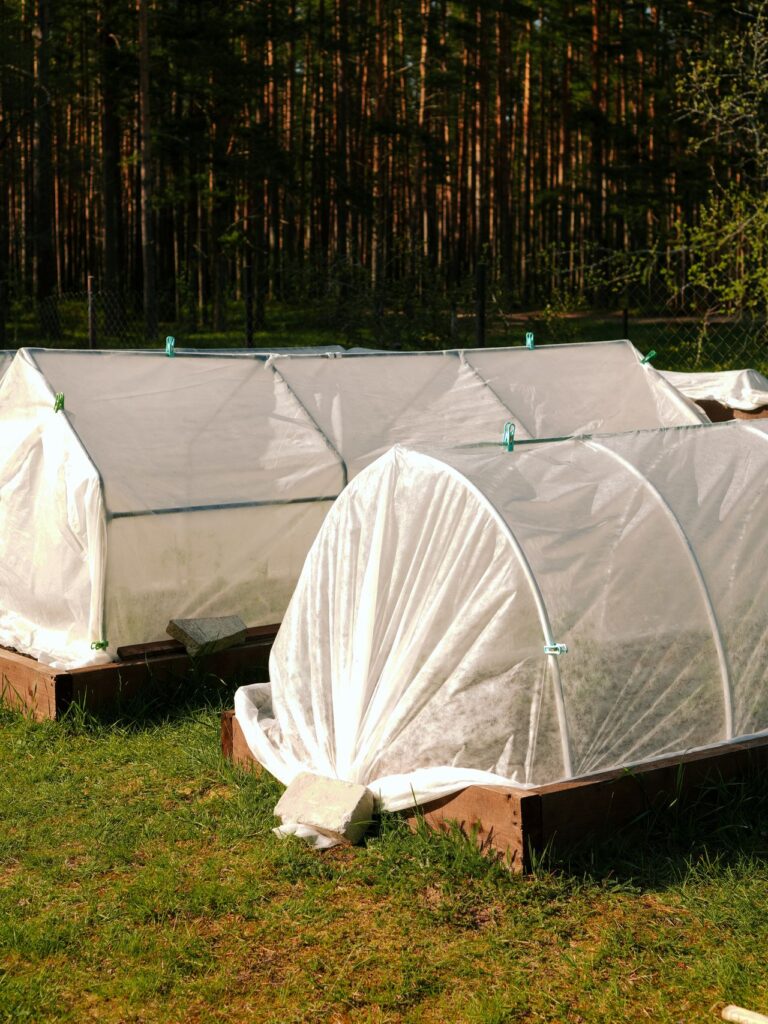
Insect netting can be one of the most useful non-chemical pest controls in a home garden.
Used properly, it can help reduce access by pests such as:
whiteflies,
thrips,
leaf-mining flies,
moths,
and other flying insects.
But in Malaysia’s hot, humid climate, very fine netting can also reduce airflow and trap heat around the crop.
That may lead to:
higher leaf temperatures,
slower drying after rain or watering,
greater humidity around foliage,
and increased disease pressure.
The goal is therefore not simply to use the finest net possible.
The goal is to create a barrier that excludes the target pest while still allowing the crop to breathe.
How Insect Netting Works
Insect netting works by physically preventing pests from reaching the plant.
Unlike a pesticide, it does not need to kill the insect.
The pest simply cannot get through the mesh.
This makes netting particularly useful in an Integrated Pest Management, or IPM, system.
It can reduce the need for repeated spraying and may help protect:
young seedlings,
leafy vegetables,
brassicas,
chillies,
brinjal,
beans,
and other vulnerable crops.
But the mesh must be chosen and installed carefully.
Smaller Mesh Blocks Smaller Pests — But Also Reduces Airflow
This is the main trade-off.
A coarse net allows more:
air movement,
light,
and ventilation,
but smaller pests may still pass through.
A finer mesh excludes smaller insects such as:
thrips,
whiteflies,
and certain small flies,
but also creates more resistance to air movement.
That means the temperature and humidity inside the enclosure may rise.
There is no single perfect mesh size for every crop and pest.
Choose netting according to the pest you are actually trying to exclude.
Do Not Automatically Buy the Finest Net Available
Very fine mesh may sound safer because fewer insects can pass through.
But if your main problem is large caterpillar-producing moths, you may not need extremely fine material.
A more open mesh may provide enough exclusion while maintaining much better airflow.
Using excessively fine netting can create:
hotter conditions,
slower leaf drying,
and more difficult plant management.
Match the mesh to the pest.
Malaysia’s Heat Makes Ventilation Critical
A netted structure in Malaysia can heat up quickly.
This is especially true when it is installed:
in full afternoon sun,
against concrete walls,
on balconies,
over dark containers,
or in enclosed courtyards.
Netting does not behave exactly like plastic sheeting, but fine mesh still slows air movement.
On a hot, still day, the temperature around leaves may become noticeably higher than outside the enclosure.
This can stress vegetables that are already close to their heat tolerance.
Give the Netting Plenty of Space Around the Plants
Do not drape fine net directly over the foliage if you can avoid it.
Instead, support it with:
hoops,
frames,
stakes,
or another simple structure.
Create a generous air space between the plant and the netting.
This allows:
leaves to move,
air to circulate,
and plants to grow without becoming pressed against the barrier.
It also prevents pests sitting on the outside of the net from feeding through it on leaves that are touching the mesh.
Bigger Enclosures Usually Ventilate Better
A tiny net tightly wrapped around one plant may trap heat more easily than a larger enclosure with a greater volume of air.
Where practical, cover:
an entire raised bed,
a group of pots,
or a growing area
rather than wrapping individual leaves and branches.
The structure should still remain sealed well enough to exclude the target pest.
Avoid Blocking Every Side With Other Materials
Problems can worsen when insect netting is combined with:
solid plastic,
walls,
shade cloth,
roofing,
or other barriers
that already restrict airflow.
For example, a fine insect net around all four sides of a balcony garden beneath a solid roof may create a much more stagnant environment than netting used over an open raised bed.
Look at the whole structure.
Air needs somewhere to enter and leave.
Use the Least Restrictive Design That Still Works
If you can exclude the pest with netting only over:
the top and exposed sides,
or one vulnerable section,
you may not need to completely wrap the entire garden.
However, this depends on the pest.
Flying insects can enter through surprisingly small openings.
The design needs to balance:
pest exclusion,
airflow,
and practicality.
Watch Humidity After Rain
Malaysia’s heavy rain can create another issue.
If the crop gets wet and fine netting reduces air movement, leaves may remain damp longer.
Prolonged leaf wetness can favour various:
fungal,
bacterial,
and fungus-like diseases.
After a heavy storm, check whether foliage inside the net is drying normally.
If the enclosure remains stagnant for hours, ventilation may need improvement.
Morning Watering Becomes Even More Useful
Where possible, water netted crops earlier in the day.
This gives any wet foliage more time to dry.
Better still, water at soil level rather than repeatedly wetting the entire canopy.
Drip irrigation or careful hand watering can help reduce unnecessary leaf wetness.
The goal is not to keep leaves permanently dry.
Rain will still happen.
The goal is to avoid adding extra hours of wetness where you can.
Do Not Overcrowd Plants Under Netting
Spacing matters even more inside a netted structure.
Plants that are too close together create dense foliage that traps moisture.
Inside fine netting, this can result in:
high humidity,
poor airflow,
slow drying,
and more difficult pest inspection.
Use sensible spacing and remember the mature size of the crop.
A structure that looks spacious when seedlings are small may become overcrowded a month later.
Prune Only When Necessary
Some crops may benefit from selective pruning to improve airflow.
Remove:
dead leaves,
diseased foliage,
and severely overcrowded growth.
But do not strip healthy plants just to create ventilation.
Leaves are still needed for photosynthesis.
Good spacing and a properly sized enclosure should do most of the work.
Monitor Temperature Inside the Net
Do not assume conditions inside and outside are the same.
On especially hot days, check how the enclosure feels.
A simple thermometer can help.
If the area inside becomes much hotter than the surrounding garden, consider:
increasing the enclosure volume,
using more open mesh where pest pressure allows,
improving airflow around the structure,
or providing appropriate shade during extreme conditions.
Do not wait until plants begin wilting every afternoon.
Shade Cloth and Insect Netting Are Different
Insect netting is designed primarily for pest exclusion.
Shade cloth is designed primarily to reduce solar radiation.
They are not interchangeable.
Combining both may sometimes be useful, but it can also greatly reduce:
light,
airflow,
and heat loss.
If both are used, monitor the crop carefully.
Do not create a dark, humid box around vegetables that need strong light and airflow.
Some Crops May Need Pollination Access
Netting can also keep pollinators out.
This matters for crops that depend heavily on insects for fruit set.
Examples include:
cucumbers,
pumpkins,
gourds,
and certain other cucurbits.
If bees cannot reach the flowers, fruit set may decline.
Solutions may include:
opening the net during suitable flowering periods,
hand-pollinating flowers,
or removing the cover when pest risk becomes lower.
Chilli, Tomato, and Brinjal Behave Differently
Chillies, tomatoes, and brinjal have flowers that can self-pollinate, although vibration and insect activity can still improve pollen movement.
These crops may therefore perform under netting more easily than crops that rely heavily on insects.
But excessive heat and humidity can still affect pollen performance and flower retention.
Netting may exclude pests while accidentally creating conditions that reduce fruit set.
Monitor both.
Netting Must Be Installed Before Pests Are Trapped Inside
This is one of the most important rules.
If you cover an already infested crop, you may create a protected enclosure for the pest.
Before installing netting:
inspect leaf undersides,
check flowers,
look at growing tips,
and remove any obvious infestations.
If whiteflies or thrips are already reproducing heavily inside the enclosure, the net may keep their predators out while allowing the pest population to continue.
Check New Plants Before Adding Them
A netted growing area works only if you do not carry pests inside.
Inspect new:
seedlings,
nursery plants,
and replacement crops
before placing them under netting.
One infested plant can introduce:
whiteflies,
thrips,
mites,
or scale
into an otherwise protected area.
Netting is an exclusion system.
Treat it like one.
Seal the Edges Properly
If the target pest can simply fly underneath the net, the barrier does little.
Secure the edges using:
clips,
weights,
frames,
or another practical fastening method.
But avoid sealing the structure so tightly that all ventilation disappears.
Good design should prevent pest entry while still allowing airflow through the mesh.
Inspect for Tears and Gaps
Small holes can defeat the entire purpose of fine netting.
Check regularly for:
tears,
loose corners,
gaps around poles,
and openings created during harvesting.
Repair damage quickly.
If you open the enclosure to:
water,
harvest,
prune,
or inspect,
close it again afterwards.
Sticky Traps Can Help You Monitor Inside
Yellow or blue sticky traps can be useful inside a netted growing area.
If you start catching:
whiteflies,
thrips,
or other flying pests,
you know something has entered or was already inside.
This gives you an early warning before the population becomes severe.
Do not use traps as a substitute for inspecting the actual plants.
Netting Does Not Stop Every Pest
Insect netting is effective only against pests physically excluded by the mesh.
It will not necessarily stop:
soil-dwelling pests,
mites already present on plants,
fungus gnat larvae in potting media,
scale already attached to stems,
or pathogens already inside the plant.
It also cannot cure an existing virus.
Use netting as one part of pest management rather than expecting it to solve every problem.
Keep the Net Clean
Fine mesh can gradually accumulate:
dust,
algae,
dead insects,
plant debris,
and dirt.
This can reduce:
airflow,
light transmission,
and visibility.
Clean the net according to the manufacturer’s recommendations.
In Malaysia’s humid climate, material that stays dirty and damp may degrade faster.
Replace Damaged Netting
Old netting can become:
brittle,
torn,
stretched,
or clogged.
If the mesh is no longer functioning properly, repairing every tiny section may become impractical.
Replace it when needed.
A pest-exclusion system with multiple unnoticed holes gives a false sense of security.
A Practical Insect-Netting Setup for Malaysian Gardens
For a home raised bed or container growing area:
1. Identify the pest you want to exclude.
Do not choose mesh blindly.
2. Use the coarsest mesh that reliably blocks that pest.
This helps preserve airflow.
3. Build a frame with generous space around the crop.
Keep netting away from leaves.
4. Avoid overcrowding plants underneath.
Plan for mature plant size.
5. Inspect plants before covering them.
Do not trap an infestation inside.
6. Secure the edges.
Prevent pests from simply flying underneath.
7. Monitor heat and humidity.
Especially during hot, still weather.
8. Water at soil level where practical.
Reduce unnecessary leaf wetness.
9. Consider pollination requirements.
Open, remove, or hand-pollinate where necessary.
10. Inspect the net and plants regularly.
Look for gaps, trapped pests, disease, and heat stress.
Signs Your Netting Setup Is Too Restrictive
Watch for:
frequent afternoon wilting despite adequate soil moisture,
very hot stagnant air,
persistent condensation or wet foliage,
leaves remaining damp for unusually long periods,
increasing fungal or bacterial leaf spots,
poor flower set,
or unusually soft stretched growth.
These symptoms do not always prove the netting is responsible.
But if they appear after the enclosure is installed, investigate the microclimate.
Do Not Sacrifice Plant Health for Perfect Pest Exclusion
A plant protected from insects but suffering from:
heat stress,
poor airflow,
disease,
or failed pollination
is not really protected.
The purpose of netting is to improve crop performance.
If the enclosure creates more problems than the pests would have caused, redesign it.
Sometimes slightly more pest exposure with much better ventilation is the healthier overall choice.
Netting Works Best as Prevention
Insect netting is most valuable when installed:
before a predictable pest problem begins,
on clean plants,
with good airflow,
and as part of a broader IPM programme.
It can reduce the number of pests reaching your vegetables and therefore reduce the need for repeated chemical control.
But it still requires observation.
The garden under the net should be inspected just as carefully as the garden outside it.
At the end of the day, using insect netting successfully in Malaysia means balancing pest exclusion with airflow, temperature control, humidity, and pollination. Use a mesh fine enough for the target pest but no finer than necessary, give plants plenty of space, keep the net away from foliage, monitor heat after installation, reduce prolonged leaf wetness, and never cover an already infested crop without dealing with the pests first. Good netting should make pest management easier — not turn your vegetable bed into a hot, humid enclosure where the plants struggle for a completely different reason.
Using insect netting over your chillies, leafy vegetables, cucumbers, or raised beds? Share photos of your setup, the mesh you are using, what pest you are trying to exclude, and whether you noticed any changes in heat or humidity by tagging @projectharvest.my on Instagram. Seeing how different netting setups perform in real Malaysian balconies, terrace-house gardens, and backyards can help other growers find the right balance between keeping pests out and keeping plants comfortable.