
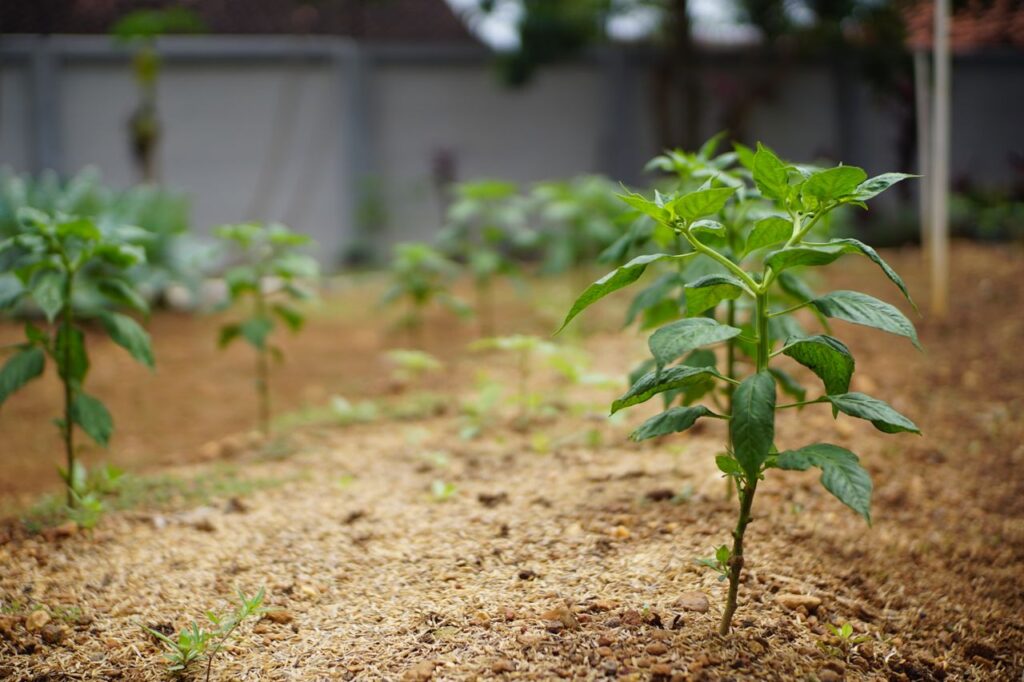
You do not need four or five large garden beds to practise useful crop rotation.
Even if you only have two or three raised beds, you can still reduce repeated pest, disease, and soil problems by moving crop families around whenever practical.
The key is to keep the system simple.
For a small Malaysian home garden, the goal is not to follow a perfect textbook rotation. It is to avoid growing the same plant family in exactly the same soil cycle after cycle.
Start by Thinking in Crop Families
The first step is to stop thinking only in individual crop names.
Chilli, tomato, and brinjal may look like very different crops, but they belong to the same plant family: Solanaceae.
Similarly, cucumber, pumpkin, bitter gourd, and melon belong to the Cucurbitaceae family.
If you replace chilli with tomato in the same bed, you have changed crops, but you have not really created much of a rotation.
A useful rotation moves between unrelated crop groups.
For example:
chilli could be followed by beans,
beans could be followed by leafy vegetables,
and leafy vegetables could eventually be followed by another solanaceous crop.
Keep the Grouping Simple
You do not need to memorise dozens of botanical families.
For a typical Malaysian edible garden, it is enough to recognise a few major groups.
Solanaceae: chilli, tomato, brinjal, potato.
Cucurbitaceae: cucumber, pumpkin, bitter gourd, melon, gourds.
Brassicaceae: sawi, kailan, cabbage, broccoli, radish.
Fabaceae: long beans, bush beans, peas.
Leafy and other crops: bayam, herbs, and various unrelated vegetables.
You can refine the system later if your garden becomes more complex.
If You Have Three Raised Beds
Three beds are enough to create a useful rotation.
For example:
Bed 1: chillies or brinjal
Bed 2: leafy vegetables
Bed 3: long beans or another legume
At the next major crop change, move things around.
For example:
Bed 1: beans
Bed 2: chillies or brinjal
Bed 3: leafy vegetables
Then rotate again in the next cycle.
The pattern does not have to be mathematically perfect.
The important thing is that each bed experiences different crop families over time.
If You Only Have Two Raised Beds
Two beds require more flexibility.
Suppose Bed A contains chillies and Bed B contains leafy vegetables.
Once the chillies finish, you might plant beans in Bed A.
Once the leafy vegetables finish, you might plant cucumber in Bed B.
After that, you can move a solanaceous crop into Bed B and another unrelated crop into Bed A.
With two beds, the rotation works more like a sequence than a fixed circular pattern.
Think of each bed as having its own planting history.
Your aim is simply to avoid immediately repeating the same family in the same bed.
Divide a Large Bed into Zones
If you only have one or two raised beds, you can create more rotation opportunities by dividing each bed mentally into sections.
For example, one long raised bed could be treated as:
Section A,
Section B,
and Section C.
You might grow chilli in Section A, bayam in Section B, and long beans in Section C.
At the next cycle, move each crop group one section over.
This gives you a small-scale rotation without needing more physical beds.
You can mark the sections with plant labels, string, or simply keep notes.
Do Not Rotate Everything at the Same Time
Not all crops finish together.
Your sawi may be harvested after several weeks, while your chilli plant may continue producing for months.
That is completely normal.
Crop rotation in a small garden does not need to happen on one fixed date.
Rotate each area when the crop occupying it finishes.
This creates a more realistic, flexible system.
A home garden is not a commercial field where the whole block must be cleared at once.
Use Short Crops Between Major Families
If you are waiting to return a particular crop family to a bed, use quick crops in between.
For example:
chilli finishes,
then bayam grows for one cycle,
then long beans,
then perhaps chilli returns later.
That gap helps create more separation between repeated solanaceous crops.
Quick leafy vegetables are especially useful because they fit easily between longer crop cycles.
Do Not Treat Legumes as a Magic Soil Reset
Beans are useful rotation crops, but they are not a magical cure for tired soil.
Legumes can form relationships with nitrogen-fixing bacteria, but they still need nutrients and remove some nutrients when harvested.
Their main value in a home rotation is that they belong to a different plant family and place different biological pressures on the bed.
They may contribute some nitrogen to the system under suitable conditions, especially if roots or residues remain, but do not assume a bean crop means you can skip soil care afterward.
Refresh the Bed Between Crops
Rotation works best when each crop change includes a quick bed check.
After removing the previous crop:
remove major roots and diseased debris,
check for pests,
loosen compacted areas if needed,
add compost or other suitable organic matter,
and adjust fertility based on the next crop.
Do not simply pull out one crop and immediately plant another into exhausted soil without inspection.
Rotation is only one part of good bed management.
Keep Disease History in Mind
If one raised bed has developed a serious disease problem, rotation becomes more important.
For example, if several chilli plants in one bed suffered from a serious soil-related problem, avoid immediately planting brinjal or tomato in the same spot.
Those crops are closely related and may be vulnerable to similar issues.
Choose a different family.
However, if the problem involves a persistent soil-borne pathogen, one short rotation may not be enough.
Some diseases can survive for long periods, so crop-specific management may be required.
Containers Can Help Your Rotation
If your raised-bed space is very limited, use containers as part of the system.
Suppose both beds recently held solanaceous crops but you still want to grow chilli.
Instead of forcing another chilli into the same soil, grow the next chilli in a large container with fresh or properly prepared growing medium.
Meanwhile, the raised bed can host an unrelated crop.
Containers effectively give you extra rotation spaces without building another bed.
This is especially useful in terrace-house gardens.
Use Trellises to Create More Options
Vertical growing can also help.
A cucumber or long-bean trellis can occupy the edge of a bed while leafy crops grow below or nearby, depending on spacing and light.
Later, once the vine finishes, that area can be replanted with another family.
This creates more flexibility without increasing the bed footprint.
Just remember that vigorous climbers can shade neighbouring plants.
Plan their position carefully.
Keep a Very Simple Bed Record
The easiest way to lose track of rotation is to rely on memory.
Label your beds:
Bed 1,
Bed 2,
Bed 3.
Then record what grew there.
For example:
January–March: Bed 1 — chilli
April–May: Bed 1 — bayam
June–August: Bed 1 — long beans
You do not need a complex spreadsheet.
A note on your phone is enough.
After several cycles, you can see immediately which plant family has occupied the bed recently.
Rotate Families, Not Necessarily Exact Crops
Suppose you grew chilli in Bed 1.
Later, you want to grow tomato.
Instead of putting the tomato straight back into Bed 1, place it in a bed that recently held beans or leafy vegetables.
Meanwhile, Bed 1 can grow something unrelated.
This is how you create meaningful rotation even when you grow many of the same favourite vegetables repeatedly.
Keep Productive Long-Term Plants Where They Are
Do not pull out a healthy chilli or brinjal simply because your rotation chart says it is time to move.
Crop rotation mainly applies between planting cycles.
If a plant is still healthy and producing well, keep harvesting it.
Rotation begins once that plant is removed.
The same applies to long-lived herbs and perennial edibles.
A good rotation system should improve productivity, not force you to destroy productive plants.
What If Your Family Only Eats a Few Crops?
This is common.
You may regularly eat chilli, sawi, bayam, cucumber, and long beans but have little interest in other vegetables.
That is still enough variety for rotation.
For example:
Cycle 1: chilli
Cycle 2: bayam
Cycle 3: long beans
Cycle 4: cucumber
Cycle 5: chilli again
You do not need to grow vegetables nobody likes just to satisfy a rotation chart.
Use the crops your household actually eats and arrange them intelligently.
Succession Planting and Rotation Can Work Together
These two systems complement each other.
Succession planting helps keep harvests continuous.
Crop rotation changes which family occupies the space over time.
For example, you might grow several staggered batches of sawi in one bed.
Once that brassica phase finishes, the bed moves to beans.
After the beans, perhaps a chilli crop goes in.
This gives you both continuous production and changing crop families.
A Practical Three-Bed Example
Imagine three raised beds.
Cycle 1
Bed A: Chillies and brinjal
Bed B: Bayam and sawi
Bed C: Long beans
Cycle 2
Bed A: Leafy vegetables
Bed B: Cucumbers
Bed C: Chillies or brinjal
Cycle 3
Bed A: Long beans
Bed B: Chillies or another unrelated crop
Bed C: Leafy vegetables
You can modify this according to what actually finishes first.
This is not a strict formula.
It is a practical framework.
Do Not Stress About Perfect Rotation
Small gardens will always involve compromises.
Sometimes you may need to grow a favourite crop in a bed sooner than ideal.
Sometimes a container becomes available.
Sometimes a pest outbreak changes the plan.
Sometimes one crop remains productive for much longer than expected.
That is fine.
A slightly imperfect rotation is still better than planting the same family in the same soil continuously without thinking about it.
The purpose is risk reduction, not perfection.
Let the Garden History Guide the Next Crop
Before planting anything new in a raised bed, ask three questions:
What grew here last?
What family did it belong to?
Did it have any serious pest or disease problems?
Those three questions are enough to make much better planting decisions.
Over time, your raised beds become easier to manage because you begin planning from their history instead of treating every planting as a fresh start.
At the end of the day, rotating crops with only a few raised beds is completely possible. You do not need four large plots or a complicated multi-year chart. Divide the space into manageable zones, track which plant families have grown there, use quick crops between longer plantings, and move related vegetables whenever practical. In a Malaysian home garden where crops can cycle throughout much of the year, a simple flexible rotation is usually far more useful than a perfect textbook system.
Working with only two or three raised beds at home? Tag @projectharvest.my on Instagram and show us how you divide your beds, what grew there last, and what you are planning next. We would love to see the simple crop-rotation systems Malaysian gardeners use to keep small spaces productive without planting the same thing in the same soil every cycle.