
Yes, crop rotation still matters in small gardens — but not because every home gardener needs to follow a strict four-year rotation chart.
The main value of crop rotation is that it helps reduce the repeated build-up of certain pests and diseases, prevents one crop type from dominating the same soil continuously, and encourages gardeners to think more carefully about what they plant next.
In a large farm, crop rotation may involve moving entire crop families between fields.
In a Malaysian terrace-house garden with two raised beds and twelve pots, that approach may be impossible.
The principle still helps.
You simply need to adapt it to your space.
What Is Crop Rotation?
Crop rotation means avoiding the repeated planting of the same crop, or closely related crops, in the same growing area cycle after cycle.
For example, instead of planting chilli in the same raised-bed section every time, you might follow it with leafy vegetables, beans, or another unrelated crop.
Later, chilli could return.
This creates a break between crops that share similar:
pests,
diseases,
nutrient demands,
and root patterns.
The goal is not variety for its own sake.
It is to avoid repeating the same biological pressures on the same patch of soil continuously.
Why Does Repeating the Same Crop Cause Problems?
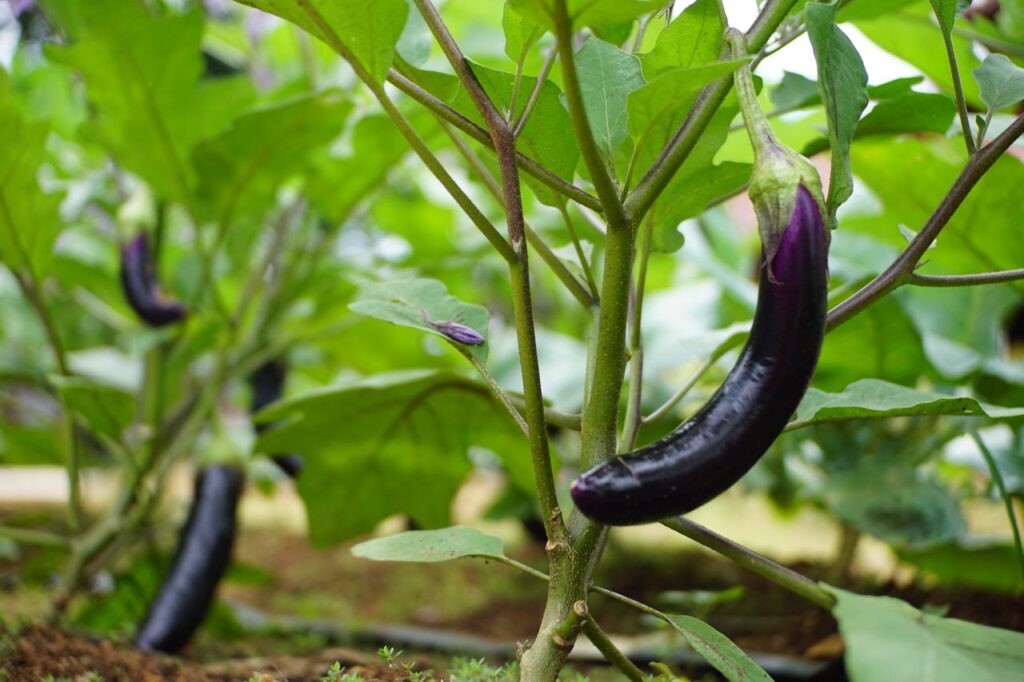
Imagine growing brinjal in the same bed repeatedly.
Brinjal belongs to the same plant family as chilli and tomato.
If a soil-borne disease or pest that attacks this family becomes established, immediately planting another related crop into the same soil can give the problem another suitable host.
Instead of disappearing after the old crop is removed, the pest or disease continues.
Rotation can interrupt that cycle.
It is not a guaranteed cure, but it can reduce the opportunity for crop-specific problems to build up.
Plant Families Matter More Than Individual Crop Names
This is one of the most important parts of crop rotation.
Rotating from chilli to tomato is not much of a rotation because both belong to the Solanaceae, or nightshade family.
This family includes:
chilli,
tomato,
brinjal,
and potato.
Likewise, cucumber, pumpkin, bitter gourd, melon, and many gourds belong to the Cucurbitaceae family.
If your goal is to reduce repeated pest or disease pressure, moving between close relatives may not provide much of a break.
Think in plant families rather than just crop names.
What Other Families Are Common in Home Gardens?
A few useful examples include:
Brassicaceae: sawi, kailan, cabbage, broccoli, radish.
Fabaceae: beans, peas, long beans.
Cucurbitaceae: cucumber, pumpkin, bitter gourd, bottle gourd, melon.
Solanaceae: chilli, tomato, brinjal, potato.
Amaranthaceae: bayam and related plants.
You do not need to memorise every botanical family.
Just learn which of your most frequently grown vegetables are closely related.
Crop Rotation Can Help with Pest and Disease Management
Suppose a bed of sawi suffers badly from a pest that specialises in brassica crops.
If you immediately plant kailan in the same bed, the new crop may face the same problem.
Replacing the sawi with beans or another unrelated crop creates a break.
The same idea applies to some soil-borne diseases.
Rotation is one tool within good garden hygiene and integrated pest management.
It does not replace:
removing infected material,
cleaning tools,
using healthy seedlings,
improving drainage,
or dealing with contaminated soil where necessary.
Rotation Also Changes Nutrient Demand
Different crops use nutrients differently.
Leafy vegetables tend to respond strongly to nitrogen.
Heavy fruiting crops such as tomatoes, chillies, and brinjal have different nutrient demands as they mature and produce fruit.
Legumes can form relationships with nitrogen-fixing bacteria under suitable conditions.
But do not oversimplify this into:
“Plant beans and you never need nitrogen again.”
Legumes still use nutrients themselves, and much of the nitrogen they fix can remain in plant tissues.
How much benefits the next crop depends on management.
The useful principle is simply that varying crops avoids placing exactly the same nutrient demand on the soil every cycle.
Does Rotation Matter in Raised Beds?
Yes.
Raised beds are often used intensively.
The same small volume of soil may produce crop after crop throughout the year.
That makes rotation especially useful.
Suppose you have three bed sections.
You could rotate them broadly like this:
Cycle 1: chilli, leafy vegetables, beans.
Cycle 2: beans, chilli, leafy vegetables.
Cycle 3: leafy vegetables, beans, chilli.
You do not need a complicated four-year system.
Even avoiding repeated plant families in the same section can be helpful.
What If You Only Have One Raised Bed?
This is where textbook crop-rotation advice becomes less practical.
If you have one small bed, you cannot magically move your chilli to another field.
Instead, rotate within time rather than space.
For example:
grow chilli,
then a quick leafy crop,
then beans,
then perhaps a cucurbit trained vertically,
before returning to chilli later.
You may also divide the bed into sections and rotate crops between them.
The key is to avoid planting the same family in exactly the same place continuously whenever practical.
Does Crop Rotation Matter in Containers?
Yes, but container gardening gives you more flexibility.
If a chilli plant finishes in a pot, you can:
refresh the potting mix,
replace part of it,
move the pot,
or assign that container to a different crop.
Because containers contain limited soil, you have more control over resetting the growing medium than you would in a large garden bed.
If a plant suffered serious root disease, simply rotating to another crop may not be enough.
The pot may need proper cleaning and the old growing medium may need to be replaced or managed appropriately.
Rotation cannot disinfect contaminated potting mix.
Do You Need a Four-Year Rotation?
Not necessarily.
Traditional crop-rotation systems often divide crops into four groups and move them through four beds over four years.
That can work in larger gardens.
For a Malaysian home gardener growing continuously throughout the year, a rigid four-year calendar may be unnecessarily complicated.
A simpler approach is:
Do not follow one crop family immediately with the same family whenever you have a reasonable alternative.
That alone captures much of the practical value.
Malaysia’s Year-Round Growing Changes the System
In temperate climates, gardeners may grow one major crop in a bed each year.
Malaysia is different.
We can often fit multiple crop cycles into one year.
That means your rotation may happen over months rather than years.
A raised bed could move through:
sawi,
long beans,
cucumber,
and chilli
within a relatively short period.
This faster turnover makes record keeping useful.
Without notes, it is easy to forget what was growing in a particular bed six months ago.
Keep Rotation Records Simple
You do not need a complex farm-management system.
Label your beds:
Bed A,
Bed B,
Bed C.
Then record what plant family occupied each bed.
For example:
January–March: Bed A — chilli
April–May: Bed A — bayam
June–August: Bed A — long beans
That is enough to prevent accidental repetition.
A phone note works.
So does a simple notebook.
What If Your Favourite Crop Is Chilli?
Many Malaysian gardeners want chillies continuously.
Rotation does not mean you can only grow chilli once every several years.
Instead, use multiple containers or beds.
While chilli grows in one location, rotate another crop through the previous area.
You can then move the next chilli generation into refreshed space later.
If you only have one permanent chilli pot and the plant remains healthy and productive, there is no reason to remove it just to satisfy a rotation rule.
Crop rotation mainly matters between crop cycles, not while a healthy perennial or long-lived plant is still productive.
Rotation Is Not the Same as Resting the Soil
You do not necessarily need to leave the soil empty.
A different crop can often follow immediately after the previous one.
The bed can remain productive while still rotating.
However, between crops you should still:
remove old plant material,
inspect roots,
check for disease,
refresh organic matter where appropriate,
and correct drainage or compaction problems.
Rotation works best as part of good soil management.
Rotation Will Not Fix Bad Soil
A common mistake is assuming crop rotation automatically restores soil fertility.
It does not.
If the growing medium is compacted, nutrient-poor, waterlogged, or depleted of organic matter, planting a different crop will not magically repair it.
You may still need:
compost,
appropriate fertiliser,
mulch,
better drainage,
or soil-structure improvements.
Rotation helps manage biological pressure.
It does not replace basic soil care.
Rotation Will Not Eliminate Every Pest
Some pests have broad host ranges.
Others can fly into your garden from neighbouring areas.
Some diseases survive in soil for long periods.
So crop rotation should never be treated as complete pest control.
Think of it as one layer of prevention.
Combine it with:
healthy planting material,
regular inspection,
clean tools,
good airflow,
proper watering,
and responsible treatment where needed.
When Rotation Matters Most
Rotation becomes especially useful when:
you grow the same vegetables repeatedly,
your beds are intensively planted,
you have experienced recurring disease,
soil-borne pests are a concern,
or the same plant family keeps struggling in one location.
If you grow only a few pots and replace the growing medium regularly, rotation may be less critical.
But even then, thinking about what follows what can improve garden planning.
When Rotation Matters Less
Rotation may matter less for permanent crops such as:
curry leaf,
pandan,
lemongrass,
established herbs,
and fruit trees.
These plants may remain in the same location for years.
You do not rotate a mature lime tree every season.
Instead, rotation applies mainly to annual and short-lived crops that are repeatedly removed and replanted.
Do Not Let Rotation Make Your Garden Impractical
If strict rotation means planting vegetables your family does not eat, the system has become too rigid.
A home garden should still serve the household.
Use rotation as a guide.
Do not treat it like a law.
If your family loves bayam, you can grow bayam frequently.
You may simply alternate it with unrelated crops, refresh the soil, and monitor for recurring problems.
Practical gardening is about managing risk, not following diagrams perfectly.
A Simple Rotation for a Small Malaysian Garden
Imagine you have three growing areas.
Area 1: chilli or brinjal.
Area 2: leafy vegetables such as bayam.
Area 3: long beans.
At the next major crop change:
move the beans into Area 1,
move leafy vegetables into Area 3,
and place your next solanaceous crop into Area 2.
Next cycle, rotate again.
It does not need to be perfectly symmetrical.
The important thing is that each space experiences different crop families over time.
What If a Serious Disease Appears?
This is where normal rotation advice may not be enough.
If a bed has a serious soil-borne disease, do not assume planting something different for one short cycle will solve it.
Some pathogens can survive for long periods.
Depending on the disease, you may need to:
remove infected plants,
avoid susceptible crops for much longer,
replace contaminated potting media,
improve drainage,
sanitise containers,
or seek crop-specific guidance.
Rotation helps prevent and reduce problems, but disease management should be based on the actual pathogen involved.
The Best Rotation Is One You Can Actually Follow
For a small home garden, the ideal system is simple enough to remember.
Know your main plant families.
Avoid repeating the same family in the same soil whenever practical.
Use different crops between major plantings.
Keep basic records.
Maintain soil fertility.
And respond quickly when recurring pest or disease problems appear.
That is more useful than owning a beautiful four-year rotation chart you never follow.
At the end of the day, crop rotation still matters in small gardens — but it should be treated as a practical risk-management tool rather than a rigid rulebook. Malaysian home gardeners may not have four large beds to rotate between, but even alternating plant families, dividing beds into smaller sections, changing crops between container cycles, and keeping simple planting records can reduce repeated problems. The goal is not a perfect rotation. It is healthier soil, fewer recurring issues, and a garden that stays productive from one crop cycle to the next.
Do you rotate crops in your raised beds and containers, or do you find yourself planting the same vegetables in the same spots every cycle? Tag @projectharvest.my on Instagram and show us your garden layout, crop rotation notes, or the simple system you use to decide what gets planted next. We would love to see how Malaysian home gardeners make crop rotation work even when space is limited.