
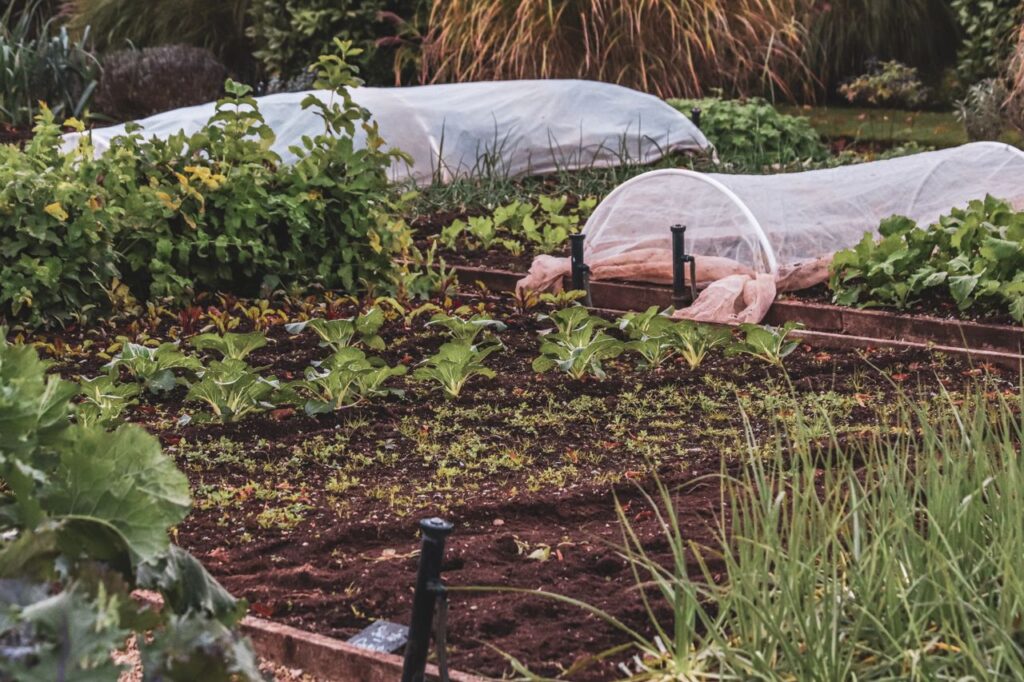
If you want leafy vegetables available every week, do not plant the entire crop at once.
Instead, sow small batches at regular intervals so one group is approaching harvest while another is still developing and the next is only beginning to grow.
For Malaysian home gardeners, this works particularly well with fast crops such as bayam, sawi, kailan, and other leafy vegetables that can move from seed to harvest relatively quickly.
The exact schedule will vary by crop, weather, growing conditions, and how much your household eats, but the principle is simple:
plant less at one time, but plant more often.
Why One Big Planting Creates One Big Harvest
Suppose you sow thirty sawi plants on the same weekend.
Most germinate together.
They grow at roughly the same rate.
Then a large number become harvestable around the same period.
For several days, you may have more sawi than your household can use.
After harvesting everything, the bed is empty.
You then sow again and wait several weeks for the next harvest.
This creates a cycle of:
too much,
then nothing,
then too much again.
Staggering smooths out those peaks.
Start by Knowing How Much Your Household Actually Eats
Before deciding how many plants to sow each week, look at your kitchen habits.
How often does your household cook leafy vegetables?
How many plants or handfuls do you normally use for one meal?
If six mature sawi plants are enough for one family meal and you usually eat sawi once a week, you probably do not need twenty plants reaching maturity together.
Start with a realistic weekly target.
You can adjust it after the first few harvests.
Choose Crops Suited to Repeated Sowing
Quick-growing leafy vegetables are easiest to stagger.
Useful Malaysian home-garden candidates can include:
bayam,
sawi,
kailan,
lettuce-type greens suited to your conditions,
pak choy-type vegetables,
and other fast leafy crops.
Different vegetables grow at different speeds, so do not assume one schedule fits all of them.
You may need a shorter interval for one crop and a longer interval for another.
Use the Seed Packet as a Starting Point
Seed packets often provide an approximate time to maturity.
Use this as a guide, not an exact promise.
Actual growth depends on:
sunlight,
temperature,
rainfall,
soil fertility,
watering,
plant spacing,
and variety.
A crop listed as ready in 35 days may take longer in cloudy weather or if plants are crowded.
That is why your own garden records become more useful over time.
Start with a One- or Two-Week Interval
For many fast leafy vegetables, sowing a small batch every one to two weeks is a practical starting point.
For example:
Week 1: Batch A
Week 3: Batch B
Week 5: Batch C
Week 7: Batch D
By the time Batch A is harvested, Batch B may be approaching maturity while C and D are still developing.
If the gap between harvests is too long, reduce the interval.
If too many crops mature together, increase it.
Weekly Sowing Can Work for Heavy Leafy-Green Eaters
If your household eats leafy vegetables several times a week, a smaller batch every week may work better.
For example:
Week 1: sow four to six plants.
Week 2: sow another four to six.
Week 3: repeat.
Week 4: repeat.
Once the first batch begins reaching harvest stage, a new batch is theoretically approaching maturity every week.
The exact plant number depends on crop size and household use.
Divide a Raised Bed into Sections
A simple physical layout can make staggered planting much easier.
Divide one raised bed into three or four sections.
For example:
Section 1: harvest-ready vegetables
Section 2: medium-sized plants
Section 3: young seedlings
Section 4: newly sown seeds
After harvesting Section 1, refresh it and sow the next batch.
The sections continue rotating.
This creates a visible cycle that is easy to manage.
Containers Work Just as Well
You do not need a raised bed.
Suppose you have eight containers.
Instead of planting all eight simultaneously, plant two at a time.
Two containers might hold mature vegetables.
Two might hold developing plants.
Two might contain seedlings.
Two might have just been replanted.
This is an excellent system for balconies, paved yards, and terrace-house gardens.
Seedling Trays Can Reduce Empty-Bed Time
For crops that transplant well, you can start the next batch in seedling trays while the current vegetables are still occupying the main bed.
Once the mature crop is harvested, prepare the bed and move in the young seedlings.
This can reduce the time between harvests.
However, some leafy vegetables also perform very well when direct-sown.
Use the method appropriate for the crop.
Label Every Batch
Once you start sowing repeatedly, it becomes very easy to forget which batch is which.
Use labels.
Write:
crop,
variety,
and sowing date.
For example:
Sawi — Batch 3 — 15 October
This helps you compare growth rates and identify whether a batch is unusually slow.
Keep a Simple Planting Calendar
A calendar makes staggering much easier.
For example:
1 October: Sow Batch A
15 October: Sow Batch B
29 October: Sow Batch C
12 November: Sow Batch D
You can create reminders on your phone or mark the dates in a garden journal.
The goal is to make repeated sowing a routine rather than something you remember only after the previous crop is gone.
Malaysia’s Weather Will Change the Timing
Do not expect every batch to mature in exactly the same number of days.
Heavy rain can affect seedlings.
Extended cloudy conditions can slow growth.
Hot, dry weather can increase water stress.
A batch planted during one period may catch up with the batch before it or fall behind.
That is normal.
Use your schedule as a framework, then adjust according to actual plant development.
Heavy Rain May Require Protection
Young seedlings can be damaged by intense Malaysian downpours.
If you are sowing continuously through rainy periods, consider starting delicate batches under a sheltered area with good light.
Once they become stronger, move them to the main growing area.
Make sure the soil drains well.
A weekly sowing plan will not help if each new batch is repeatedly drowned.
Hot Periods May Need Different Management
During hotter weeks, leafy vegetables may dry out more quickly.
Young seedlings are especially vulnerable because their root systems are small.
Check moisture regularly.
Mulching around established crops can help reduce evaporation.
Where appropriate, protection from the harshest afternoon sun may help sensitive leafy vegetables.
But avoid unnecessarily deep shade that produces weak, stretched growth.
Do Not Overcrowd Each Batch
Planting fewer batches does not mean squeezing more plants into each one.
Leafy vegetables still need appropriate spacing.
Crowded plants may remain small, receive less airflow, and compete strongly for water and nutrients.
If several seeds germinate close together, thin them appropriately.
A smaller number of healthy plants often provides a better-quality harvest than a dense patch of weak ones.
Baby Leaves Can Change Your Schedule
You do not always need to wait for full-sized plants.
Some leafy vegetables can be harvested younger.
If you enjoy baby leaves, you can plant somewhat more densely and harvest earlier.
This may shorten the time between sowing and eating.
Another option is to harvest some plants young while allowing the remaining plants more room to mature.
This creates two harvest stages from one batch.
Harvesting Style Matters
Some crops are normally harvested as whole plants.
Others may allow gradual leaf harvesting.
If the crop responds well to outer-leaf picking or cut-and-come-again harvesting, one batch may remain productive for longer.
This can overlap with later batches and make weekly harvests easier.
However, not every leafy vegetable regrows strongly after cutting.
Learn the normal harvest style of each crop rather than assuming all greens behave the same way.
Mix More Than One Leafy Crop
You do not need to stagger only one vegetable.
You could alternate crops.
For example:
Week 1: bayam
Week 2: sawi
Week 3: kailan
Week 4: bayam again
This gives the household more variety while still maintaining a regular flow of greens.
It can also prevent you from becoming tired of eating the same vegetable every week.
Adjust the Quantity After Each Cycle
Suppose you plant six sawi every two weeks and constantly have leftovers.
Reduce the next batches to four.
If four plants barely provide one meal and your household wants more, increase to six or eight.
Your planting quantity should be based on actual consumption.
This is much smarter than blindly sowing the same number every cycle.
Record the First Harvest Date
Write down when each batch becomes ready.
For example:
Batch A — sown 1 October — first harvest 5 November
Batch B — sown 15 October — first harvest 20 November
Now you know roughly how long that crop takes in your garden.
Over several batches, you can improve the timing.
Expect Some Overlap
Continuous harvesting does not mean exactly one perfectly sized batch becomes ready every Monday morning.
Plants are biological systems.
Some batches will overlap.
Others will be delayed.
The goal is simply to avoid long periods with nothing ready and large periods where everything must be harvested together.
Think of it as creating a steady flow rather than a perfectly timed production line.
Keep Backup Seedlings
If you have space, start a few extra seedlings.
Some may fail to germinate.
Others may be damaged by pests or heavy rain.
A few backups can fill gaps without disrupting the entire schedule.
But avoid producing so many replacements that they become another overcrowding problem.
A Simple Four-Batch System
For a beginner, try this:
Batch 1: mature or almost ready for harvest.
Batch 2: halfway developed.
Batch 3: young seedlings.
Batch 4: newly sown.
When Batch 1 is removed, sow the next batch in its place.
Now every section moves forward one stage.
This can continue indefinitely as long as the crop suits current conditions.
Combine Staggering with Other Garden Crops
Your leafy-vegetable system can operate alongside longer-term crops.
For example, a Malaysian home garden might contain:
permanent curry leaf and pandan,
productive chilli and brinjal,
a cucumber trellis,
and one raised bed dedicated to staggered leafy vegetables.
The longer crops provide regular harvests while the leafy bed produces new batches every week or two.
This creates a much more balanced edible garden.
Do Not Be Afraid to Pause
Continuous planting does not mean you must sow without interruption forever.
If your family is going away, the weather is particularly unsuitable, or pest pressure has become severe, pause a batch.
Restart when conditions improve.
A staggered system should make gardening more convenient, not turn it into an obligation.
At the end of the day, staggering leafy vegetable plantings is one of the simplest ways to create a more reliable kitchen harvest. Sow smaller batches at regular intervals, keep several growth stages in the garden at once, record how long each crop actually takes, and adjust the quantity to what your household uses. In Malaysia’s year-round growing climate, a small raised bed or collection of containers can keep producing fresh greens regularly without the familiar cycle of having far too much one week and nothing the next.
Trying to build your own weekly supply of bayam, sawi, kailan, or other leafy greens? Tag @projectharvest.my on Instagram and show us your different planting batches, weekly harvests, bed sections, or seedling schedule. We would love to see how Malaysian home gardeners are turning a handful of seeds every week or two into a steady flow of fresh vegetables for the kitchen.