
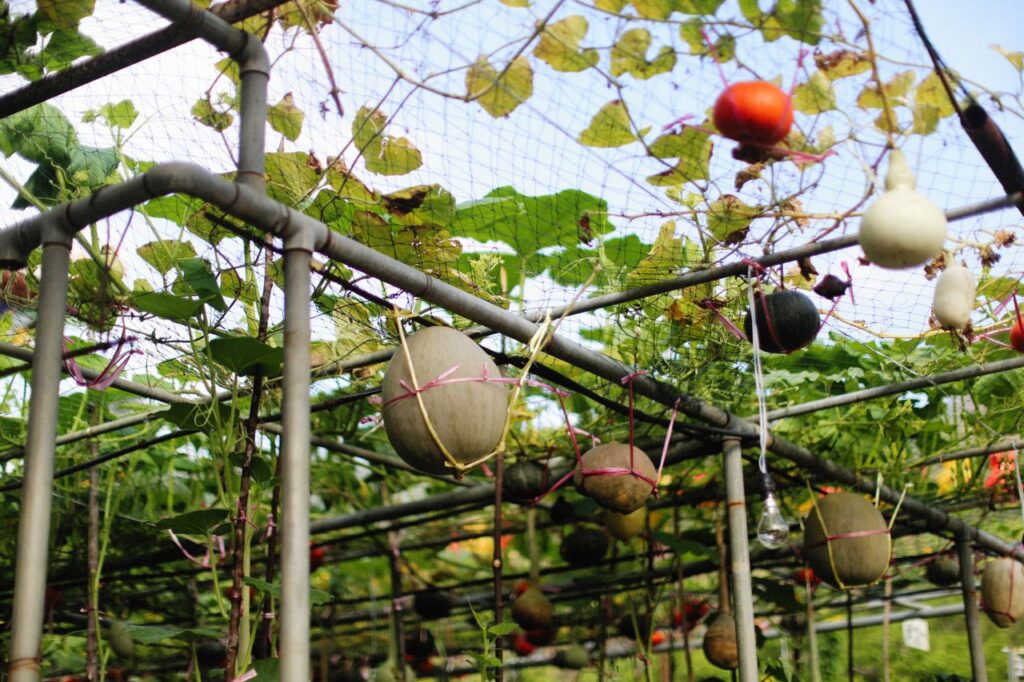
Heavy fruit can snap branches when the weight of the developing crop becomes greater than the stem can safely support.
This is common with vegetables such as:
tomatoes,
brinjal,
large chillies,
pumpkins,
gourds,
and other heavily fruiting plants.
In Malaysian home gardens, the risk can increase further during thunderstorms because wet leaves and fruit become heavier, while strong wind can twist already-loaded branches.
The best solution is to support the plant before the branch reaches its breaking point.
A stake, trellis, sling, or soft tie can redistribute the load so the plant does not have to carry everything by itself.
Support the Plant Early
Do not wait until a branch is already bending dangerously.
It is much easier to train a young plant onto a support than to rescue a mature branch carrying several fruits.
Install stakes, cages, or trellises early where possible.
This allows the stems to develop in the correct position from the beginning.
It also reduces the risk of damaging roots by pushing a stake into the soil later.
Look at the Branch Angle
Branches that grow at narrow, weak angles can be more vulnerable to splitting.
A heavy fruit positioned far from the main stem acts like a weight at the end of a lever.
The farther the fruit is from the branch attachment point, the greater the strain.
If you see a branch bending sharply downward, support it before the tissue begins to crack.
Do not wait for an actual split.
Use a Strong Main Stake
For crops such as brinjal, chilli, and some tomatoes, a sturdy stake beside the main stem can provide basic structural support.
The stake should be strong enough to handle:
the mature plant,
wet foliage,
fruit weight,
and wind.
In a container, push the stake deeply enough that it does not wobble.
In a raised bed, position it securely without damaging major roots.
A support that collapses during a storm can cause more damage than having no support at all.
Tie the Main Stem Loosely
Do not tie stems tightly against a stake.
Stems expand as the plant grows.
A tight string can eventually cut into the plant and damage vascular tissue.
Use:
soft plant ties,
fabric strips,
plant clips,
or other flexible material.
Leave enough room for stem expansion.
A loose figure-eight tie works well because one loop goes around the stake and the other around the stem, reducing rubbing between the two.
Avoid Thin Wire or Fishing Line
Very thin material can cut into soft stems.
Wire, fishing line, and narrow plastic string can act almost like a blade as the branch gets heavier.
If you must use string, choose something broad and soft enough that pressure is distributed over a larger area.
Check ties regularly and loosen them as the plant grows.
Support the Branch, Not Just the Trunk
A strong main stake will not always protect every fruiting branch.
Large brinjal fruits or clusters of tomatoes may pull individual branches downward even when the main stem is secure.
In that situation, add a second tie or support closer to the fruiting branch.
The goal is to take some of the load away from the branch without forcing it into an unnatural position.
Support the branch gently from below or attach it loosely to a nearby structure.
Use a Sling for Very Heavy Fruit
Large pumpkins, melons, gourds, or heavy tomatoes grown vertically may need a sling.
A sling supports the fruit itself rather than asking the vine or branch to carry the entire weight.
Suitable sling materials can include:
soft fabric,
mesh with enough strength,
or purpose-made fruit supports.
The sling should allow airflow and drainage.
Avoid materials that trap water against the fruit.
Make Sure the Sling Can Expand
Fruit continues growing.
A support that fits tightly today may become restrictive next week.
Leave enough room for expansion.
The sling should cradle the fruit, not squeeze it.
Check it regularly as the fruit becomes heavier.
Support Pumpkins Grown on Trellises
Pumpkins grown along the ground are naturally supported by the soil.
Pumpkins grown vertically are different.
Once the fruits become heavy, the vine may not be able to hold them safely.
Use a strong trellis and provide individual support for larger fruits where needed.
Do not assume the fruit stem alone can safely carry a mature pumpkin hanging in the air.
Trellises Must Be Strong Enough for Wet Weather
A trellis that looks strong on a dry day may struggle during Malaysian rain.
Wet vines, leaves, and fruit can become significantly heavier.
Strong wind also creates additional force.
Before the crop matures, check:
posts,
ties,
wire,
netting,
and anchor points.
Repair weak areas early.
Tomato Clusters May Need Extra Support
Some tomato varieties produce heavy clusters.
If a cluster begins pulling the branch downward, you can support the stem above the cluster or use a soft clip attached to a strong stake or trellis.
Do not tie directly around individual tomatoes.
Support the branch structure instead.
For indeterminate tomatoes, regular training along a strong support system is especially useful.
Brinjal Branches Can Split Under Fruit Weight
Brinjal plants often develop sturdy stems, but a large fruit can still pull a side branch downward.
This is particularly risky when several fruits develop on the same branch.
Use stakes or branch supports before the fruit reaches full size.
If the plant naturally forks into several main stems, supporting each major stem can distribute the load more safely.
Large Chillies Can Weigh Down Branches Too
Smaller chilli varieties rarely need fruit-specific support, but larger-fruited types can become surprisingly heavy.
A branch carrying many large chillies may bend or split.
Supporting the main stems and maintaining good plant structure is usually enough.
Avoid letting fruit clusters pull branches against pot edges or other hard surfaces.
Do Not Overload One Branch
If a plant is producing a very heavy cluster, the branch may simply be carrying more than it can safely support.
In some crops, selective fruit thinning may be considered when branches are seriously overloaded.
However, thinning should not be treated as a universal rule.
Many vegetables naturally carry multiple fruits without difficulty if the plant is healthy and supported.
Use support first.
Thin only when there is a clear reason.
Watch for Cracks at Branch Junctions
The earliest sign of structural failure may be a small split where the branch joins the main stem.
If you see cracking:
support the branch immediately,
reduce movement,
and avoid loading it further.
A partially split branch may sometimes continue functioning if it remains attached and is stabilised.
However, badly torn tissue may not recover well.
Do not rely on tape or tying alone if the branch is almost completely detached.
Avoid Lifting Heavy Branches Too Far
A mature branch that has grown downward over several weeks may become stiff.
Do not suddenly force it upright.
That can snap the branch at the joint.
Support it close to its natural position.
The goal is to remove excessive strain, not redesign the branch shape in one movement.
Protect Branches from Wind
Fruit weight is only part of the problem.
Wind can make heavy branches swing repeatedly.
That movement can weaken branch junctions.
For balcony or exposed terrace-house gardens, place supports so the plant cannot whip violently in strong wind.
Secure tall plants before stormy weather, especially if they are already carrying fruit.
Do Not Tie Fruit-Bearing Branches Too Tightly
A fruiting branch still needs room to expand.
Tight ties can damage the bark or stem tissue.
They can also create weak points.
Check supports every week during rapid growth.
Loosen or reposition ties as necessary.
Use Multiple Support Points for Tall Plants
One tie near the bottom of a tall plant may not be enough.
Support the plant at several heights.
For example:
lower stem,
middle stem,
and upper fruiting section.
This spreads the load and reduces movement.
Do not make every tie extremely tight.
The plant should still have a small amount of natural movement.
Avoid Damaging Roots When Adding Stakes Late
If the plant is already mature, inserting a thick stake close to the stem can damage roots.
Push the stake farther from the main root crown when possible.
Another option is to attach the plant to an existing trellis or external support rather than driving a new stake directly beside the stem.
Plan supports early whenever possible.
Containers Need Stable Supports
A tall stake inside a very small pot can make the entire container top-heavy.
A strong gust may tip the whole plant over.
For container-grown fruiting vegetables:
use a sufficiently large, stable pot,
position supports securely,
and consider anchoring tall trellises independently of the container.
The support system should stabilise the plant, not make the pot easier to topple.
Do Not Let Fruit Rest Against Sharp Edges
Heavy fruit can become damaged if it presses against:
wire,
metal railings,
rough walls,
or sharp pot edges.
As the fruit grows, inspect its position.
A small contact point can become a deep indentation later.
Reposition the branch or add padding where appropriate.
Keep Airflow Around Supported Fruit
Do not wrap fruit tightly in plastic or dense material just to support it.
Poor airflow can trap moisture.
In Malaysia’s humid climate, that can encourage rot and fungal problems.
Use breathable support materials.
The fruit should remain exposed to air.
Rainwater Should Be Able to Drain
Any sling or support should not become a cup that collects water.
Standing water against the fruit can contribute to rot.
Use mesh, breathable fabric, or a design that drains freely.
Check supports after heavy rain.
Healthy Plants Still Need Structural Help
A strong, well-fed plant can still break.
Supporting heavy fruit is not evidence that the plant is weak.
Some fruits simply become heavier than the branch structure can comfortably handle.
Support is part of good crop management.
Nutrition Cannot Prevent Every Branch Break
Fertiliser cannot turn every branch into a stronger one.
Plants need adequate nutrition to grow healthy stems, but excessive fertiliser can create large, soft growth that may actually be more vulnerable.
Do not add extra calcium, potassium, or other products simply because a branch is bending.
Use physical support where physical support is needed.
Watering Affects Stem Strength Indirectly
Severely stressed plants may have weaker growth.
Keep watering consistent so stems develop normally.
But do not assume extra watering will strengthen a branch that is already overloaded.
Once the fruit is heavy, mechanical support is the practical solution.
Prune Carefully Around Heavy Fruit
If you remove nearby branches or leaves, the weight distribution of the plant can change.
Do not heavily prune a fruiting plant without considering how the remaining branches are supported.
Healthy leaves are also needed to supply energy to the fruit.
Remove damaged or diseased growth where appropriate, but avoid stripping the plant unnecessarily.
Harvesting Can Reduce the Load
If fruits are already mature enough to harvest, picking them removes weight immediately.
This is especially useful before strong storms.
Do not leave mature fruit hanging purely to see how large it can become if the branch is clearly struggling.
Harvesting at the correct stage protects both the fruit and the plant.
Check Supports After Heavy Rain
After strong Malaysian thunderstorms, inspect the garden.
Look for:
loose ties,
leaning stakes,
stretched netting,
bent trellises,
and newly cracked branches.
A quick repair after one storm can prevent the next one from causing major damage.
A Simple Support Checklist
When a plant begins carrying heavy fruit:
1. Secure the main stem or vine.
2. Check branch angles.
3. Add support beneath heavily loaded branches.
4. Use soft, loose ties.
5. Add slings for large hanging fruit.
6. Make sure trellises can handle rain and wind.
7. Leave room for stems and fruit to expand.
8. Keep airflow around supported fruit.
9. Harvest mature fruit before unnecessary overloading.
10. Recheck the support system regularly.
Supporting plants should be an ongoing process rather than a one-time job.
The Best Support Is Installed Before You Need It
Most branch breakage becomes predictable.
If you know you are growing:
large tomatoes,
brinjal,
pumpkin,
or another heavy-fruiting crop,
plan support from the beginning.
Installing a strong structure early is easier, safer, and usually neater than trying to rescue the plant after a branch begins splitting.
At the end of the day, supporting heavy fruit is about helping the plant carry its crop without restricting its natural growth. Use sturdy stakes, strong trellises, soft ties, and fruit slings where necessary, and adjust them as the plant expands. In Malaysian home gardens, remember that heavy rain and strong wind can add even more strain to already-loaded branches. A few minutes spent checking supports before the fruit becomes heavy can save an entire branch — and the harvest hanging from it.
Have a tomato cluster, brinjal branch, pumpkin, chilli plant, or gourd that is getting heavier by the day? Tag @projectharvest.my on Instagram and show us how you supported it. We would love to see the simple stakes, slings, trellises, and DIY solutions Malaysian home gardeners are using to keep heavy harvests safely attached until picking day.