
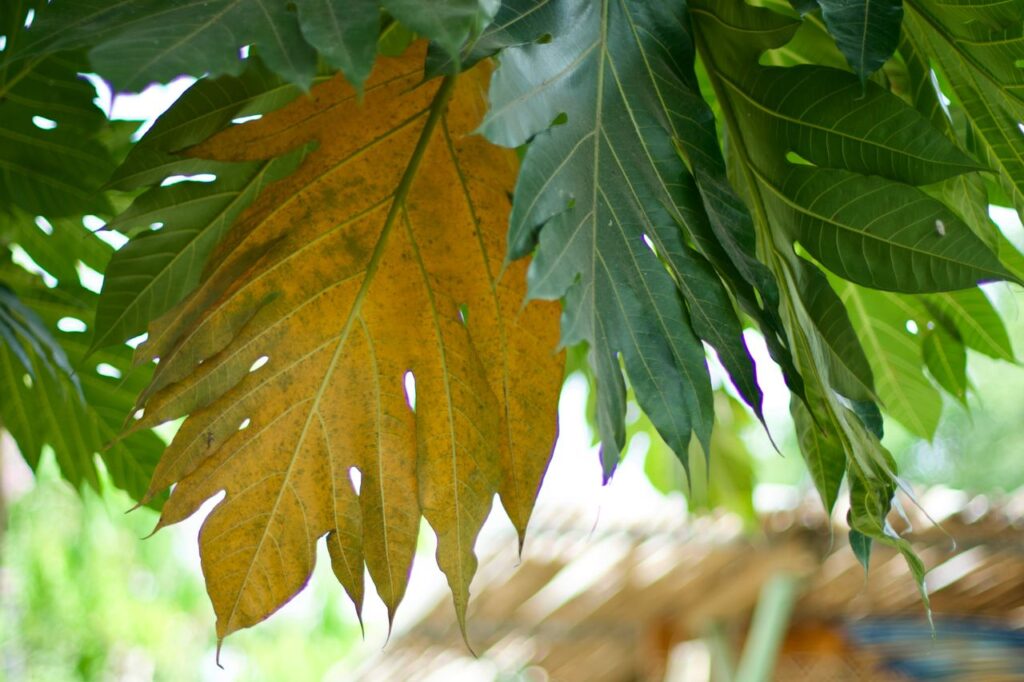
Magnesium deficiency usually appears first on older leaves, where the tissue between the veins begins turning yellow while the veins remain noticeably greener.
This pattern is known as interveinal chlorosis.
As the deficiency becomes more severe, the yellow areas may spread, leaves may develop brown or dead patches, and older foliage may eventually fall.
Because magnesium can move from older parts of the plant into younger growth, the plant tends to sacrifice its older leaves first when supplies become limited.
However, not every yellow leaf with green veins proves that magnesium is missing from the soil.
Root damage, unsuitable soil pH, nutrient imbalance, heavy rainfall, and other problems can also interfere with magnesium uptake.
What Does Magnesium Actually Do?
Magnesium is an essential plant nutrient.
One of its best-known roles is as a central component of chlorophyll, the green pigment plants use during photosynthesis.
That makes magnesium important for the plant’s ability to capture light energy.
It also participates in:
enzyme activity,
energy metabolism,
protein production,
and movement of carbohydrates within the plant.
Plants require less magnesium than nitrogen, phosphorus, or potassium, but they still need a reliable supply.
Why Do Older Leaves Show Symptoms First?
Magnesium is considered a mobile nutrient within plants.
When magnesium becomes scarce, the plant can move some of it from older leaves toward younger tissues where active growth is taking place.
The older leaves therefore begin showing deficiency symptoms first.
This is a useful diagnostic clue.
If the youngest leaves are turning yellow while the older ones remain green, magnesium deficiency is less likely to be your first explanation.
The Classic Interveinal Yellowing Pattern
The most recognisable symptom is yellowing between the veins.
Imagine the veins forming a green network across the leaf while the tissue in between gradually becomes pale or yellow.
Early on, this can create a distinctive striped or marbled appearance.
As deficiency progresses:
the yellow areas may become larger,
the leaf may develop rusty or brown patches,
edges may become damaged,
and the entire older leaf may eventually decline.
The exact appearance varies by crop and severity.
Chilli, Tomato, and Brinjal Can Show Magnesium Problems
Long-lived fruiting vegetables can sometimes develop magnesium deficiency, especially when grown in containers for extended periods.
Chillies, tomatoes, and brinjal continually remove nutrients from a limited volume of growing medium.
If magnesium is not replenished or becomes unavailable, older leaves may begin showing interveinal chlorosis.
But before adding magnesium, check the rest of the growing conditions.
Do Not Confuse Magnesium Deficiency with Nitrogen Deficiency
Both usually begin on older leaves because both nutrients are mobile.
The difference is mainly the pattern.
Nitrogen deficiency:
Older leaves usually become more uniformly pale or yellow.
Magnesium deficiency:
Older leaves tend to yellow between the veins while the veins stay greener.
Think:
nitrogen = whole-leaf paling
magnesium = green veins with yellow tissue between them.
This is a useful guide, although real plants do not always follow textbook patterns perfectly.
Do Not Confuse It with Potassium Deficiency
Potassium deficiency also tends to affect older leaves.
But potassium problems are more commonly associated with:
yellowing around the leaf margins,
followed by brown or scorched edges.
Magnesium deficiency is more strongly associated with yellowing between the veins.
If the leaf edge is the main area deteriorating, potassium deficiency, salinity, drought, or fertiliser burn may be more likely.
Iron Deficiency Usually Appears on Younger Leaves
Iron deficiency can look surprisingly similar because it also causes interveinal chlorosis.
The major difference is location.
Magnesium deficiency: older leaves first.
Iron deficiency: younger leaves first.
This is one of the most useful distinctions in plant nutrition diagnosis.
Always check where on the plant the symptoms began.
Heavy Malaysian Rain Can Contribute to Magnesium Loss
Magnesium can be lost from soil through leaching.
This is especially relevant in Malaysia during prolonged periods of heavy rainfall.
Containers, grow bags, and very free-draining raised beds are particularly vulnerable because soluble nutrients can move out through drainage water.
After repeated tropical storms, a long-lived plant may gradually become depleted even if the soil originally contained adequate magnesium.
That does not mean you should fertilise after every rainstorm.
Look for a consistent symptom pattern first.
Frequent Container Watering Can Also Leach Magnesium
During hotter periods, Malaysian gardeners may need to water containers frequently.
Every time large volumes of water drain through the pot, some soluble nutrients can be carried away.
Over several months, long-lived chillies, tomatoes, or brinjal may therefore require nutrient replenishment.
This is one reason container gardening needs more active nutrient management than planting directly into a large volume of fertile soil.
Acidic Soil Can Affect Magnesium Availability
Malaysia has many naturally acidic soils.
At very low soil pH, magnesium availability can become limited and the nutrient may also be more easily leached.
However, this does not mean every Malaysian garden needs lime or dolomite.
Raised beds and container mixes may have completely different chemistry from surrounding native soil.
Test pH before making major adjustments.
Too Much Potassium Can Interfere with Magnesium Uptake
This is an important point for fruiting-plant growers.
Plants absorb magnesium and potassium through related root processes.
Very high potassium levels can sometimes reduce magnesium uptake.
So a gardener who repeatedly applies high-potassium “fruiting fertiliser” may create a magnesium imbalance even though magnesium is present in the growing medium.
This is one reason more potassium does not always mean better fruit production.
Balanced nutrition matters.
Excess Calcium Can Also Affect Nutrient Balance
Large amounts of calcium can also compete with magnesium uptake in some situations.
This does not mean calcium is harmful.
Plants need calcium too.
The problem is excessive or poorly balanced supplementation.
If you are applying:
calcium products,
high-potassium fertiliser,
magnesium supplements,
and several other feeds
without a clear programme, diagnosing future problems becomes much harder.
Root Damage Can Create a False Magnesium Deficiency
The soil may contain enough magnesium, but damaged roots may not absorb it properly.
Possible causes include:
waterlogging,
root rot,
severe compaction,
poor drainage,
or root restriction.
If the plant is yellowing while the pot remains constantly wet, fix the root-zone problem before adding fertiliser.
A healthy root system is required for nutrient uptake.
Salt Buildup Can Complicate Diagnosis
Repeated fertiliser use in containers can cause soluble salts to accumulate.
Salt stress can damage roots and interfere with water and nutrient uptake.
That can produce symptoms that resemble nutrient deficiencies.
Check for signs such as:
white crusting on the pot or soil,
leaf-tip burn,
poor growth,
or a history of heavy fertilisation.
Adding more magnesium fertiliser without addressing salinity may make the situation worse.
Should You Use Epsom Salt?
Epsom salt is magnesium sulphate, so it can supply magnesium when a genuine magnesium deficiency exists.
But it should not be treated as a universal plant tonic.
Many healthy plants do not need extra magnesium.
Applying Epsom salt routinely can contribute to nutrient imbalance and increased salt concentration in containers.
If magnesium deficiency is reasonably likely, use an appropriate magnesium-containing product according to labelled or well-established application guidance rather than repeatedly adding unmeasured handfuls.
Epsom Salt Does Not Fix Every Yellow Leaf
This is one of the most common gardening myths.
Epsom salt will not correct yellowing caused by:
nitrogen deficiency,
iron deficiency,
overwatering,
root rot,
poor drainage,
pest damage,
or disease.
It only supplies magnesium and sulphur.
If those nutrients are not the actual problem, it does not solve the cause.
What About Dolomitic Lime?
Dolomitic lime supplies both:
calcium,
and magnesium.
But it also raises soil pH.
That means it should not be applied simply because you suspect magnesium deficiency.
If the soil is already at an appropriate pH, adding dolomite unnecessarily can make it too alkaline and reduce availability of other nutrients.
Dolomite makes the most sense when testing shows that:
the soil is too acidic,
and magnesium supplementation is also appropriate.
Check Your Existing Fertiliser First
Before buying a magnesium supplement, read the fertiliser label.
Some fertilisers already contain magnesium.
You may see something such as:
+ Mg
or
MgO
listed in the nutrient analysis.
If you are already using a fertiliser containing magnesium at the correct rate, the problem may involve uptake rather than supply.
Review:
watering,
pH,
roots,
pot size,
and other fertilisers.
How Should You Correct Genuine Magnesium Deficiency?
If the symptom pattern strongly suggests magnesium deficiency, the roots are healthy, and current fertilisation provides too little magnesium, use a suitable magnesium-containing fertiliser or amendment.
Follow the product’s application directions.
Do not attempt to speed recovery by using extremely concentrated solutions.
Too much fertiliser can damage the roots you need for nutrient uptake.
Do Not Expect Damaged Leaves to Become Perfect Again
Once sections of a leaf have become severely yellow or brown, they may not fully recover.
The better signs of improvement are:
healthier new growth,
slower progression of symptoms,
and normal colour in leaves developing after correction.
Old damaged leaves may remain unattractive until they eventually drop.
Do not keep applying magnesium because the original damaged leaf still looks damaged.
Check New Growth After Treatment
Because magnesium deficiency appears on old leaves first, recovery can take some observation.
After correcting the likely cause, watch:
whether newer leaves remain healthy,
whether additional old leaves stop developing symptoms,
and whether overall plant vigour improves.
Give the plant time.
Repeated supplementation every few days can quickly turn a deficiency correction into over-fertilisation.
Soil or Growing-Medium Testing Can Help
If magnesium problems repeatedly appear in the same raised bed or container system, testing can provide useful evidence.
A soil test may help identify:
pH,
magnesium levels,
and broader nutrient balance.
Testing becomes particularly valuable if you are considering major amendments such as dolomitic lime.
Persistent nutritional problems are better managed with evidence than repeated guesswork.
A Simple Magnesium-Deficiency Checklist
Magnesium deficiency is more likely when:
1. Older leaves show symptoms first.
2. Tissue between the veins turns yellow.
3. The main veins remain greener.
4. Several older leaves show the same pattern.
5. Symptoms gradually progress upward if the problem continues.
6. Heavy rain or frequent container watering could have leached nutrients.
But before supplementing, also check:
7. Is the root zone waterlogged?
8. Is soil pH unusually low or otherwise unsuitable?
9. Have you been applying large amounts of potassium or calcium?
10. Does your existing fertiliser already contain magnesium?
Those questions help separate genuine deficiency from an uptake or nutrient-balance problem.
Think in Terms of Nutrient Balance
Magnesium does not work alone.
A healthy plant needs:
nitrogen,
phosphorus,
potassium,
calcium,
magnesium,
sulphur,
and micronutrients
in appropriate proportions.
Adding one nutrient excessively can influence how others behave.
The goal is not to maximise magnesium.
It is to restore balance.
Diagnose the Pattern Before Reaching for Epsom Salt
When you see yellow leaves, look first at:
which leaves are affected,
where the yellowing appears on the leaf,
whether the veins remain green,
the condition of the roots,
recent rainfall,
watering,
and fertiliser history.
That information is much more useful than automatically adding Epsom salt because somebody online said yellow leaves need magnesium.
At the end of the day, magnesium deficiency is most recognisable by interveinal yellowing on older leaves, with the veins remaining greener while the tissue between them becomes pale or yellow. Malaysian home gardeners should also consider nutrient leaching from heavy rain, frequent container watering, acidic soil, excessive potassium feeding, salinity, and root health before adding magnesium. When a genuine deficiency exists, magnesium supplementation can help — but good diagnosis is what separates a useful correction from another unnecessary fertiliser application.
Seeing older chilli, tomato, brinjal, or vegetable leaves turning yellow between green veins? Share clear photos of the older and younger leaves, your fertiliser label, and your growing setup, and tag @projectharvest.my on Instagram. Comparing these real symptom patterns can help Malaysian home gardeners learn when magnesium is genuinely running low — and when the plant is actually asking us to look somewhere else.