
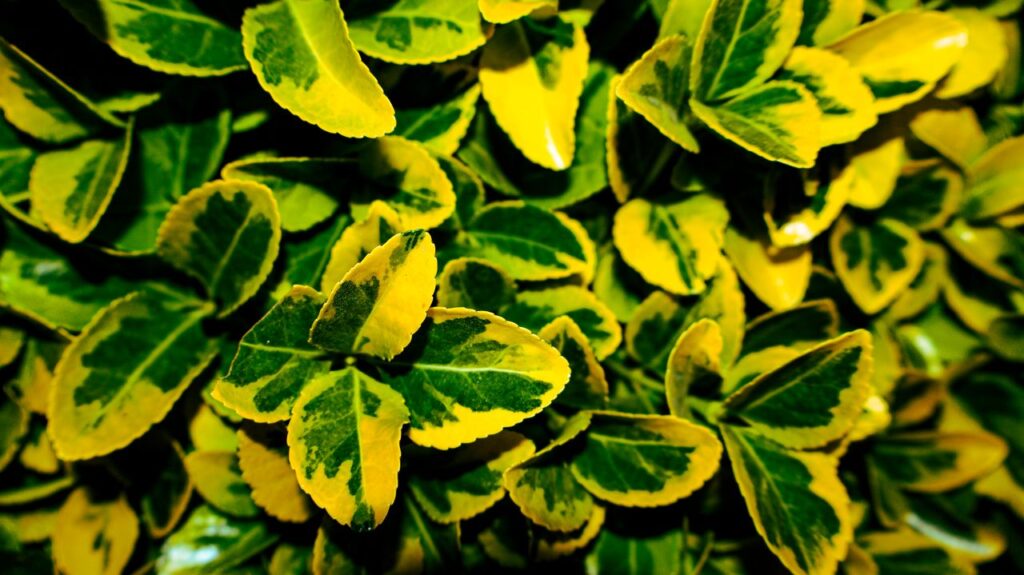
When the newest leaves on a plant turn yellow while the veins remain noticeably greener, one possible cause is iron chlorosis.
The word chlorosis simply means a loss of normal green colour because the plant is producing less chlorophyll.
Iron is required for several processes involved in chlorophyll formation and plant metabolism.
When young leaves cannot obtain enough usable iron, the tissue between their veins often becomes pale yellow while the veins remain green.
One of the most important clues is where the symptoms appear first.
Iron deficiency normally affects the newest growth before the older leaves.
Why Do Young Leaves Show Iron Deficiency First?
Iron is considered relatively immobile inside plants.
Unlike nutrients such as nitrogen or magnesium, a plant cannot easily move iron out of old leaves and redistribute it to young growing tissues.
So when usable iron becomes limited, older leaves may remain green while the newest leaves begin showing deficiency symptoms.
This makes iron chlorosis quite different from nitrogen or magnesium deficiency.
What Does Iron Chlorosis Look Like?
Early symptoms often include:
pale young leaves,
yellowing between the veins,
green veins remaining clearly visible,
and older leaves staying relatively normal.
As the problem becomes more severe, the newest leaves may become almost completely yellow or pale cream.
In extreme cases, leaf edges or patches of tissue may eventually become brown and die.
The plant may also grow more slowly if the problem continues.
The Key Pattern: Young Leaves First
When diagnosing yellow leaves, always ask:
Which leaves changed colour first?
That single question can quickly narrow down several nutrient problems.
Iron deficiency
Usually affects youngest leaves first.
Magnesium deficiency
Usually affects older leaves first, often with yellowing between green veins.
Nitrogen deficiency
Usually affects older leaves first, but the yellowing is often more uniform across the whole leaf.
This does not make visual diagnosis perfect, but it gives you a much better starting point.
Iron Chlorosis Does Not Always Mean Your Soil Lacks Iron
This is one of the most important things to understand.
A plant can show iron deficiency symptoms even when plenty of iron exists in the soil.
The problem may be that the iron is chemically unavailable to the roots.
This often happens when soil pH becomes too high.
At higher pH, iron can convert into forms that plants have difficulty absorbing.
So adding more iron to soil that already contains iron may not fully solve the problem.
Soil pH Is a Major Cause
Iron availability is strongly influenced by soil pH.
As soil becomes more alkaline, iron becomes progressively less available to many plants.
This can lead to iron-induced chlorosis even when laboratory testing shows that iron is physically present in the soil.
For Malaysian home gardeners, this is especially relevant in:
containers,
raised beds,
and amended soil
where the pH may be very different from the natural soil surrounding the home.
Do not assume that because Malaysia has many acidic soils, every garden must also be acidic.
Potting media, lime, tap water, compost, and repeated amendments can all influence pH.
Test Before Trying to Change pH
If iron chlorosis repeatedly affects your plants, checking pH is useful.
Do not immediately add acidic materials because the leaves look yellow.
Changing soil pH incorrectly can make other nutrients less available and create new problems.
A soil pH test gives you evidence before you begin making adjustments.
Over-Liming Can Trigger Iron Chlorosis
Gardeners sometimes add lime because they have heard that Malaysian soils are acidic.
But unnecessary lime can raise pH too far.
If pH becomes too high, nutrients such as iron may become less available.
This is another reason lime should not be applied automatically.
Use it when testing shows that soil pH actually needs correction.
Waterlogging Can Also Cause Iron-Deficiency Symptoms
Healthy roots are required for nutrient uptake.
When soil remains waterlogged, roots receive less oxygen.
Root function declines.
The plant may then struggle to absorb iron and other nutrients effectively.
A plant can therefore develop chlorosis even if the fertiliser programme appears adequate.
During Malaysia’s prolonged rainy periods, always check drainage before assuming the plant needs more fertiliser.
Compacted Soil Can Reduce Root Function
Severe compaction can also reduce:
air movement,
water drainage,
and root development.
Poor roots have difficulty accessing nutrients.
If a plant showing iron chlorosis is growing in hard, poorly drained soil, improving the root environment may be more important than simply adding iron.
Root Disease Can Mimic Nutrient Deficiency
Root rot and other root problems may reduce nutrient uptake.
The plant can then develop deficiency-like symptoms even though the required nutrients are present.
If yellowing is accompanied by:
wilting,
persistent wet soil,
poor growth,
or declining roots,
investigate root health.
A fertiliser cannot repair a diseased root system by itself.
Containers Can Develop Iron Problems Too
Container plants are not automatically protected from nutrient issues.
Potting media can change over time because of:
fertiliser use,
irrigation water,
organic matter decomposition,
and repeated amendments.
Long-lived chillies, brinjal, herbs, citrus, and other container plants may eventually experience pH or nutrient imbalances.
If a plant has lived in the same pot for a long time, consider the condition of the growing medium as part of the diagnosis.
Irrigation Water Can Influence pH Over Time
Water itself can affect the root zone.
Some water sources contain dissolved minerals that may gradually influence soil or potting-medium pH.
This becomes more relevant for long-lived container crops that are watered frequently.
You do not need to test your water because one leaf turns yellow.
But if iron chlorosis repeatedly returns despite proper fertilisation and healthy roots, irrigation water may be one factor worth considering.
Excess Phosphorus Can Complicate Iron Nutrition
Very high phosphorus levels can interfere with iron nutrition in plants under certain conditions.
This is another reason repeated use of strong “flowering fertilisers” is not always harmless.
If the soil already contains enough phosphorus, continuously adding more may create nutrient imbalance rather than better flowering.
Plant nutrition works as a system.
Micronutrients Are Needed in Small Amounts
Iron is a micronutrient.
That means plants require it in much smaller quantities than macronutrients such as:
nitrogen,
phosphorus,
and potassium.
Small requirement does not mean unimportant.
A genuine iron shortage can severely affect plant growth.
But because plants need relatively little, adding large amounts without evidence is unnecessary and potentially harmful.
Check Your Existing Fertiliser
Some complete fertilisers already contain iron.
The label may list:
Fe,
iron,
or chelated iron
among the micronutrients.
If you are already using a complete fertiliser correctly and the plant still shows iron chlorosis, the problem may involve availability or uptake rather than total supply.
That should make you look more closely at:
pH,
roots,
drainage,
and growing-medium condition.
What Is Chelated Iron?
You may see fertiliser products described as containing chelated iron.
Chelation means the iron is attached to an organic molecule that helps keep it available to plants under certain soil conditions.
Different iron chelates remain stable across different pH ranges.
This can make chelated iron more effective than some ordinary iron sources when high pH is causing poor availability.
But the correct product depends on the actual conditions.
Do not assume every iron product works equally well in every soil.
Should You Use an Iron Supplement?
An iron-containing fertiliser may be appropriate when iron deficiency is reasonably well established.
But before applying one, check:
which leaves are affected,
soil pH,
root health,
drainage,
existing fertiliser,
and whether the symptoms fit iron chlorosis.
Then follow the product’s labelled dosage.
Do not keep applying iron indefinitely because the old yellow leaves remain yellow.
Foliar Iron Can Sometimes Produce a Faster Visual Response
Some iron products are formulated for foliar application.
Because the nutrient is applied to the leaves, this can sometimes produce a relatively quick greening response.
However, foliar feeding may treat the visible symptom without correcting the underlying root-zone problem.
If high pH is preventing iron uptake from the soil, the plant may develop chlorosis again on new growth.
Use foliar products according to their label and treat them as part of a wider diagnosis.
Do Not Use Rusty Nails as Your Main Iron Treatment
A common gardening tip is to push rusty nails into the soil to provide iron.
Rust contains iron compounds, but that does not mean the iron becomes available to roots in the form, concentration, or timing the plant needs.
If soil pH is preventing iron uptake, adding rusty metal does not solve the chemistry.
Use established horticultural approaches rather than relying on random pieces of metal.
Coffee Grounds Are Not a Reliable Iron-Chlorosis Cure
Another common recommendation is to add coffee grounds because they are supposedly acidic.
Used coffee grounds are not a precise soil-pH treatment, and their effect depends on how they are processed and incorporated.
They also do not provide a controlled iron treatment.
Composted coffee grounds can contribute organic matter as part of a composting system, but they should not be treated as an emergency cure for iron chlorosis.
Epsom Salt Will Not Fix Iron Deficiency
Epsom salt supplies:
magnesium,
and sulphur.
It does not supply iron.
This matters because magnesium and iron deficiencies can both produce interveinal chlorosis.
If the newest leaves are affected first, automatically applying Epsom salt may treat the wrong nutrient.
Correct identification matters.
Yellow Leaves Are Not Always a Fertiliser Problem
Before diagnosing iron chlorosis, also consider:
pest damage,
viral symptoms,
root disease,
waterlogging,
and environmental stress.
For example, certain pests can distort and discolour new growth.
A nutrient deficiency usually creates a more consistent pattern.
If young leaves are twisted, mottled, severely stunted, or unusually shaped in addition to being yellow, investigate pests or disease too.
How Should You Correct Iron Chlorosis?
The correct approach depends on the cause.
If pH is too high, long-term management may involve carefully correcting the root-zone pH using an appropriate method.
If drainage is poor, improve drainage.
If roots are unhealthy, fix the root problem.
If the growing medium genuinely lacks iron, use an appropriate iron-containing fertiliser.
If a container mix has become severely degraded, refreshing or replacing it at the correct time may be necessary.
Treat the cause rather than simply treating the leaf colour.
Do Not Lower pH Too Quickly
If high pH is responsible, avoid dramatic correction.
Sudden large pH changes can damage roots and alter availability of multiple nutrients.
Adjust gradually using appropriate horticultural products and guidance.
The goal is a stable root environment, not the lowest possible pH.
Do Not Expect Severely Yellow Leaves to Recover Completely
Once a leaf has become severely chlorotic or damaged, it may not return to perfect condition.
Judge recovery mainly by:
new leaves,
greener emerging growth,
and renewed plant vigour.
If new growth develops normally after treatment, the problem is improving.
Watch the Next Flush of Growth
Because iron chlorosis affects the youngest leaves, new growth provides an excellent way to judge treatment.
For example:
Before correction: newest leaves emerge yellow with green veins.
After correction: newer leaves emerge progressively greener.
That is much more meaningful than waiting for the original damaged leaf to become perfect again.
A Simple Iron-Chlorosis Checklist
Iron chlorosis is more likely when:
1. The youngest leaves are affected first.
2. Tissue between the veins turns yellow.
3. The veins remain noticeably greener.
4. Older leaves initially remain relatively normal.
5. New growth becomes increasingly pale if the problem continues.
But before adding iron, also check:
6. Is soil pH too high?
7. Has lime been applied unnecessarily?
8. Is the root zone waterlogged or compacted?
9. Are the roots healthy?
10. Does the fertiliser already contain iron?
That second set of questions is often where the real solution is found.
Compare Iron and Magnesium Carefully
An easy way to remember the difference is:
Iron chlorosis = new leaves first.
Magnesium deficiency = old leaves first.
Both can produce yellow tissue between green veins.
Location on the plant is therefore one of the most valuable diagnostic clues.
Treat Availability, Not Just Quantity
The most important lesson with iron is that nutrient concentration and nutrient availability are not the same thing.
Your soil may contain iron.
Your fertiliser may contain iron.
But if pH and root conditions prevent the plant from accessing it, chlorosis can still develop.
That is why another dose of fertiliser is not always the answer.
At the end of the day, iron chlorosis is most recognisable when young leaves turn yellow between veins that remain green, while older foliage initially stays healthier. The plant may genuinely need more iron, but Malaysian home gardeners should also investigate high pH, unnecessary liming, waterlogged roots, compacted soil, long-term container conditions, and nutrient imbalance. Iron has to be both present and available. Correct the reason the plant cannot access it, then judge recovery by the colour of the next new leaves rather than the appearance of foliage that was already damaged.
Seeing pale new leaves with a clear network of green veins on your chilli, brinjal, citrus, vegetable, or other garden plant? Share photos showing both the newest and older foliage, your fertiliser label, and your growing setup, and tag @projectharvest.my on Instagram. Comparing exactly where chlorosis begins can help Malaysian home gardeners learn the crucial difference between iron deficiency, magnesium deficiency, and the many other problems that can turn a plant yellow.