
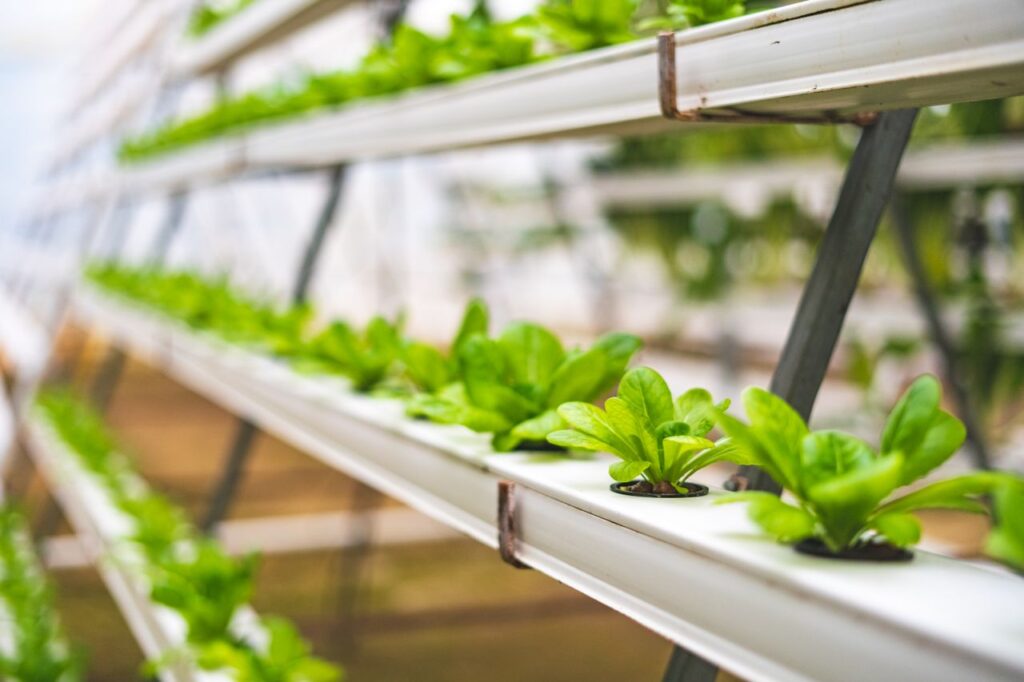
Hydroponics can absolutely be worth trying in a Malaysian home — especially if you have limited soil space, enjoy experimenting with growing systems, and want to produce leafy vegetables or herbs in a controlled setup.
But it is not automatically:
easier,
cheaper,
faster,
or more productive
than growing in soil.
Hydroponics replaces soil with a system where plant roots receive water, oxygen, and dissolved nutrients directly.
That gives you much more control.
It also means you become responsible for things that soil normally helps buffer, including:
nutrient concentration,
pH,
water supply,
and root-zone conditions.
For a beginner, the best approach is usually to start small rather than building a complicated system immediately.
What Exactly Is Hydroponics?
Hydroponics means growing plants without conventional soil.
The roots receive nutrients from water containing dissolved fertiliser.
Depending on the system, the roots may be supported by materials such as:
coco coir,
perlite,
rockwool,
clay pebbles,
or a small net pot.
Some systems keep roots partly in nutrient solution.
Others continuously circulate water.
Some deliver nutrient solution periodically.
The basic idea remains the same:
the plant gets its water and mineral nutrition without relying on ordinary garden soil.
Is Hydroponics Suitable for Malaysia?
Yes.
Malaysia’s year-round growing climate means hydroponic systems can operate throughout the year.
There is no winter shutdown to worry about.
However, our climate creates its own challenges.
These include:
high daytime temperatures,
warm nutrient solution,
intense sun,
high humidity,
heavy rain,
and rapid algae growth when reservoirs are exposed to light.
A hydroponic system designed for a cooler climate may therefore need adjustments before it performs well in a Malaysian balcony or backyard.
Heat Is One of the Biggest Challenges
Leafy vegetables may grow quickly in Malaysia, but excessive heat can create problems.
A nutrient reservoir sitting in direct afternoon sun can become very warm.
Warm solution contains less dissolved oxygen than cooler water.
That can stress roots and increase the risk of root problems.
For this reason, reservoir placement matters.
Keep nutrient containers:
out of direct sun,
covered from light,
and protected from unnecessary heat gain.
Light-coloured or insulated containers may also help reduce heating.
Do You Need a Lot of Space?
No.
This is one of hydroponics’ biggest advantages.
You can grow hydroponically on:
balconies,
small patios,
covered porches,
rooftops,
or compact backyards.
A simple system can occupy less space than a traditional raised bed.
That makes hydroponics attractive for Malaysian urban homes where garden space is limited.
But plants still need adequate:
light,
airflow,
and spacing.
Hydroponics does not allow you to ignore mature plant size.
What Crops Are Best for Beginners?
Leafy vegetables are generally the easiest place to start.
Suitable options may include:
pak choi,
sawi,
kailan,
lettuce varieties suited to warmer conditions,
bayam,
and some herbs.
These crops are relatively fast-growing and have simpler support requirements than large fruiting plants.
Herbs such as:
basil,
mint,
and some leafy culinary herbs
can also perform well.
What About Chillies and Tomatoes?
Yes, chillies and tomatoes can be grown hydroponically.
But they are not usually the easiest first crop.
Fruiting plants require:
more space,
stronger support,
longer growing periods,
more careful feeding,
and greater attention to nutrient concentration.
They also produce larger root systems.
A beginner is usually better off learning the basics with leafy crops before moving on to a long-term hydroponic chilli or tomato system.
Does Hydroponics Make Plants Grow Faster?
Sometimes.
When roots receive:
adequate nutrients,
water,
oxygen,
light,
and suitable temperatures,
plants can grow very efficiently.
But hydroponics does not override biology.
Poor light will still produce weak plants.
Extreme heat will still cause stress.
Incorrect nutrient concentration can still damage roots.
A badly managed hydroponic system can perform worse than a simple pot of good soil.
Is Hydroponics More Water-Efficient?
Recirculating hydroponic systems can use water very efficiently because water is retained and reused rather than draining away into surrounding soil.
This can be a major advantage.
However, actual water use depends on the system.
Water can still be lost through:
evaporation,
leaks,
system cleaning,
and reservoir changes.
So while hydroponics can be highly water-efficient, it is not automatically waste-free.
What Does a Plant Eat in Hydroponics?
Plants need the same essential mineral nutrients whether they grow in:
soil,
containers,
or hydroponics.
These include macronutrients such as:
nitrogen,
phosphorus,
potassium,
calcium,
magnesium,
and sulphur,
plus smaller quantities of essential micronutrients.
A proper hydroponic nutrient formulation provides these in forms the roots can absorb.
Ordinary garden fertiliser is not always suitable for hydroponics.
Hydroponic nutrient products are formulated to dissolve properly and supply a more complete nutrient profile.
Why You Should Not Use Random Homemade Fertiliser Solutions
Hydroponic roots depend almost entirely on what is dissolved in the water.
This makes inconsistent homemade mixtures risky.
Kitchen scraps, compost water, banana peel water, or similar homemade feeds do not provide reliably balanced hydroponic nutrition.
They may also:
introduce organic material,
encourage microbial growth,
block small channels,
or create unstable nutrient concentrations.
For beginner hydroponics, use a nutrient formulation designed for hydroponic cultivation.
What Is pH and Why Does It Matter?
pH tells you how acidic or alkaline the nutrient solution is.
It affects how easily roots can access different nutrients.
If the pH moves too far outside a suitable range, nutrients may be present in the water but become harder for the plant to take up.
This can create deficiency symptoms even when you are adding enough fertiliser.
Hydroponic growers therefore often monitor pH more closely than soil gardeners.
Do Beginners Need an EC Meter?
An EC meter measures electrical conductivity.
In hydroponics, it is commonly used as an estimate of how concentrated the dissolved nutrient solution is.
Higher EC generally means more dissolved ions.
An EC meter cannot tell you which nutrient is present, but it helps prevent nutrient solution from becoming:
too weak,
or too concentrated.
You can begin with a simple system following a reliable nutrient programme, but anyone planning to grow hydroponically long-term will benefit from understanding EC and pH.
Hydroponics Requires More Monitoring Than Soil
Healthy soil provides some buffering.
If you miss one small fertiliser adjustment, the plant may continue growing normally.
Hydroponics can react faster.
If:
a pump fails,
a reservoir empties,
nutrient concentration becomes excessive,
or pH shifts badly,
roots may be affected relatively quickly.
That is why hydroponics suits gardeners who enjoy checking their system.
Does Hydroponics Need Electricity?
It depends on the system.
Some hydroponic methods use:
water pumps,
air pumps,
or both.
Systems such as NFT rely on circulating nutrient solution and therefore normally need power.
Other designs, such as the Kratky method, can operate passively without pumps.
This makes Kratky particularly interesting for beginners who want to try hydroponics without building an electrical system.
Power Failure Matters
If your system depends on continuous pumping, consider what happens if:
the pump fails,
electricity goes out,
or a pipe becomes blocked.
Some systems tolerate interruptions better than others.
In Malaysian homes, a simple system with fewer failure points may be easier to manage than a highly automated setup when you are just learning.
Hydroponics Does Not Mean No Pests
This is another common misconception.
Removing soil can reduce some soil-related problems, but hydroponic plants can still be attacked by:
aphids,
thrips,
whiteflies,
spider mites,
caterpillars,
and other pests.
Leaf diseases can still develop.
Root diseases can also become serious if water conditions are poor.
Hydroponics changes the growing environment.
It does not make plants pest-proof or disease-proof.
Algae Can Become a Problem
Algae needs:
light,
water,
and nutrients.
A hydroponic reservoir provides two of those automatically.
If light reaches the nutrient solution, algae can grow quickly.
This is why reservoirs and nutrient channels should generally be kept opaque or properly covered.
Algae can compete for nutrients and oxygen and make the system more difficult to maintain.
Mosquito Prevention Matters in Malaysia
Any system containing standing water deserves special attention in Malaysia.
Reservoirs should be:
securely covered,
properly screened,
or otherwise designed so mosquitoes cannot easily access the water.
Do not leave open nutrient containers around the garden.
Hydroponics should produce vegetables — not mosquito breeding habitat.
Heavy Rain Can Affect Outdoor Systems
An uncovered hydroponic reservoir exposed to Malaysian thunderstorms can receive large amounts of rainwater.
That can:
dilute the nutrient solution,
change nutrient concentration,
overflow the reservoir,
and alter pH.
Outdoor systems should therefore have appropriate rain protection without becoming poorly ventilated or excessively hot.
Is Hydroponics Expensive?
It can be — but it does not have to be.
A basic passive system may require only:
a suitable container,
net pots,
growing medium,
hydroponic nutrients,
and seedlings.
More advanced setups may involve:
pumps,
pipes,
channels,
timers,
air stones,
meters,
reservoirs,
frames,
and replacement parts.
The cost rises quickly when a simple hobby becomes a technical project.
Start with the smallest system that teaches you the principles.
Does It Save Money on Vegetables?
Not necessarily at first.
A beginner may spend more on equipment than the first few harvests are worth.
Hydroponics becomes more financially interesting when:
equipment is reused,
crop failures decrease,
systems stay productive,
and you grow crops your household actually eats.
This is why tracking harvest weight and costs can be useful.
Do not judge the system based on one expensive first harvest of lettuce.
Hydroponics Requires Cleaning
Unlike a soil pot that can sometimes continue for several crop cycles with minimal equipment cleaning, hydroponic systems need periodic maintenance.
Between crops, you may need to clean:
reservoirs,
pipes,
channels,
net pots,
and other reusable parts.
Dead roots and algae should not simply remain in the system indefinitely.
Good hygiene becomes particularly important after root disease.
What Happens When You Travel?
This depends on the system.
A well-designed reservoir may keep plants supplied for several days.
A small reservoir may run low quickly during hot weather.
Pump-dependent systems also need to keep functioning while you are away.
Before leaving home, check:
water level,
pump operation,
power supply,
leaks,
and plant demand.
Hydroponics can automate watering, but it does not automatically become maintenance-free.
Is Hydroponics Better Than Soil Gardening?
Neither is universally better.
Hydroponics may suit you if you:
have limited ground space,
enjoy measuring and monitoring,
want clean compact systems,
like experimenting with technology,
and want to grow leafy vegetables regularly.
Soil gardening may suit you better if you:
prefer simpler systems,
want to grow many different crop types,
do not want to monitor nutrient solution,
have good garden space,
or enjoy working with compost and soil biology.
You can also do both.
There is no need to choose one gardening identity forever.
A Hybrid Home Garden Can Work Very Well
For many Malaysian homes, the most practical setup may be:
hydroponic leafy greens,
with soil-grown chillies,
fruit trees,
herbs,
and long-term vegetables.
This allows each growing method to do what it does well.
Hydroponics does not need to replace your existing garden.
It can simply become another tool.
Start Small Before Building a Large System
A beginner does not need a 40-hole NFT system immediately.
Start with:
a few leafy greens,
a small passive setup,
or one compact hydroponic unit.
Learn:
how quickly water levels change,
how plants respond to nutrients,
how hot the reservoir gets,
and how often maintenance is needed.
Then decide whether you actually enjoy the process.
Scaling a system you understand is much easier than troubleshooting a large one you built before learning the basics.
A Simple Beginner Checklist
Before starting hydroponics, ask:
1. What crop do I actually want to grow?
Leafy greens are usually easier than large fruiting crops.
2. How much light does my space receive?
Hydroponics does not replace sunlight.
3. Can I keep the nutrient reservoir shaded and covered?
This helps with heat, algae, and mosquitoes.
4. Do I want a passive or pump-driven system?
Consider complexity and power dependence.
5. Am I willing to learn pH and nutrient concentration?
Long-term success becomes easier when you understand both.
6. Can I inspect the system regularly?
Hydroponics rewards observation.
7. Is the system protected from heavy rain?
Especially if grown outdoors.
8. Can I clean and reset it between crops?
Maintenance matters.
9. Will I actually eat what I grow?
Choose crops around your household.
10. Can I start with a small trial instead of a major investment?
Usually, yes.
So, Is Hydroponics Worth Starting?
For many Malaysian home gardeners, yes — if you treat it as a different growing method rather than an automatic upgrade from soil.
It is particularly attractive for:
urban homes,
balconies,
small spaces,
and gardeners who want regular leafy-green production.
But it comes with responsibilities.
You need to understand:
water,
nutrients,
pH,
heat,
root health,
and system maintenance.
If that sounds interesting rather than annoying, hydroponics may suit you very well.
If you want the simplest possible way to grow a few herbs and chillies, pots and good soil may still be the easier option.
At the end of the day, hydroponics is worth starting in a Malaysian home when its strengths match your space, crops, and willingness to manage the system. Our year-round tropical climate allows continuous growing, but hot nutrient solution, strong sun, heavy rain, humidity, algae, and mosquitoes all need to be considered. Start with a small system and an easy leafy crop, learn how the water and nutrients behave in your own home environment, and expand only if you enjoy the process. Hydroponics does not have to replace soil gardening — it can simply give you another way to grow more food from the space you already have.
Already experimenting with hydroponics in your balcony, terrace house, backyard, or kitchen garden — or thinking about building your first system? Share your setup, crops, successes, failures, and questions by tagging @projectharvest.my on Instagram. Seeing how hydroponics performs in real Malaysian homes can help other gardeners decide whether growing without soil is genuinely worth starting for them.