
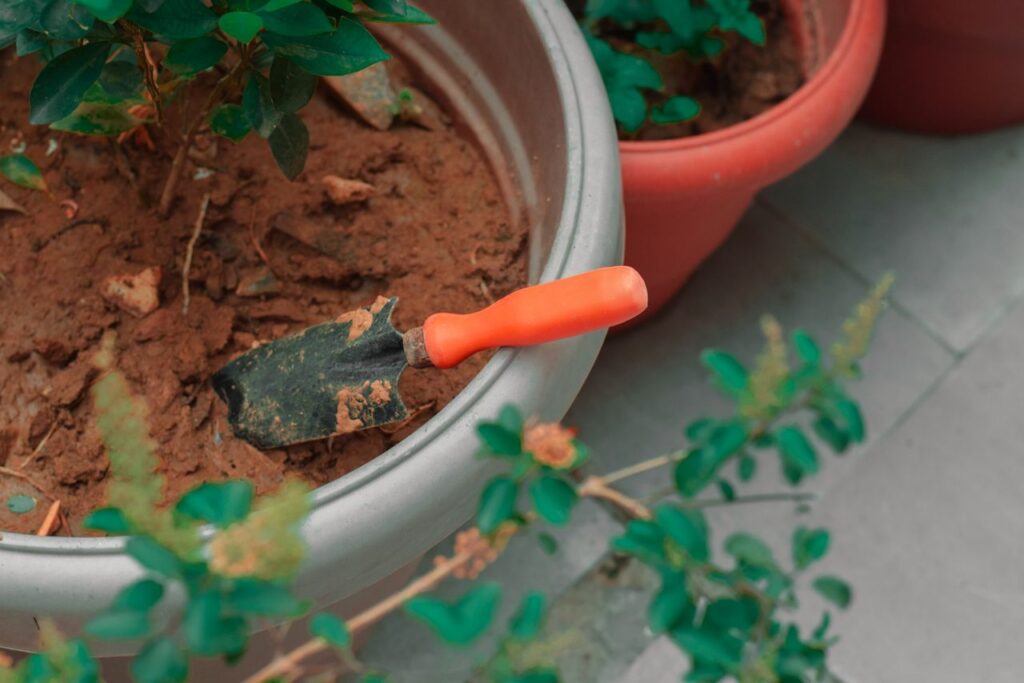
Compacted soil does not always mean you need to empty the garden bed, remove every plant, and start again. In many home gardens, especially established beds with herbs, vegetables, shrubs, or fruit plants already growing, soil structure can be improved gradually with far less disruption.
The goal is to restore air spaces, water movement, root pathways, and biological activity without repeatedly turning the whole soil profile upside down.
That usually means combining gentle aeration with compost, mulch, living roots, and better habits over several growing cycles.
Start by Stopping the Cause
Before trying to improve the soil, work out why it became compacted.
If people regularly walk through the planting area, create a defined pathway.
If heavy pots, storage containers, or equipment are sitting directly on the soil, move them.
If you frequently dig the bed while it is saturated after heavy Malaysian rain, wait until the soil is moist but not sticky before working it.
There is little value in loosening compacted soil if the same pressure immediately compresses it again.
Use a Garden Fork Instead of Turning Everything Over
One of the gentlest ways to loosen a compacted bed is with a garden fork.
Push the fork vertically into the soil between established plants, being careful around major roots. Instead of lifting and flipping the soil, gently rock the handle backward and forward to create cracks and channels.
Then remove the fork and repeat in another area.
This is sometimes called broadforking or vertical aeration when done with larger tools.
The aim is not to break the soil into tiny pieces. You are simply creating pathways for air, water, roots, and organic matter.
For a small Malaysian home garden, an ordinary garden fork is often enough.
Add Finished Compost to the Surface
After creating some openings, spread a moderate layer of finished compost over the soil surface.
You do not need to bury it deeply.
Rain, watering, earthworms, insects, roots, and microorganisms will gradually move organic material downward.
Compost helps improve aggregation, supports soil life, and adds organic matter that makes the soil more resistant to future compaction.
In Malaysia’s warm climate, organic matter decomposes fairly quickly, so smaller regular additions are usually better than treating compost as a one-time fix.
Mulch After Adding Compost
Covering the soil with mulch helps protect the improvements you are making.
Organic mulch such as dried leaves, bark, wood chips, or other suitable plant material reduces the impact of heavy rain on exposed soil.
This matters because repeated rainfall hitting bare ground can break apart soil aggregates and contribute to surface crusting.
Mulch also slows evaporation, moderates soil temperature, and adds more organic material as it gradually breaks down.
Keep the mulch slightly away from plant stems and trunks rather than piling it directly against them.
Let Roots Do Some of the Work
Roots are natural soil engineers.
As plants grow, their roots push through small cracks and channels. Fine roots eventually die and decompose, leaving organic matter and pathways behind.
This means one of the best ways to improve soil is often to keep it planted.
In empty sections of a bed, consider growing crops with different root structures instead of leaving the ground bare.
Leafy vegetables, herbs, legumes, and deeper-rooted plants all explore the soil differently.
In larger garden areas, cover crops can be particularly useful because their root systems help keep the soil biologically active between main growing cycles.
Do Not Over-Till the Soil
When gardeners see hard soil, the natural reaction is to dig harder.
Sometimes initial loosening is necessary, but repeated deep tilling can create new problems.
Constant cultivation breaks apart soil aggregates, disturbs fungal networks and soil organisms, and may leave a loose surface sitting above a compacted layer.
In other words, a bed may look beautifully fluffy immediately after digging but become dense again after repeated watering and rain.
Aim for minimal disturbance with a clear purpose rather than digging because loose-looking soil seems healthier.
Aerate When the Moisture Is Right
Timing matters, especially with clay-heavy soils.
Never aggressively work saturated soil.
Wet clay can smear and compress around your tools, damaging structure rather than improving it.
At the other extreme, completely dry soil may be too hard to penetrate and may break into large blocks.
The best time is generally when the soil is moist enough to work but not sticky.
After rain, wait until excess water has drained before using the fork.
Use Organic Matter Repeatedly
Compacted soil usually did not develop overnight, and it may not recover overnight either.
A repeated cycle works better:
gently aerate,
add compost,
mulch,
grow plants,
avoid compaction,
and repeat when necessary.
Over several months or growing seasons, the soil can become noticeably more crumbly and easier for roots to penetrate.
This gradual approach is especially useful when you cannot remove established curry leaf plants, herbs, fruit trees, or permanent landscaping.
What About Adding Sand?
Adding small quantities of sand is not a reliable shortcut for compacted clay soil.
Changing soil texture significantly requires a very large amount of mineral material, and poorly balanced mixtures can remain dense.
For most home gardeners, increasing organic matter and improving structure is more practical than trying to physically convert clay into sandy soil.
Should You Use Gypsum?
Gypsum is often sold as a clay-breaking solution, but it does not work universally.
It can help certain soils with specific sodium-related structural problems, but ordinary soil compaction is not automatically a gypsum deficiency.
Do not treat gypsum as a guaranteed fix simply because the soil feels hard.
A soil test and proper diagnosis are more useful if you suspect a serious chemical problem.
Consider Raised Beds for Severe Compaction
There are situations where minimal intervention is not enough.
If the soil was heavily compressed during construction, contains rubble, remains waterlogged for long periods, or is almost impossible for roots to penetrate, creating a raised growing zone may be more practical.
You can place a raised bed above the existing soil and gradually improve the ground underneath over time.
This allows vegetables to grow in a healthy root zone immediately without requiring you to excavate the entire yard.
Container Soil Can Compact Too
Compaction is not limited to the ground.
Old potting mix gradually breaks down and settles, reducing pore space around roots.
If a potted plant has been in the same container for years, water runs strangely through the pot, or the mix has become dense and shrunken, it may need refreshing or repotting.
In this case, gently aerating the surface can help temporarily, but severely degraded potting mix may eventually need partial or complete replacement.
Know When Not to Disturb the Soil
If established plants are growing strongly, drainage is reasonable, and roots are healthy, do not aerate the bed aggressively just because the soil feels slightly firm.
Soil does not need to feel like fluffy potting mix to function well.
The goal is not maximum looseness.
The goal is enough pore space for roots, air, and water while still maintaining stable structure.
At the end of the day, fixing compacted soil without digging everything up is completely possible, but it requires patience. Stop walking on growing areas, loosen the soil gently with a fork, add finished compost, protect the surface with mulch, and let living roots and soil organisms continue the process. Rather than rebuilding the garden in one dramatic weekend, focus on helping the soil recover a little more with every growing cycle.
Working on compacted soil without tearing apart your whole garden? Tag @projectharvest.my on Instagram and share your fork-aeration method, compost layers, mulch setup, root progress, or before-and-after soil photos with us. Your slow soil recovery might encourage another Malaysian gardener who thinks the only solution is to dig everything up and start again.