
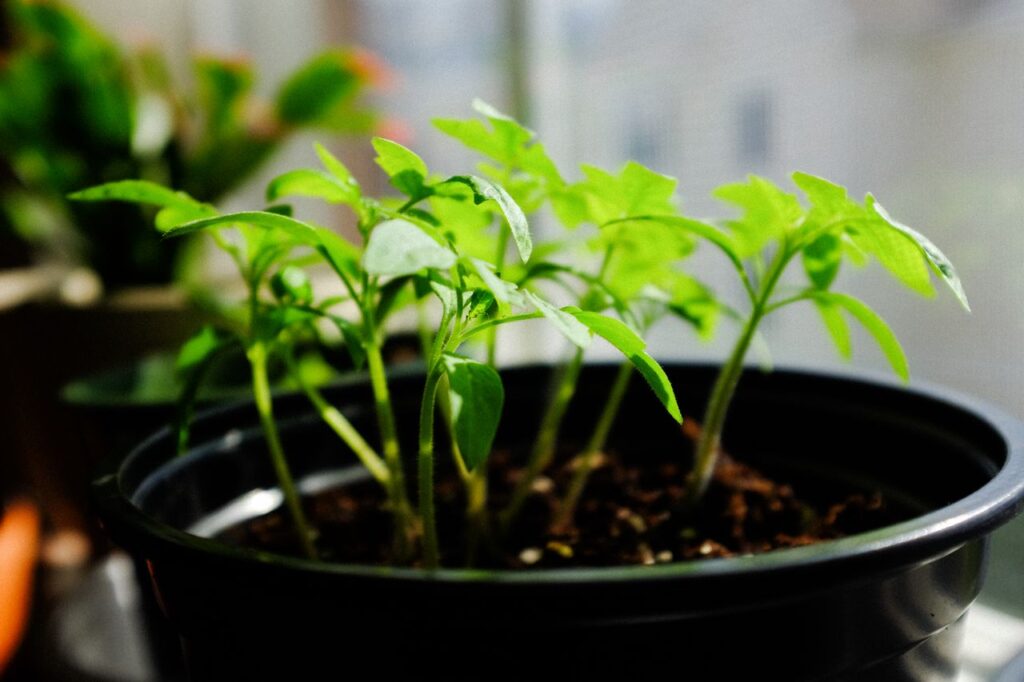
If you sow several seeds in each cell or scatter vegetables directly into a garden bed, you may eventually end up with far more seedlings than the space can support.
That is when thinning becomes necessary.
Thinning means removing some seedlings so the remaining plants have enough space, light, water, nutrients, and root room to grow properly.
It can feel wasteful to remove perfectly healthy seedlings, especially when you watched them germinate from tiny seeds.
Fortunately, thinning does not always mean throwing plants away.
Depending on the crop, extra seedlings can sometimes be transplanted elsewhere, eaten as young greens, shared with another gardener, or added to the compost.
The trick is knowing when saving every seedling actually makes sense — and when trying to rescue them causes more harm than good.
Why Do Seedlings Need Thinning?
When seedlings grow too close together, they begin competing almost immediately.
Their leaves compete for light.
Their roots compete for moisture and nutrients.
Airflow becomes poorer.
Seedlings may stretch upwards and become thin or leggy as they try to escape the shade of neighbouring plants.
Crowded conditions can also keep foliage damp for longer, something worth paying attention to in Malaysia’s humid climate.
If every seedling is allowed to remain simply because you do not want to waste one, you may eventually end up with ten weak plants instead of three strong ones.
Sometimes removing a few plants is what allows the rest to succeed.
Thin While Seedlings Are Still Young
Thinning is generally easier when seedlings are young.
At this stage, root systems are smaller and less intertwined.
If you wait until several plants have developed dense root networks in the same cell, separating them can tear many fine roots.
For crops you plan to transplant, working when the seedlings have developed their first true leaves can often be practical.
The exact timing varies by crop, but do not wait until overcrowding has already become severe.
First, Choose the Strongest Seedling
When several seedlings are growing together, identify the healthiest one you want to keep.
Look for a seedling that is:
upright,
well coloured,
sturdy rather than excessively stretched,
free from visible damage,
and developing normally shaped leaves.
The tallest seedling is not automatically the best.
A shorter, stockier plant may be healthier than a long, weak seedling stretching towards light.
Once you identify the keeper, remove competitors carefully.
Method 1: Transplant the Extra Seedlings
For crops that tolerate transplanting well, you can often save the extras.
This works particularly well with crops such as:
chillies,
tomatoes,
brinjal,
basil,
and many leafy vegetables.
Water the growing medium first.
Moist soil is easier to separate than dry, crumbly soil.
Use a small spoon, plant label, chopstick, or similar tool to gently lift the extra seedling with as much root attached as possible.
Avoid pulling it straight upwards by the stem.
Immediately place it into another prepared cell or small pot.
Water gently afterwards and give it temporary protection from harsh sunlight while it recovers.
Separate Seedlings Before Their Roots Become Tangled
If you intend to rescue extra seedlings, timing matters.
Two young chilli seedlings growing together can often be separated fairly easily.
Two older plants whose roots have formed one dense mass may be much more difficult.
Once roots are heavily intertwined, saving both plants may create so much damage that neither performs well.
This is another reason to inspect seed trays regularly instead of waiting until overcrowding becomes obvious.
Method 2: Snip Unwanted Seedlings at Soil Level
Not every seedling should be pulled out.
For crops with sensitive roots, or where seedlings are packed very closely together, cutting the unwanted seedlings at soil level is often safer.
Use clean scissors and snip the weaker seedling just above the growing medium.
The small root system left behind will eventually decompose.
This avoids disturbing the roots of the plant you want to keep.
This technique is especially useful with carrots.
Carrot roots can be easily disturbed, and pulling one crowded seedling may shift or damage neighbouring roots.
Snipping the extras is often the safer choice.
Carrots Are Not Good Rescue Candidates
It can be tempting to transplant every carrot seedling you remove.
Usually, it is not worth it.
The carrot you eventually harvest develops from its main root.
Disturbing that root while transplanting can cause crooked, forked, or poorly shaped carrots.
For carrots, it is generally better to direct sow and then thin carefully.
If seedlings are extremely close, cut unwanted plants rather than pulling aggressively around the ones you are keeping.
Not every seedling needs to be saved as another plant.
What About Radishes?
Radishes are another crop where direct sowing is usually simplest.
Because they grow quickly and develop an enlarged edible root, transplanting thinned seedlings is often more effort than benefit.
Thin early so the remaining radishes have room to develop properly.
Where appropriate, very young removed radish seedlings may be edible, provided you know exactly what they are and they have not been exposed to unsuitable treatments.
Leafy Greens Are Easier to Rescue
Leafy vegetables are much more forgiving.
Sawi, kailan, lettuce-type greens, bayam, and similar plants can often be moved while young.
If you sowed too densely, carefully lift some seedlings and replant them at wider spacing.
This is a useful way to turn one crowded patch into several productive areas.
If there is no extra garden space, some young edible thinnings may also be used as baby greens.
Can You Eat the Seedlings You Thin?
Sometimes, yes.
Young seedlings from known edible crops can sometimes be eaten as tender greens.
Examples may include suitable young:
radish,
mustard-type greens,
kailan,
bayam,
and some herbs.
But there are important conditions.
Only eat seedlings when you are completely certain of the plant species.
Seeds should not have been treated with chemicals that make the resulting seedlings unsuitable for consumption.
The seedlings should also have been grown under clean conditions.
Do not assume every plant seedling is edible simply because its mature fruit or another part of the plant can be eaten.
For example, tomato seedlings are not something you should casually add to a salad just because tomatoes themselves are edible.
When uncertain, compost them instead.
Seed Treatments Matter
Some commercially supplied seeds may be treated with fungicides, insecticides, or other products.
Treated seeds are sometimes visibly coated or labelled accordingly.
If a seed packet indicates chemical treatment, follow the label instructions carefully.
Do not assume seedlings produced from treated seed are suitable to be eaten as microgreens or very young thinnings.
For crops you specifically intend to eat at the seedling stage, use seed intended and labelled for that purpose.
Thinnings Are Not Automatically Microgreens
Microgreens are grown intentionally for harvest at a young stage using suitable edible crops and production methods.
A random collection of seedlings removed from a vegetable bed is not automatically the same thing.
You may still be able to eat certain thinnings safely, but treat that as a crop-specific decision.
Knowing the species, seed treatment, and growing conditions matters.
Method 3: Compost the Extras
If a seedling cannot be transplanted or eaten, it still does not need to become household waste.
Healthy young seedlings can usually go into your compost.
They contain soft green plant material that breaks down relatively quickly.
Do not compost seedlings that appear badly diseased if your composting system is not capable of managing plant pathogens appropriately.
For ordinary healthy thinnings, however, composting returns their nutrients and organic matter to the garden.
That is not really waste.
It is recycling.
Method 4: Share Them
If you successfully separate healthy seedlings, consider giving extras to:
friends,
neighbours,
family members,
community gardeners,
or someone who has been saying they want to start gardening.
A few spare chilli or basil seedlings can become someone’s first edible garden.
Label the plants before giving them away.
“Chilli” is useful.
“That little green one I think might be spicy” is less useful.
Should You Sow Fewer Seeds to Avoid Thinning?
Sometimes.
If your seeds have a high germination rate, you may only need one or two seeds per cell.
This reduces wasted seed and later thinning work.
However, gardeners often sow several seeds because germination is uncertain.
There is nothing wrong with that.
Once you have tested your seeds and understand their germination rate, you can adjust.
If nine out of ten seeds normally germinate, sowing five seeds into every tiny cell is probably unnecessary.
Thinning Direct-Sown Beds
When seeds are scattered or sown in rows, thinning is just as important.
Wait until seedlings are large enough to distinguish and handle.
Then remove plants gradually until the remaining seedlings reach the spacing appropriate for that crop.
You do not always need to achieve the final spacing in one session.
For some leafy vegetables, you can thin progressively.
Remove some young plants first.
Allow the remaining plants to grow.
Then thin again later.
If the removed plants are suitable for eating, this can turn thinning into several small harvests.
Water Before Thinning
Moist soil makes the process easier.
If you intend to pull or transplant seedlings, water beforehand.
The soil should be damp rather than waterlogged.
Dry soil can grip roots tightly and break them as you pull.
Very muddy soil can collapse around neighbouring roots.
Work gently.
Water Again After Thinning
Once thinning is finished, lightly water the area if needed.
This helps settle soil around any roots that were disturbed.
For transplanted extras, keep the root zone appropriately moist while they recover.
Do not immediately flood everything.
Some disturbance is normal, but stable moisture will help seedlings establish again.
Protect Transplanted Thinnings from Harsh Sun
A rescued seedling may have lost some fine roots during separation.
That means it temporarily has less ability to replace water lost through the leaves.
In Malaysian conditions, intense sun immediately after separation can cause rapid wilting.
Give newly transplanted thinnings gentle conditions for a short period.
Bright shade or morning sunlight may be appropriate before gradually returning the plants to their normal light exposure.
This is essentially a small version of managing transplant shock.
Do Not Sacrifice the Main Seedling to Save Every Extra
This is perhaps the most important rule.
If three seedlings are so tangled that separating them will badly damage the strongest plant, stop.
Cut the unwanted seedlings instead.
It may feel wasteful, but protecting one healthy root system is often better than damaging three plants in an attempt to save everything.
Successful gardening sometimes means choosing which plant gets the space to thrive.
A Simple Thinning Routine
When a tray or bed becomes crowded:
identify the strongest seedlings,
decide which extras can realistically be transplanted,
water the soil beforehand,
gently lift transplantable seedlings with their roots,
snip sensitive or badly tangled seedlings at soil level,
replant suitable extras immediately,
eat only clearly identified and appropriately grown edible thinnings,
compost healthy leftovers,
and water disturbed plants gently afterwards.
That turns thinning from a frustrating job into part of managing the crop properly.
At the end of the day, thinning seedlings is not about throwing away successful germination. It is about giving each remaining plant enough space to become productive. Some extras can become new plants, some edible crops can provide an early mini-harvest, and healthy leftovers can return to the garden through compost. In a small Malaysian home garden where every pot and raised-bed space matters, knowing when to save a seedling — and when to simply snip it — can help you grow fewer weak plants and more strong ones.
Got a seed tray where every seed unexpectedly decided to germinate at once? Tag @projectharvest.my on Instagram and show us your crowded seedlings, successful rescues, transplanted extras, or even the little harvest you made from edible thinnings. We would love to see how Malaysian gardeners turn overcrowding into more plants instead of more waste.