
A productive-looking garden does not always produce the most useful food.
One large pumpkin vine may occupy several square metres and give you only a few fruits. A small group of okra plants may quietly produce pods several times a week. A chilli plant may provide hundreds of grams over many months while a leafy crop gives one large harvest and is finished.
Tracking harvest weight helps you move beyond impressions and answer a much more useful question:
Which crops are actually earning their space in your garden?
For Malaysian home gardeners with limited raised beds, containers, balconies, or terrace-house growing areas, this can make future crop planning much smarter.
Why Weigh Your Harvest?
You do not need to weigh vegetables simply to prove that your garden is productive.
The real value is comparison.
Harvest records can help you understand:
which crops give the most food,
which plants remain productive longest,
which varieties perform best,
how much each growing area produces,
and whether a crop is worth repeating.
Without records, it is easy to overestimate crops that produce impressive-looking fruit and underestimate crops that give smaller but frequent harvests.
Start with a Simple Digital Kitchen Scale
You do not need specialised equipment.
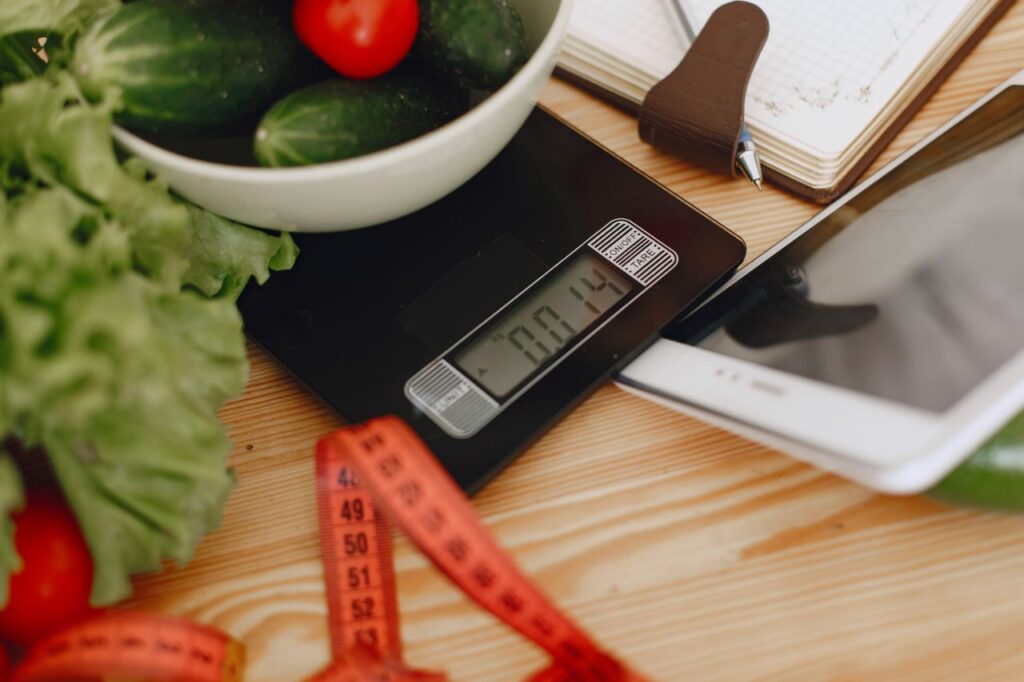
A basic digital kitchen scale that measures in grams is usually enough for a home garden.
Keep a container or bowl beside it.
Place the empty bowl on the scale and use the tare function to return the display to zero.
Then add your harvest.
Record the weight.
That is all you need to begin.
Record the Crop and Date
Every harvest entry should include at least:
date, crop, and weight.
For example:
12 October — Okra — 185 g
14 October — Cili Padi — 72 g
16 October — Bayam — 410 g
If you grow several varieties, record the variety too.
For example:
Tomato Variety A — 620 g
This becomes especially useful when comparing seed varieties later.
Record Harvests Every Time
Small harvests count.
If you pick five chillies today and another seven three days later, record both.
Do not wait until the end of the month and guess.
Frequent crops can produce surprisingly large totals when small harvests are added together.
A plant that never gives you a dramatic basket of produce may still become one of the highest-yielding crops in the garden.
Add Up the Monthly Total
At the end of each month, calculate the total harvest for each crop.
For example:
Okra — 2.4 kg
Chilli — 840 g
Cucumber — 5.2 kg
Bayam — 3.1 kg
This gives you a much clearer picture of what the garden actually produced.
You can also calculate a full crop-cycle total once the plants are removed.
Weight Alone Does Not Tell the Whole Story
This is important.
A pumpkin weighing 4 kg will easily beat a chilli plant by weight.
That does not necessarily mean pumpkin is the better crop for your garden.
You also need to consider:
how much space it used,
how long it occupied that space,
how much work it required,
and whether your household actually ate the harvest.
Harvest weight is useful, but it should be interpreted together with the rest of the garden.
Compare Yield with Space Used
Suppose a pumpkin vine gives you 6 kg of fruit but occupies a huge area for several months.
Meanwhile, one square metre of leafy vegetables produces several smaller harvests throughout the same period.
The question becomes:
How much food did each crop produce for the space it occupied?
For raised beds, you can roughly compare yield per square metre.
For containers, compare crops using similar pot sizes.
You do not need perfect scientific measurements.
Even approximate comparisons can reveal which crops use your limited space well.
Compare Crops by Growing Duration
Time matters too.
A crop that produces 2 kg in six weeks may be more useful than a crop producing 3 kg after five months.
This is especially important if the space could have supported several crop cycles.
Record:
sowing date,
first harvest,
last useful harvest,
and final harvest weight.
Then you can compare how quickly each crop turns garden space into food.
Track Yield per Plant
For some crops, weighing each plant separately can be useful.
This works particularly well for:
chillies,
brinjal,
tomatoes,
okra,
and other larger individual plants.
Suppose you grow four chilli plants.
At the end of the cycle you discover:
Plant 1 produced 1.1 kg.
Plant 2 produced 620 g.
Plant 3 produced 1.4 kg.
Plant 4 produced 550 g.
Now you can investigate why.
Perhaps one received more sun.
Perhaps one variety performed better.
Perhaps two became heavily affected by pests.
That information can influence your next planting layout.
Use Separate Labels for Different Varieties
If you are testing two cucumber varieties, do not combine all their harvests into one “cucumber” total.
Track them separately.
Otherwise you lose the comparison.
For example:
Cucumber Variety A — 6.5 kg
Cucumber Variety B — 3.7 kg
If Variety A also tasted better and resisted disease more successfully, your next seed purchase becomes much easier.
Consider How Often the Crop Produces
Some crops give one major harvest.
Others provide food continuously.
This difference matters.
A batch of sawi may give one main harvest.
Okra can produce repeatedly.
Chillies may continue over months.
Basil can be harvested again and again.
A crop that gives smaller but frequent harvests may fit household cooking better than one enormous harvest that has to be eaten, shared, preserved, or wasted immediately.
Record What You Actually Use
A crop is only valuable if its harvest is useful to you.
Suppose you grow 8 kg of a vegetable your family barely eats.
Technically, the crop is productive.
Practically, it may not deserve much garden space next cycle.
Compare harvest totals with kitchen use.
Ask:
Did we eat most of it?
Did we give a lot away?
Did some go to waste?
Would we have bought this ingredient anyway?
Those answers matter as much as the number on the scale.
Think About What the Harvest Replaces
Some crops are particularly useful because you would otherwise buy them regularly.
For example, if your household uses:
chillies,
curry leaves,
pandan,
basil,
mint,
okra,
or leafy vegetables every week,
even a relatively small home harvest can be valuable.
You are producing something the kitchen actually needs.
A crop does not have to produce the highest kilogram total to earn its place.
High-Value Crops May Be Worth Growing Even at Lower Weight
Weight should not automatically determine what you grow.
One kilogram of pumpkin and one kilogram of herbs have very different usefulness and market value.
Small quantities of chillies, herbs, or speciality vegetables may be particularly worthwhile because they can be relatively expensive to buy or are used frequently in small amounts.
This is why “worth growing” should include more than kilograms.
Consider the Work Required
Some crops may produce well but require constant attention.
Ask:
How often did I need to water it?
Did it require complicated trellising?
Was it constantly attacked by pests?
Did it need repeated spraying or intervention?
Was harvesting difficult?
Did it become a source of stress?
A slightly lower-yielding crop that is reliable and easy to maintain may be a better choice for a busy home gardener.
Consider Pest and Disease Losses
Record rejected produce too.
For example:
Harvested: 1.2 kg cucumber
Usable: 850 g
Damaged: 350 g
This gives you a better idea of actual productivity.
A crop can look highly productive until you realise a large percentage of the harvest is damaged by fruit flies, caterpillars, disease, or cracking.
Usable yield matters more than total biological production.
Record Failed Plants
Plants that produce nothing are part of the calculation.
Suppose you planted ten chilli plants but only seven survived to meaningful harvest.
Do not calculate yield using only the seven survivors if you want to evaluate the entire crop cycle.
The three failed plants still used:
seeds,
potting mix,
space,
water,
and time.
Recording failures gives you a more honest picture of how reliable the crop is.
Use a Simple Crop Score
If you want an easy way to compare crops, give each one a score from 1 to 5 for a few categories.
For example:
Yield
Space efficiency
Ease of care
Pest resistance
Kitchen usefulness
Would I grow it again?
A crop may not have the highest yield but might score extremely well overall.
For example, curry leaf may not produce kilograms every week, but it can be useful for years and require relatively little space once established.
A Simple Harvest Tracking Example
Imagine three crops grown over several months.
Okra
Total harvest: 4.2 kg
Space: moderate
Harvest frequency: several times a week
Maintenance: easy
Kitchen use: high
Cucumber
Total harvest: 7.5 kg
Space: trellis required
Harvest frequency: heavy but shorter period
Maintenance: moderate
Kitchen use: medium
Brinjal
Total harvest: 3.6 kg
Space: moderate
Harvest period: long
Maintenance: moderate
Kitchen use: high
Cucumber produced the most by weight.
But depending on your household, okra or brinjal might still be more worthwhile because of longer production, easier management, or more frequent use.
Track Yield Across Several Cycles
Do not judge a crop from one attempt.
Weather can distort the result.
A very rainy cycle may reduce productivity.
A pest outbreak may damage one planting.
The next cycle may perform completely differently.
Try to compare crops across several rounds.
Once you see similar results repeatedly, the pattern becomes much more meaningful.
Use the Records to Change Next Season’s Garden
This is the most important step.
If your records show that three chilli plants already produce more than your household needs, do not automatically plant eight next time.
Use that space for something else.
If your family constantly runs out of bayam between harvests, increase or stagger the planting.
If cucumber takes up a large trellis but everyone loves the harvest, keep it.
If a crop produces poorly every cycle and requires constant treatment, reconsider whether it deserves space.
Garden records should influence future decisions.
You Can Track Value Later
Once you are comfortable tracking weight, you can eventually compare the harvest with supermarket or market prices.
For example, if you harvested 3 kg of a crop, you could estimate what buying that amount would have cost.
This gives you another way to judge whether a crop is worth growing.
But start with yield first.
You do not need to turn your home garden into an accounting department from day one.
A Simple Tracking Template
For each harvest, record:
Date:
When did you harvest?
Crop and variety:
What did you pick?
Weight:
How many grams or kilograms?
Plant or bed:
Where did it come from?
Usable amount:
Was any damaged or discarded?
At the end of the crop cycle, add:
Total harvest:
How much did it produce overall?
Space used:
One pot, half a bed, one square metre, and so on.
Growing duration:
How long did it occupy the space?
Kitchen usefulness:
Did your household actually use it?
Grow again?
Yes, no, or maybe.
That is enough to make far better crop decisions.
The Best Crop Is Not Always the Heaviest
A productive home garden is not a competition to produce the maximum number of kilograms.
The best crops are the ones that balance:
good yield,
manageable space,
reasonable effort,
reliable growth,
and real usefulness in your household.
For one family, that may mean chillies, curry leaf, pandan, and okra.
For another, it may be cucumber, bayam, basil, and brinjal.
Your harvest records help you discover the answer for your own garden.
At the end of the day, tracking harvest weight turns “I think this crop did well” into something you can actually compare. Weigh what you harvest, record where it came from, note how much space and time the crop used, and pay attention to how much your household genuinely ate. After several Malaysian growing cycles, you will begin to see which crops consistently earn their place — and which ones are taking up valuable garden space without giving enough back.
Already weighing your home harvests, or ready to start with your next picking? Tag @projectharvest.my on Instagram and show us your kitchen scale, harvest log, weekly totals, or the crop that surprised you with how much it produced. We would love to see which vegetables, herbs, and edible plants Malaysian home gardeners decide are truly worth growing once the numbers start adding up.