
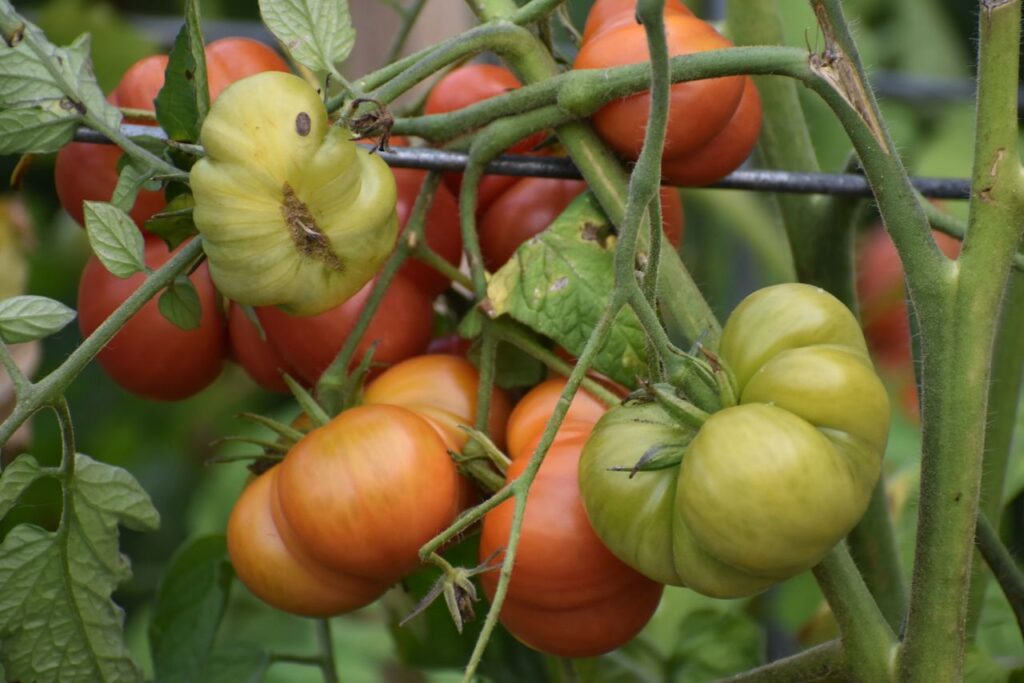
Misshapen fruit usually develops because something affected the flower, pollination, young fruit, or growing conditions while the fruit was forming.
Common causes include:
incomplete pollination,
temperature stress,
uneven watering,
physical damage,
pest feeding,
crowding,
genetics,
and occasionally nutrient problems.
An oddly shaped cucumber or tomato does not automatically mean the plant is diseased, and it does not necessarily mean the fruit is unsafe to eat.
The useful question is:
At what stage did the fruit’s development become uneven?
Understanding that can help you decide whether there is actually something in the garden that needs fixing.
Fruit Shape Starts at the Flower
A fruit begins developing from the flower’s ovary.
If flower development, pollination, fertilisation, or early cell growth is disrupted, the finished fruit may reflect that problem.
This means the cause of a strange-looking fruit may have occurred days or even weeks before you notice the unusual shape.
By the time a cucumber is visibly curved, for example, the event that caused the uneven growth may already be over.
Poor or Incomplete Pollination Can Cause Uneven Growth
Pollination is one of the most important causes of malformed fruit in some vegetables.
Cucumbers are a good example.
In varieties that require pollination, successful fertilisation of enough ovules helps the fruit develop evenly.
When pollination is incomplete, some sections may develop more strongly than others.
The result can be:
curved cucumbers,
fruit that is thick at one end,
narrow sections,
or fruit that stops developing evenly.
This is why improving pollinator activity or hand-pollinating female flowers can sometimes improve cucumber shape as well as fruit set.
One Strange Cucumber Does Not Prove You Have a Pollination Problem
Do not diagnose the entire garden from one unusual fruit.
Plants occasionally produce imperfect fruits.
Instead, look for a pattern.
If one cucumber is curved but the next five are normal, there may be little reason to intervene.
If most fruits repeatedly develop with similar deformities, then investigate pollination and growing conditions.
Pollination Problems Can Affect Other Cucurbits Too
Pumpkins, squash, and gourds may also show poor or uneven development when pollination is inadequate.
Sometimes a female flower begins developing, but the young fruit stops growing and eventually drops.
In other cases, development may be uneven.
Successful pollination is therefore important not only for getting a fruit to start growing but also for normal development in many pollination-dependent crops.
Tomatoes Can Become Misshapen for Different Reasons
Tomatoes can develop irregular shapes for reasons that are not the same as cucumber problems.
One well-known disorder is commonly called catfacing.
Affected tomatoes may develop:
deep grooves,
scarring,
large indentations,
or unusually lobed shapes,
especially around the blossom end.
Catfacing is associated with abnormal flower development and can be influenced by environmental stress during flowering.
Temperature conditions and varietal sensitivity can play a role.
The problem occurred very early in fruit formation, so trying to reshape the fruit later is impossible.
Weather During Flowering Matters
Temperature can influence pollen, flower development, fertilisation, and early fruit growth.
Very hot conditions can reduce successful fruit set in some vegetables.
Unusual temperature stress during flower development can also contribute to malformed fruits in certain crops.
In Malaysia, home gardens can experience particularly harsh microclimates.
A plant beside a west-facing concrete wall may experience much stronger afternoon heat than the air temperature reported for your area.
Balconies, rooftops, and paved yards can also create significant heat stress.
Heavy Rain Can Affect Fruit Development Indirectly
Heavy Malaysian rain can interfere with fruit development in several ways.
It may:
reduce pollinator activity,
damage flowers,
saturate soil,
cause sudden changes in water availability,
and increase disease pressure.
If heavy rainfall happens during flowering, pollination may suffer.
If it occurs during fruit enlargement, excessive soil moisture may affect roots and plant balance.
The rain itself does not necessarily “bend” the fruit, but the stress it creates can influence development.
Irregular Watering Can Produce Uneven Growth
Fruit develops by expanding cells.
Consistent access to water helps this process occur more steadily.
If a plant repeatedly experiences:
very dry soil,
followed by heavy watering,
followed by severe drying again,
fruit development may become less uniform.
Irregular watering is particularly common in containers.
A cucumber or tomato in a small pot may go from comfortably moist to extremely dry in a single hot day.
Keeping moisture reasonably consistent can reduce stress during fruit development.
Excess Water Is Not the Solution
Do not respond by keeping the soil permanently wet.
Waterlogged roots cannot function normally because oxygen availability is reduced.
This can stress the entire plant and interfere with fruit production.
Aim for:
consistent moisture,
not constant saturation.
Good drainage is especially important during Malaysia’s wetter periods.
Physical Damage Can Change Fruit Shape
Young fruits are soft and vulnerable.
If a developing fruit is:
pressed against a trellis,
trapped between stems,
resting awkwardly on the ground,
tied too tightly,
or repeatedly rubbing against a rough surface,
its shape may become distorted as it grows.
Pumpkins and gourds can be especially affected when large fruits develop in confined spaces.
Sometimes the solution is simply better vine training and fruit positioning.
Fruit Can Become Trapped Inside Dense Growth
In overcrowded gardens, young fruits may grow between:
branches,
trellis wire,
pots,
walls,
or neighbouring fruits.
As they enlarge, they may be forced into unusual shapes.
This is a structural problem rather than a nutrient deficiency.
Regularly inspect fruiting plants so you can reposition young fruit gently before it becomes firmly trapped.
Pest Feeding Can Scar or Distort Young Fruit
Pests may attack flowers or young developing fruits.
Damage early in development can remain visible as the fruit grows.
Depending on the pest and crop, you may see:
scarring,
rough patches,
sunken areas,
uneven growth,
or distortion.
Thrips, fruit flies, sucking insects, and other pests may cause different types of damage.
Do not identify a pest from fruit shape alone.
Inspect:
flowers,
young fruits,
leaves,
and nearby stems
for actual signs of insect activity.
Fruit Flies Can Cause Serious Damage
In tropical gardens, fruit flies can be a major problem for certain fruiting vegetables and fruits.
Females may lay eggs into suitable developing fruit.
The resulting damage can cause:
soft areas,
premature rotting,
deformation,
or fruit drop.
This is different from a purely cosmetic shape problem.
If you suspect fruit fly damage, investigate promptly and use appropriate integrated pest management rather than assuming the fruit simply grew strangely.
Disease Can Distort Fruit Too
Some plant diseases can interfere with normal fruit development.
Viral diseases, for example, may sometimes cause a combination of:
distorted leaves,
mottled colouring,
stunted growth,
and malformed fruits.
That pattern is very different from one curved cucumber on an otherwise healthy vine.
If misshapen fruit appears together with unusual leaf symptoms throughout the plant, investigate more carefully.
Do not save seed from suspiciously diseased plants without understanding the problem.
Nutrient Problems Are Possible — But Do Not Guess
Gardeners often see a malformed vegetable and immediately add fertiliser.
That is risky.
Nutrient imbalances can affect plant and fruit development, but the shape of one fruit is rarely enough to diagnose a deficiency accurately.
Some micronutrient deficiencies can cause distorted growth under specific circumstances, but these problems are much less straightforward than social-media advice sometimes suggests.
Adding random calcium, boron, magnesium, or other products without evidence can create new problems.
Boron in particular is required only in very small amounts, and the difference between enough and too much can be narrow.
Do not apply micronutrients casually.
Blossom-End Rot Is Not Simply Misshapen Fruit
Tomatoes, chillies, brinjal, and some other crops may develop a dark, sunken area at the blossom end.
This is known as blossom-end rot.
It involves disrupted calcium supply to developing fruit tissue, often associated with water-management and root-zone conditions rather than simply “not enough calcium fertiliser.”
A fruit with blossom-end rot may become distorted as damage progresses, but this is a specific physiological disorder rather than ordinary misshapen fruit.
Diagnose it separately.
Genetics and Variety Can Influence Shape
Not every unusual shape is abnormal.
Some varieties naturally produce:
ribbed tomatoes,
curved chillies,
long irregular gourds,
or fruits that vary considerably from one another.
Before deciding something is wrong, compare the fruit with the expected characteristics of the variety.
Seed packets, nursery information, or earlier harvests can help.
A heavily ribbed heirloom-style tomato may look strange beside a supermarket tomato while being completely normal for its genetics.
Hybrid Variation Is Different from Plant Stress
If you save seed from an F1 hybrid and grow the next generation, the offspring may not look exactly like the original parent plant.
Fruit size, colour, shape, and other characteristics can vary because genetic traits are segregating.
This is not necessarily a deficiency or disease.
If predictable fruit characteristics matter, use seed from a reliable known variety.
Overloaded Plants May Produce Uneven Fruit
A plant carrying more developing fruit than it can support may produce smaller or lower-quality harvests.
The effect varies by crop.
Water, leaf area, root health, and nutrient availability all influence how much fruit the plant can support.
For some crops, excessive fruit load can result in fruits that remain small or develop poorly.
That does not mean gardeners should automatically remove fruit from every vegetable plant.
Evaluate the species and the overall health of the plant.
Damaged Flowers Can Lead to Damaged Fruit
Remember that the fruit began as a flower.
A flower that was:
physically damaged,
attacked by pests,
affected by extreme weather,
or developed abnormally
may produce an irregular fruit later.
This is why examining flowers can be just as important as examining mature fruit.
Why Cucumbers Become Curved
Curved cucumbers are especially common in home gardens.
Possible causes include:
incomplete pollination,
uneven growth,
physical obstruction,
water stress,
or environmental stress.
If the fruit is otherwise healthy, firm, and free from disease or pest damage, a curved cucumber may still be perfectly usable.
Home-grown vegetables do not need supermarket geometry.
Why Tomatoes Become Irregular or Lobed
Tomatoes can develop odd shapes because of:
abnormal flower development,
temperature stress during flowering,
genetic characteristics,
physical injury,
or disorders such as catfacing.
Large-fruited varieties may show more irregularity than small varieties.
Again, unusual shape alone does not necessarily make the fruit unusable.
Inspect for rot, disease, pest damage, and overall quality separately.
Why Chillies Can Become Bent or Twisted
Chilli fruits naturally vary in shape according to variety.
When unexpected twisting or deformation appears, possible factors include:
physical restriction,
pest injury,
environmental stress,
or damage during early fruit development.
If the plant also has distorted young leaves, investigate pests or disease rather than focusing only on the fruit.
Can You Fix a Fruit Once It Is Misshapen?
Usually, no.
Once a fruit has developed significantly with an unusual shape, you cannot make it grow back into a perfect form.
Instead, use it as information.
Ask:
What happened during flowering?
Was pollination good?
Was watering inconsistent?
Was the fruit trapped?
Were there pests?
Was the weather unusually harsh?
Then improve conditions for the next fruit.
Should You Remove Misshapen Fruit?
Not automatically.
If the fruit is:
continuing to grow,
free from serious pest damage,
not rotting,
and otherwise healthy,
you may choose to let it mature.
A strange shape is often only cosmetic.
However, remove fruits that are:
rotting,
badly pest-infested,
severely damaged,
or clearly declining.
Leaving badly damaged fruit on the plant may waste plant resources or provide opportunities for pests and disease.
Do Misshapen Vegetables Taste Different?
Not necessarily.
A curved cucumber or oddly shaped tomato can still taste completely normal.
Supermarkets favour uniform produce partly because it is easier to grade, pack, and sell.
A home garden does not have the same cosmetic standard.
Judge the harvest by:
health,
texture,
ripeness,
flavour,
and safety,
not perfect appearance.
Keep Records If the Problem Repeats
If malformed fruit becomes common, record:
the crop and variety,
date of flowering,
weather conditions,
watering,
fertiliser use,
pollination,
pest activity,
and fruit shape.
Patterns may appear.
Perhaps cucumbers become misshapen only during weeks of heavy rain.
Maybe tomatoes show catfacing during certain weather conditions.
Perhaps one variety consistently produces irregular fruit while another performs well.
Those observations can improve future crop planning.
A Simple Diagnosis Checklist
When you see misshapen fruit, ask:
Is this normal for the variety?
Did the flower receive adequate pollination?
Has the weather been extremely hot or wet?
Has watering been inconsistent?
Was the young fruit trapped or physically damaged?
Are pests present?
Are there unusual symptoms on leaves or stems?
Is the whole crop affected or only one fruit?
Have fertilisers or micronutrients recently been applied?
This gives you a much better starting point than automatically adding another product.
Focus on the Next Fruit
The best response to malformed fruit is usually preventive.
Support future fruit by maintaining:
healthy flowers,
good pollination,
consistent watering,
good drainage,
appropriate plant spacing,
adequate sunlight,
balanced nutrition,
and regular pest inspection.
You may not achieve perfectly uniform vegetables.
That is fine.
The aim is healthy, productive plants — not factory-standard produce.
At the end of the day, misshapen fruit in a home garden is usually evidence that something influenced development while the flower or young fruit was forming. Poor pollination, Malaysia’s heat and heavy rain, inconsistent moisture, physical obstruction, pest damage, genetics, disease, and occasionally nutrient problems can all play a role. Look for patterns across the whole plant before trying to correct anything, and remember that an oddly shaped vegetable can still be a perfectly good harvest. Your garden does not need to produce supermarket-perfect cucumbers and tomatoes to be productive.
Harvested a curved cucumber, unusually shaped tomato, twisted chilli, or another vegetable that made you wonder what happened? Tag @projectharvest.my on Instagram and show us the fruit together with the plant it came from. Tell us what the weather and growing conditions were like too — unusual harvests can teach Malaysian home gardeners a surprising amount about what was happening in the garden long before the fruit reached the kitchen.