
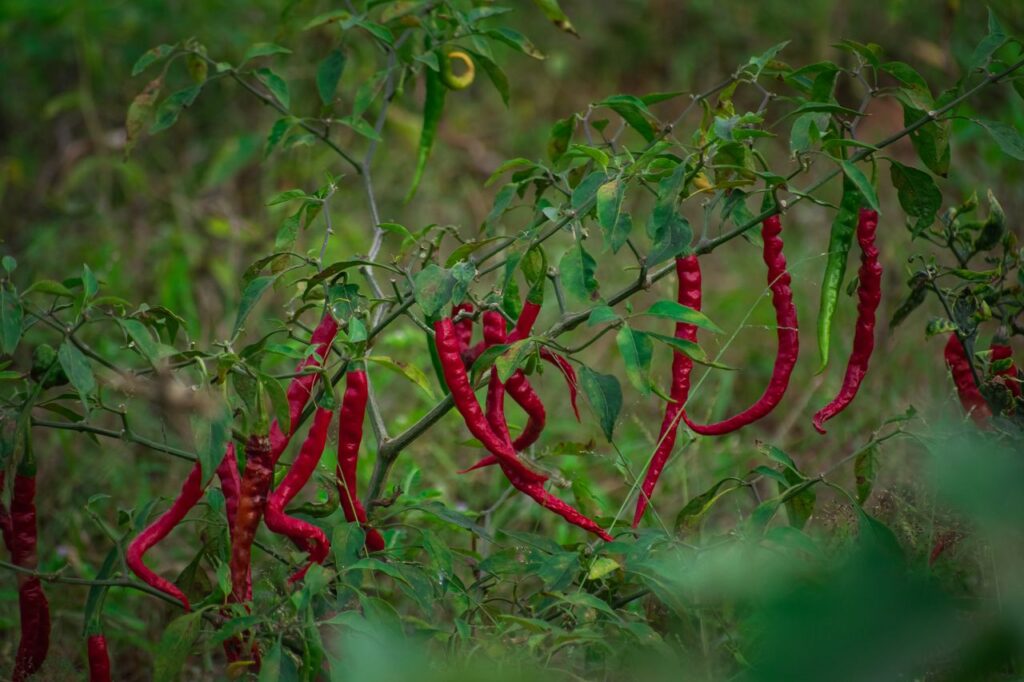
If your chilli plant looks green, vigorous, and healthy but the fruits remain smaller than expected, the first thing to check is whether they are actually supposed to become much larger.
Chilli size is strongly influenced by variety and genetics.
Some chillies naturally mature at only a few centimetres long, while others produce much larger fruits.
If you are certain the variety should produce larger chillies, then small fruit can also result from heavy fruit load, insufficient sunlight, limited root space, inconsistent watering, unsuitable nutrition, environmental stress, or a combination of several factors.
The important thing is not to assume that small chillies automatically mean the plant needs more fertiliser.
Start with the Variety
Before changing anything, identify what you are growing.
Different chilli varieties have dramatically different mature fruit sizes.
A small bird’s eye-type chilli should not be compared with a long cayenne-style chilli or a large fresh-market chilli.
Even plants commonly sold simply as “cili padi” or “cili merah” may vary depending on seed source and variety.
Check:
the seed packet,
nursery label,
original product listing,
or previous fruits from the same variety.
If every fruit reaches roughly the same small size and ripens normally, genetics may simply be the explanation.
A Healthy-Looking Plant Can Still Be Underproducing
Green leaves do not always mean every growing condition is perfect.
A plant can maintain attractive foliage while receiving less energy, water, root space, or nutrition than it needs to produce large fruits.
Vegetative health and fruit productivity are related, but they are not identical.
This is why gardeners sometimes become confused when a lush chilli plant gives small harvests.
Look beyond leaf colour.
Too Many Fruits Can Reduce Individual Fruit Size
A chilli plant has a limited amount of energy.
If it is carrying a very large number of fruits at once, those fruits must share the carbohydrates, water, and nutrients produced or absorbed by the plant.
In some situations, a heavy fruit load can lead to smaller individual fruits.
This is not necessarily a bad thing.
A plant producing many small-to-medium chillies may still give a larger total harvest than one producing only a few big fruits.
The useful question is whether you care more about:
individual fruit size,
or total harvest weight.
Young Plants Can Produce Small Early Fruits
A young chilli plant may begin flowering before it has developed a large canopy and root system.
If early fruits set successfully, the plant may not yet have the resources to produce its best-sized fruit.
Later harvests can improve as the plant:
develops more leaves,
builds a stronger root system,
and becomes more established.
Do not judge the long-term performance of a chilli variety solely from its first few fruits.
Sunlight Has a Major Role
Chilli plants need sufficient light to produce the energy required for fruit development.
A chilli grown in marginal light may stay green and survive quite comfortably.
It may even flower.
But fruit size and total yield can still suffer.
This is common in Malaysian urban gardens where plants may receive shade from:
neighbouring houses,
walls,
roof overhangs,
balconies,
trees,
or larger plants.
Observe the actual direct sunlight reaching the chilli rather than assuming an outdoor position automatically provides enough light.
Watch for Increasing Shade as the Garden Grows
A spot that received excellent sun when you planted the chilli may become shaded later.
Nearby cucumber vines may climb over the area.
A brinjal may become large.
Trees may put out new growth.
Even the chilli plant itself can become very dense.
If fruit size begins declining later in the crop cycle, check whether the light environment has changed.
Root Space Can Limit Fruit Production
A chilli plant growing in an undersized pot can look surprisingly healthy above ground while the roots become crowded below.
Limited root volume affects the plant’s ability to access:
water,
nutrients,
and physical growing space.
This becomes increasingly important as the plant grows larger and begins carrying more fruit.
If a chilli has been sitting in the same small nursery pot for months, it may need more root space.
How Do You Know If the Pot Is Too Small?
Possible clues include:
soil drying extremely quickly,
roots circling densely inside the container,
roots emerging heavily from drainage holes,
frequent wilting,
and growth slowing despite otherwise reasonable care.
Do not repot purely because one chilli fruit is small.
Look at the entire root-zone situation.
Inconsistent Watering Can Restrict Fruit Growth
Developing fruits require a reliable water supply.
If the soil repeatedly becomes extremely dry, the plant may struggle to maintain steady fruit expansion.
This is especially common in Malaysian container gardens.
A pot may be moist early in the morning and severely dry by late afternoon during hot weather.
Repeated drought stress can reduce fruit development even if the leaves recover after watering.
Aim for reasonably consistent root-zone moisture.
More Water Is Not Automatically Better
Do not respond by keeping the pot permanently soaked.
Waterlogged roots receive less oxygen and function poorly.
A chilli plant with unhealthy roots will eventually struggle regardless of how green the leaves looked initially.
Use a growing medium that holds useful moisture while allowing excess water to drain.
During Malaysia’s rainy periods, reduce irrigation when nature is already doing the watering.
Heat Can Affect Fruiting
Chillies generally cope well with warm tropical conditions, but extreme heat still creates stress.
Plants growing near:
west-facing concrete walls,
metal fencing,
rooftops,
or paved areas
may experience much harsher heat than the weather forecast suggests.
Severe heat can interfere with:
flowering,
fruit set,
water balance,
and fruit development.
If fruit remains small during an especially hot period, look at the plant’s microclimate as well as fertiliser.
Nutrition Matters — But Diagnose Before Feeding More
Chilli plants need balanced nutrition to grow leaves, roots, flowers, and fruits.
But “small chillies” is not a specific nutrient-deficiency diagnosis.
A gardener may see small fruits and immediately add:
more potassium,
more phosphorus,
calcium,
magnesium,
or another supplement.
That can create unnecessary nutrient imbalance.
Look for broader symptoms and review what fertiliser has already been applied.
Follow appropriate product rates rather than repeatedly increasing fertiliser because the fruit is disappointing.
Too Much Nitrogen Can Work Against Fruiting
A chilli plant receiving excessive nitrogen may become extremely leafy.
You may notice:
large dark-green leaves,
rapid soft growth,
many branches,
but relatively weak fruit production.
Nitrogen is essential.
The problem is excessive nitrogen relative to the plant’s overall needs.
Once flowering and fruiting are underway, a balanced feeding programme is more useful than continuously pushing leafy growth.
Potassium Is Important, But It Is Not a Magic Fruit Enlarger
Potassium plays important roles in plant water regulation and fruit development.
A serious potassium deficiency can affect crop performance.
But that does not mean adding high-potassium fertiliser will automatically turn small chillies into large ones.
If the variety is naturally small, potassium will not change its genetics.
If poor sunlight is the problem, fertiliser cannot replace light.
If roots are confined, extra feeding may make matters worse.
Treat the cause, not the appearance alone.
Soil Fertility Can Decline Over Time
Container-grown chillies may remain in the same pot for many months.
During that time:
nutrients are taken up,
organic material decomposes,
fertiliser salts can accumulate,
and the growing medium can become physically degraded.
An older productive chilli may therefore need more thoughtful soil and nutrient management than a young plant.
This does not mean replacing all the soil while the plant is actively growing.
It means recognising that long-term container crops need ongoing management.
Heavy Rain Can Leach Nutrients
Malaysia’s intense rainfall can wash soluble nutrients through containers and raised beds.
This is particularly relevant for pots exposed directly to repeated heavy rain.
A plant may look reasonably healthy yet experience fluctuations in nutrient availability.
Use an appropriate fertiliser programme and observe plant response rather than feeding heavily immediately after every storm.
Poor Pollination Usually Causes Different Problems
Chillies have flowers containing both male and female reproductive structures and are generally capable of self-pollination.
Poor pollination can reduce fruit set and may sometimes contribute to abnormal development.
But if your chillies are consistently well-shaped, simply smaller than expected, pollination is usually not the first explanation to investigate.
Look first at:
variety,
fruit load,
light,
water,
root space,
and plant nutrition.
Pests Can Reduce Plant Resources
A chilli plant under persistent pest attack may have less energy available for fruit production.
Look for:
thrips,
mites,
aphids,
whiteflies,
scale,
or other pests.
Check especially:
young leaves,
growing tips,
flower buds,
and leaf undersides.
A plant may still look broadly green while small pests are reducing its performance.
Do not spray automatically.
Identify the pest first and use an appropriate management approach.
Thrips Deserve Particular Attention Around Flowers
Thrips can feed on chilli flowers and young developing tissues.
Depending on the severity of infestation, they may contribute to:
poor fruit set,
scarring,
distortion,
and weaker growth.
If small chillies are also badly scarred or misshapen, inspect flowers and new growth carefully.
Fruit size alone, however, is not enough to diagnose thrips.
Disease Can Affect Fruit Size Indirectly
Some plant diseases reduce overall plant vigour and productivity.
If the chilli plant has:
distorted new growth,
mottled leaves,
unusual yellowing,
stunting,
or persistent dieback,
small fruit may be part of a larger problem.
A plant that truly looks healthy with normal foliage and vigorous growth is less likely to have a severe disease causing the fruit size issue.
Saved Hybrid Seeds Can Produce Unexpected Fruits
If you saved seed from an F1 hybrid chilli and planted the next generation, the offspring may not produce identical fruits.
The plants can vary in:
fruit size,
shape,
colour,
heat level,
and growth habit.
This happens because genetic traits can segregate in the next generation.
So if last year’s chilli was large but this year’s seed-grown descendants are smaller, genetics may be involved.
This does not necessarily mean anything is wrong with the plant.
Harvest Timing Can Cause Confusion
Some gardeners harvest chillies extremely early and then assume the fruits are not getting bigger.
Fruit size usually increases before full ripening.
Allow the chilli enough time to reach the expected mature size.
However, once it has reached its genetically determined mature size, leaving it on the plant longer mainly changes:
colour,
ripeness,
and flavour development,
rather than dramatically increasing size.
Know what mature fruit should look like for your variety.
Compare Fruits Over Several Harvests
Do not make major changes based on one fruit.
Record the next ten or twenty.
Ask:
Are all of them small?
Are later fruits larger than the first ones?
Did size decline when the plant became heavily loaded?
Did fruits become smaller during hotter weather?
Did size improve after moving the plant into stronger sunlight?
Patterns are far more useful than individual observations.
Measure Instead of Guessing
If you want to improve your chilli crop seriously, record average fruit size.
For example:
Harvest 1: average 5 cm
Harvest 2: average 7 cm
Harvest 3: average 8 cm
Or weigh a typical group of ten chillies.
This gives you objective information.
A fruit can look small simply because you are comparing it with a supermarket variety that may be genetically very different.
Should You Remove Some Fruits to Make the Rest Bigger?
For an ordinary healthy home chilli plant, routine fruit thinning is usually unnecessary.
If a very young or severely stressed plant is carrying a heavy early fruit load, removing some fruit may allow the plant to focus resources elsewhere.
But do not turn thinning into a standard rule for every chilli.
For most home gardeners, improving the plant’s overall growing conditions is more useful.
Check the Plant in This Order
If your chillies remain small, ask:
1. Is this actually a small-fruited variety?
2. Is the plant still young?
3. Is it carrying a very heavy fruit load?
4. Does it receive sufficient sunlight?
5. Is the container large enough?
6. Is watering reasonably consistent?
7. Is the soil well drained?
8. Has fertilisation been balanced rather than excessive?
9. Are pests or disease present?
10. Was the plant grown from saved hybrid seed?
That sequence can prevent a lot of unnecessary fertiliser use.
Focus on the Next Flush of Fruit
Once a chilli is nearly mature, you cannot dramatically increase its final size.
Instead, improve conditions for the next flowers and developing fruits.
Make sure the plant has:
adequate light,
healthy roots,
consistent moisture,
appropriate nutrition,
manageable fruit load,
and good pest control.
Then compare the next harvest.
Bigger Is Not Always Better
A large chilli is not automatically a more successful harvest.
Some small-fruited varieties are:
extremely productive,
strongly flavoured,
well suited to Malaysian cooking,
and capable of producing many fruits over a long period.
Your real measure of success might be:
total harvest weight,
number of usable fruits,
flavour,
plant longevity,
or how often your household actually uses the chillies.
A productive small-fruited chilli plant may be more valuable than a large-fruited variety that struggles in your garden.
At the end of the day, chillies can stay small even when the plant looks healthy because fruit size depends on much more than leaf colour. Variety genetics, plant age, fruit load, sunlight, root space, water consistency, nutrition, heat, pests, and even the seed source can all influence the harvest. Start by confirming what size your chilli is actually supposed to reach, then improve the growing environment rather than trying to force larger fruits with extra fertiliser. A healthy Malaysian chilli plant does not need to produce the biggest fruit — it needs to produce a reliable harvest that suits the variety and your kitchen.
Growing a chilli plant that looks fantastic but keeps giving you surprisingly small fruits? Tag @projectharvest.my on Instagram and show us the plant, pot size, fruit, and variety if you know it. We would love to see how Malaysian gardeners compare different chilli varieties and work out whether those small fruits are a problem — or simply exactly what the plant was meant to produce.