
You started a compost pile expecting dark, crumbly compost, but months later you can still recognise the dry leaves, vegetable scraps, and garden trimmings you added. Does that mean your compost has failed?
Usually, no.
Composting depends on microorganisms breaking organic material down, and those organisms need the right combination of moisture, oxygen, suitable materials, and time. If one of those conditions is missing, decomposition can slow dramatically.
Malaysia’s warm climate generally favours composting, but tropical heat and heavy rain can create their own problems. The key is to work out what your pile is missing rather than throwing more random ingredients into it.
Your Compost May Be Too Dry
A dry compost pile is one of the most common reasons decomposition slows down.
Microorganisms need moisture to function. If your pile feels dusty, crispy, and unchanged, there may simply not be enough water.
This can happen surprisingly quickly in a compost bin exposed to Malaysian afternoon heat, especially when the pile contains large amounts of dry leaves, cardboard, or woody material.
Take a handful from inside the pile.
Ideally, the material should feel damp like a wrung-out sponge — moist but not dripping.
If it is very dry, add water gradually while turning or mixing the pile so moisture reaches more than just the surface.
Do not flood it all at once.
Or It May Be Too Wet
The opposite problem can slow composting too.
A pile saturated by repeated Malaysian downpours may have plenty of moisture but not enough oxygen.
Water fills the air spaces between materials, creating anaerobic conditions. Instead of healthy aerobic decomposition, the pile may become slimy and start smelling rotten.
If your compost is soggy, mix in dry carbon-rich materials such as shredded cardboard, dry leaves, or small dry plant pieces.
Turn the pile gently to restore airflow and protect it from excessive rain with a lid or simple shelter.
A compost pile needs moisture — not a swimming pool.
You Have Too Many “Browns”
Composting works best with a mixture of materials often called greens and browns.
Greens are generally nitrogen-rich materials such as fresh grass clippings, vegetable scraps, coffee grounds, and soft green plant growth.
Browns are generally carbon-rich materials such as dry leaves, cardboard, paper, and woody garden waste.
If your pile is mostly dry brown leaves and cardboard, it may decompose very slowly because microorganisms do not have enough readily available nitrogen to multiply rapidly.
Add modest amounts of fresh green material and mix it through the pile.
Do not worry about achieving a perfect laboratory ratio at home. Aim for variety and observe how the pile responds.
You May Have Too Many Greens
Adding more nitrogen is not always the answer either.
A pile dominated by wet grass, kitchen scraps, and soft green material can become dense, wet, and oxygen-starved.
This often produces strong unpleasant smells.
Mixing in dry leaves, shredded cardboard, or other bulky brown material creates more structure and helps air move through the pile.
A healthy compost pile needs balance.
The Pieces Are Too Large
A whole branch takes much longer to decompose than a pile of small wood chips.
The same principle applies to kitchen scraps and garden material.
Microorganisms work on the surface of organic material. Breaking larger pieces into smaller ones gives them more surface area to work on.
Chop thick plant stems.
Tear cardboard.
Cut large fruit and vegetable scraps into smaller pieces.
You do not need to turn everything into powder. Simply reducing very large materials can noticeably speed things up.
Woody branches and thick stems will naturally take longer than soft leafy material, even under good conditions.
The Pile May Be Too Small to Heat Up
If you are trying to hot compost, size matters.
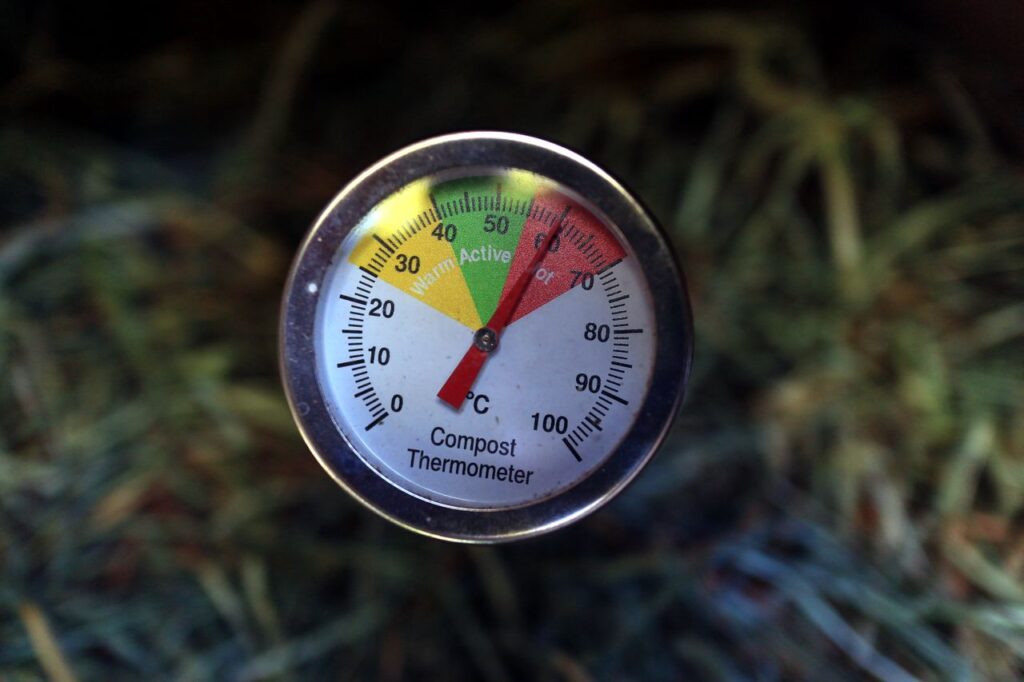
A very small pile loses heat rapidly to the surroundings and may never reach the temperatures associated with active hot composting.
That does not mean decomposition stops completely.
It simply becomes cold composting, which takes much longer.
If you only produce small amounts of organic material, accepting a slower system may actually be easier than continually trying to force a tiny pile to become hot.
Alternatively, collect enough materials first and build a larger pile at once.
Your Compost Needs More Air
Microorganisms involved in normal aerobic composting need oxygen.
Over time, materials can settle and compact, particularly when the pile contains wet grass clippings or lots of soft food waste.
Turning the pile with a garden fork helps bring oxygen back into the centre and redistributes wet and dry materials.
You do not need to turn a cold compost pile every few days.
But if decomposition has stalled completely, a good mix can reveal whether the centre is too wet, too dry, or simply compacted.
After turning, the pile may become noticeably more active.
You Keep Adding New Material
Sometimes the compost actually is breaking down — you just keep adding fresh ingredients to it.
If new vegetable scraps, leaves, and garden waste go into the same container every week, the pile will always contain recognisable material at different stages of decomposition.
One practical solution is to use two bins.
Fill the first bin and then stop adding material to it while it finishes decomposing.
Start adding new waste to the second bin.
This makes it much easier to eventually harvest a batch of finished compost rather than maintaining one container that is permanently half-finished.
Woody Material Simply Needs More Time
Not everything decomposes at the same speed.
Soft vegetable scraps can disappear relatively quickly.
Dry leaves take longer.
Wood chips, coconut husk, twigs, thick stems, and other woody materials can take much longer again.
If most of your pile is coarse woody material, slow decomposition may be completely normal.
You can remove large pieces when screening finished compost and return them to the next pile.
They will continue breaking down.
You May Be Expecting Results Too Quickly
Social media sometimes makes composting look like a process where kitchen scraps turn into perfect black soil within a few days.
Real composting is usually slower.
Even a well-managed hot pile needs time after its active heating stage to finish decomposing and mature.
Cold composting can take many months.
Malaysia’s warmth helps microbial activity, but temperature alone cannot compensate for poor moisture, inadequate airflow, or difficult materials.
Good compost is a biological process, not an instant recipe.
Be Careful with Too Much Citrus, Oil, or Cooked Food
A small amount of many kitchen scraps is manageable, but an ordinary home compost pile should not become a dumping ground for everything from the kitchen.
Large quantities of oily food, dairy, meat, fish, sauces, and heavily cooked leftovers can create smells and attract rodents, flies, cockroaches, or other pests.
If you need to process a broader range of food waste, a system such as bokashi may be more appropriate.
For conventional compost, stick mainly to suitable plant-based kitchen scraps combined with plenty of garden browns.
Check the Centre, Not Just the Surface
The top few centimetres of a compost pile can be misleading.
The surface may look completely dry while the centre is wet and decomposing actively.
Before deciding that nothing is happening, use a garden fork to inspect deeper material.
You may discover that the middle has already turned dark and crumbly while the outer layers still resemble dry leaves.
Mixing the pile can move those outer materials inward so they decompose more efficiently.
A Simple Compost Reset
If your compost has barely changed for months, you can usually restart it without throwing everything away.
Turn the pile thoroughly.
Break up very large materials.
If it is dry, add water.
If it is wet, add dry browns.
If it contains mostly browns, add some greens.
If it contains mostly wet greens, add dry carbon-rich material.
Then cover it from excessive Malaysian rain while allowing enough airflow.
Give the microorganisms better conditions and let them continue the work.
At the end of the day, slow compost usually does not mean failed compost. It means the conditions are not yet ideal — or that the materials simply need more time. Check moisture first, then look at your mix of greens and browns, airflow, pile size, and ingredient size. Make one or two sensible adjustments instead of adding everything at once. Once the balance improves, that pile of recognisable garden waste can gradually become the dark, earthy compost your plants can actually use.
Got a compost pile that seems to have been sitting there forever? Tag @projectharvest.my on Instagram and show us what is inside, how wet or dry it is, what materials you have been adding, or how it changes after your compost reset. Your slow pile might turn into a useful troubleshooting example for another Malaysian gardener wondering why theirs refuses to disappear.