
Every day, Malaysian households send litres of relatively lightly used water down the drain from showers, bathroom sinks, and washing machines. It is understandable to wonder whether some of that water could be redirected to the garden instead.
In some situations, yes.
This type of reusable household wastewater is commonly known as greywater. When selected carefully and used appropriately, greywater can reduce the amount of treated mains water needed for landscape irrigation.
However, not every drain in your house produces water that belongs in the garden.
Water contaminated with toilet waste, food residues, strong cleaning chemicals, oils, or potentially harmful microorganisms should be treated very differently.
The safest approach begins by understanding where the water came from before deciding where it can go.
What Is Greywater?
Greywater generally refers to wastewater from relatively low-contamination household activities such as:
showers,
baths,
bathroom hand basins,
and some washing-machine water.
It does not include toilet wastewater, commonly called blackwater.
For practical home reuse, water from kitchen sinks and dishwashers should also be treated much more cautiously because it can contain grease, food particles, microorganisms, cleaning chemicals, and other contaminants.
That means the water from yesterday’s shower and the water from washing a greasy frying pan should not automatically be treated as the same resource.
Which Household Water Is the Easiest to Reuse?
For a Malaysian home gardener interested in experimenting with greywater, relatively clean shower, bath, or appropriate laundry rinse water is generally a more sensible starting point than kitchen wastewater.
Even then, what went into the water matters.
Shampoo, soap, detergent, bleach, fabric softener, disinfectant, hair products, and household cleaners can all change its chemistry.
If you plan to use greywater regularly, your choice of household products becomes part of your gardening system.
Avoid Water Containing Bleach or Harsh Cleaners
Do not direct water containing strong bleach, disinfectants, solvents, paint residue, automotive chemicals, or other harsh household products into the garden.
These substances may damage plants, disrupt soil organisms, or create longer-term soil problems.
If a particular laundry load contains bleach or heavily soiled material, send that water through the normal wastewater system.
A greywater setup should ideally have a way to divert unsuitable water away from the garden when necessary.
Reusing water does not mean every washing cycle must be recycled.
Watch Out for Sodium and Boron
Laundry and cleaning products can contain ingredients that plants and soil do not appreciate in repeated doses.
Two particularly important ones are sodium and boron.
Repeated sodium accumulation can damage soil structure and interfere with plant water uptake.
Boron is an essential micronutrient in tiny amounts but becomes toxic to plants when concentrations become excessive.
If household greywater will be used regularly, look for products intended to be compatible with greywater systems and low in sodium and boron.
Do not assume that a product labelled “natural” or “eco-friendly” is automatically suitable.
Check the ingredients where possible.
Should You Use Greywater on Vegetables?
This is where caution becomes much more important.
Untreated household greywater can contain bacteria and viruses even when the water does not look dirty.
Because of this, avoid allowing untreated greywater to contact the edible parts of vegetables, particularly crops eaten raw.
Leafy greens such as lettuce-type vegetables and herbs eaten fresh deserve particular caution because the harvest itself is close to where irrigation water lands.
Root vegetables are another poor candidate because the edible portion develops directly within the irrigated soil.
For a simple home system, ornamental plants, shade trees, and suitable established fruit trees generally provide lower-risk uses than raw-eaten vegetables.
What About Chillies, Brinjal, or Fruit Trees?
If greywater is used around food-producing plants, apply it to the soil, not the crop.
For example, water directed below a fruit tree canopy without touching the fruit creates a very different exposure situation from spraying untreated greywater over lettuce leaves.
Likewise, established chillies or brinjal produce their edible portions above the soil.
Even so, minimise contact between untreated greywater and anything you plan to eat.
A subsurface or soil-level irrigation method is preferable to overhead spraying.
When in doubt, reserve cleaner sources such as rainwater, AC condensate from a well-maintained system, or mains water for your edible crops and use household greywater on ornamentals instead.
Never Use Toilet Wastewater
Water from toilets should never be treated as ordinary garden greywater.
It can contain human faecal material and disease-causing organisms and requires appropriate wastewater treatment.
The same caution applies to laundry water used for washing nappies or heavily contaminated clothing.
Do not attempt to create a DIY garden irrigation system using this type of water.
Water conservation should never come at the expense of sanitation.
Do Not Spray Greywater
Avoid connecting untreated household greywater to a sprinkler.
Spraying creates tiny droplets that can contact leaves, fruit, people, pets, garden furniture, and neighbouring areas.
Instead, deliver the water directly to the soil.
Subsurface distribution, mulch basins, or appropriately designed low-level irrigation systems are better approaches.
The aim is to keep greywater below or close to the soil surface where plants can use the moisture while reducing unnecessary human contact.
Do Not Let Greywater Pool
Greywater should soak into the soil rather than form puddles.
If water collects on the surface, you may be applying it faster than the soil can absorb it.
Pooling creates several problems.
It increases human and animal exposure.
It can produce unpleasant smells.
And in Malaysia, any persistent standing water deserves attention because of mosquitoes.
Reduce the amount being applied, spread the water over a larger area, or improve the distribution system.
Greywater irrigation should never leave stagnant pools around the garden.
Use Greywater Quickly Rather Than Storing It
Unlike properly harvested rainwater, untreated greywater contains organic material and microorganisms.
Storing it for long periods can allow microbial populations to increase and the water to develop unpleasant odours.
For simple household reuse, it is usually better to direct greywater into the garden shortly after it is produced rather than collecting large amounts in a tank for later.
If you want a permanent storage-and-treatment system, that becomes a more sophisticated water-reuse project requiring proper design and treatment rather than a simple garden hack.
Does Greywater Contain Nutrients?
Sometimes.
Laundry or washing water may contain nitrogen, phosphorus, or other substances that can influence soil fertility.
But that does not make greywater a predictable fertiliser.
Its composition changes every time you shower, wash clothes, or change cleaning products.
You should therefore never calculate your plant-feeding programme around untreated household water as though it were a standard fertiliser.
If anything, regular greywater use makes monitoring your soil more important.
Alternate Greywater with Fresh Water
If you use greywater regularly, occasionally irrigating deeply with fresh water can help move accumulated soluble salts through the soil where drainage is adequate.
Malaysia’s rainfall may naturally provide some of this flushing during wet periods.
However, do not rely on heavy rain to solve every long-term soil problem.
Watch how plants respond.
If leaf tips begin burning, growth declines, or soil develops unusual crusting, investigate the water source as well as fertiliser and drainage.
Some Plants Are More Sensitive Than Others
Not every plant will tolerate greywater equally well.
Plants sensitive to salinity may struggle if the water contains repeated doses of sodium and other salts.
Container plants deserve additional caution because salts accumulate more easily within a small, confined root zone.
Garden beds with good drainage and larger soil volumes have more capacity to buffer changing water quality.
For this reason, directing untreated laundry greywater into a small herb pot every day may be far less sensible than distributing it around several established ornamental shrubs.
Malaysia’s Heavy Rain Changes Greywater Use Too
During wet weeks, your garden may already have more than enough water.
Do not continue directing household water into saturated soil simply because you have installed a greywater system.
Roots still need oxygen.
If the garden is waterlogged after repeated thunderstorms, divert greywater back into the normal wastewater system until the soil dries sufficiently.
A good system should always allow you to decide not to reuse the water.
Keep Greywater Away from Children and Pets
Because untreated greywater can contain microorganisms and household chemicals, design the system so children and pets do not have direct access to stored or pooling wastewater.
Ideally, the water should disappear into soil shortly after application.
Avoid open buckets, uncovered channels, or shallow pools.
Good greywater design should make the reused water almost invisible once it reaches the garden.
What About Kitchen Sink Water?
For Project HARVEST’s home-gardening approach, we would generally avoid untreated kitchen sink water for routine irrigation.
Kitchen wastewater can contain:
food particles,
grease,
cooking oil,
detergent,
salt,
and microorganisms associated with raw food.
It can also clog simple irrigation systems and attract pests.
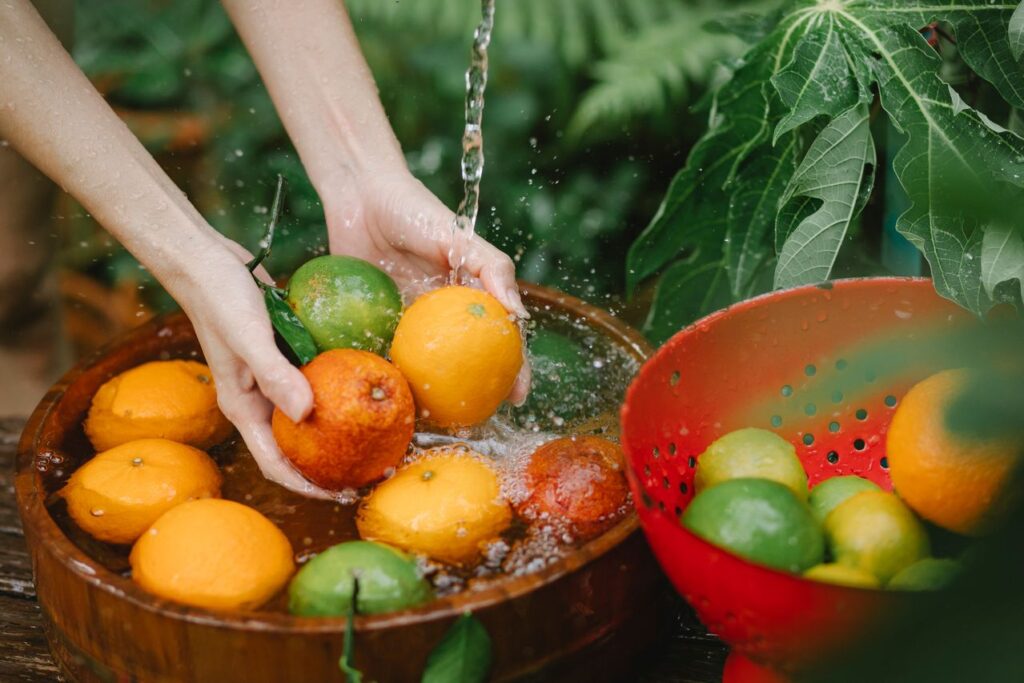
Using a bucket of vegetable-rinsing water that contains no soap is different from redirecting everything that leaves the kitchen sink.
Clean water used only to rinse fruits or vegetables can often simply be carried outside and used promptly on suitable plants.
Once grease, detergent, meat residue, or other contaminants become involved, send it down the normal wastewater route.
A Simple Household Water Hierarchy
If you want to reduce mains-water use in your Malaysian garden, think of available water sources in levels.
First choice: harvested rainwater.
Another useful option: clean AC condensate used appropriately.
Then: carefully selected greywater from suitable household activities.
Avoid: kitchen wastewater contaminated with food, grease, or detergent.
Never use untreated: toilet wastewater or water contaminated with hazardous chemicals.
You do not need to reuse the riskiest water source simply because it exists.
Often there are easier alternatives.
What About a Permanent Greywater System?
If you want to permanently reroute shower or washing-machine plumbing into your landscape, this moves beyond carrying a bucket of suitable rinse water outside.
Plumbing, drainage, treatment, public-health requirements, building requirements, and local authority rules may apply.
Malaysia has explored and developed guidance around greywater management and reuse, including landscaping applications, but permanent systems should be designed around applicable local requirements rather than improvised plumbing.
For a homeowner, consulting a qualified plumber or appropriately experienced water-reuse professional is sensible before changing household drainage.
Start Small Before Building Anything Complicated
You do not need to redesign your plumbing to experiment with household water reuse.
Start with a very simple example.
Perhaps you have a basin of clean water left after rinsing vegetables.
Use it on an ornamental plant instead of pouring it down the sink.
Or collect suitable rinse water and use it immediately around a mature landscape plant.
Observe how much water your household realistically produces and whether reusing it is actually convenient.
If it becomes part of your routine, then you can investigate a more structured system.
Is Household Water Reuse Worth It in Malaysia?
For some homes, yes.
It can reduce treated-water consumption and make better use of a resource that would otherwise enter the wastewater system.
But greywater should sit below rainwater harvesting and other cleaner alternative sources in terms of simplicity.
It requires more thought because whatever you put down your shower or laundry drain can eventually reach the garden soil.
The safest approach is selective rather than enthusiastic.
Use suitable water.
Use plant-friendly products.
Keep it away from edible plant parts.
Apply it at soil level.
Do not store it unnecessarily.
And divert unsuitable water away from the garden.
At the end of the day, household water can sometimes be reused safely in a Malaysian garden, but the question should never simply be, “Can I save this water?” Ask instead, “What is in this water, where will it go, and could it affect the plant, soil, food, people, or pets around it?” When those questions have good answers, carefully managed greywater can become another useful part of a water-efficient garden. When they do not, sending the water through the proper wastewater system is the smarter choice.
Have you experimented with reusing rinse water or greywater around your home garden? Tag @projectharvest.my on Instagram and share your water-saving setup, what types of household water you reuse, which plants receive it, or what you learned along the way. Thoughtful experiments from Malaysian gardeners can help the community conserve water without forgetting that safe reuse matters just as much as reuse itself.