
Yes.
Home gardeners can grow parthenocarpic vegetable varieties, and they can be particularly useful in balconies, protected growing areas, small urban gardens, and other places where natural pollination is unreliable.
Parthenocarpy means a plant can develop fruit without fertilisation taking place.
In practical terms, that means some varieties can produce usable fruit even when pollen does not successfully fertilise the flower.
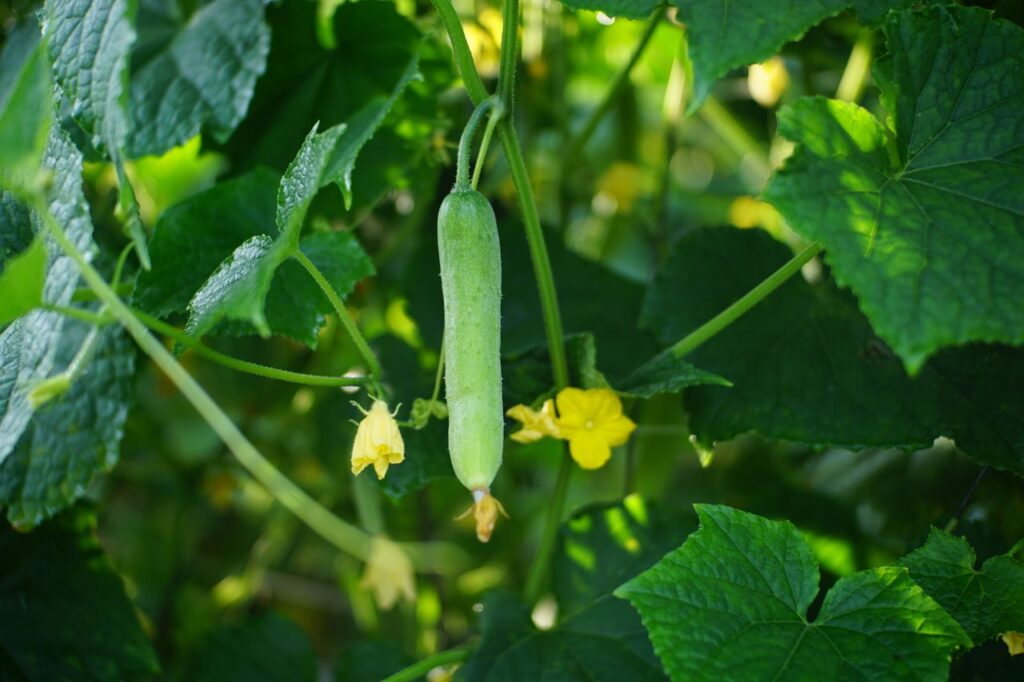
Parthenocarpic cucumbers are probably the example most home gardeners are likely to encounter.
But before buying seeds simply because they say “parthenocarpic,” it helps to understand what the term actually means and what it does — and does not — change about growing the plant.
Parthenocarpic Does Not Mean Self-Pollinating
These terms are often confused.
A self-pollinating plant still uses pollen and fertilisation.
A parthenocarpic plant can form fruit without fertilisation.
That is an important difference.
Tomatoes, chillies, and brinjal are generally capable of self-pollination because their flowers contain both male and female reproductive structures.
A parthenocarpic cucumber variety, on the other hand, may develop cucumbers even without successful pollen transfer.
Parthenocarpic Fruit Is Often Seedless
Because fertilisation does not occur, parthenocarpic fruit is often seedless or contains only poorly developed seeds.
This is one reason the trait is useful commercially.
Seedless cucumbers, for example, can have a desirable eating texture.
However, “parthenocarpic” and “seedless” should not be treated as completely interchangeable terms in every crop.
The key horticultural trait is fruit development without fertilisation.
Cucumbers Are the Most Familiar Example
Parthenocarpic cucumbers are widely associated with greenhouse and protected cultivation.
Many modern varieties have been selected to produce a high proportion of female flowers and develop fruit without pollination.
This makes them particularly useful where bees and other pollinators have limited access.
For a Malaysian home gardener growing cucumber on:
an apartment balcony,
a covered porch,
a sheltered terrace-house side area,
or another semi-protected space,
this can be very convenient.
You Can Grow Them Outdoors Too
Parthenocarpic does not mean the plant must be grown indoors or in a greenhouse.
You can grow suitable varieties outdoors.
The trait simply means the fruit does not require fertilisation to begin developing.
The plant still needs the same fundamentals as any productive vegetable crop:
adequate sunlight,
healthy roots,
sufficient water,
appropriate nutrition,
good airflow,
and pest and disease management.
Pollination may become less important, but good gardening does not.
Check the Seed Packet Carefully
Do not assume every cucumber is parthenocarpic.
Some traditional and open-pollinated cucumber varieties still depend on successful pollination for normal fruit development.
When buying seed, look for wording such as:
parthenocarpic
or
fruit sets without pollination.
Some seed descriptions may also indicate that the variety is particularly suited to protected cultivation.
The variety information matters more than the general crop name.
Why Are Parthenocarpic Varieties Useful for Small Gardens?
One of their biggest advantages is reliability.
Imagine growing only one cucumber vine on a high-rise balcony.
You may have:
few bee visits,
heavy rain interrupting pollinator activity,
or male and female flowers that do not open at convenient times.
With a traditional cucumber, poor pollination may result in female flowers aborting.
With a suitable parthenocarpic variety, fruit development is less dependent on those pollination conditions.
That can make small-space growing easier.
They Can Be Useful During Wet Malaysian Weather
Malaysia’s heavy rain can reduce pollinator activity.
Bees may visit fewer flowers during persistent storms, and flowers may stay wet.
For pollination-dependent cucumbers, this can reduce fruit set.
A parthenocarpic cucumber does not rely on that pollen transfer in the same way.
That does not make it immune to heavy rain.
Waterlogged roots, disease pressure, weak sunlight, and plant stress can still reduce production.
It simply removes one potential bottleneck.
They Can Also Suit Protected Growing Spaces
Some home gardeners grow vegetables under:
clear roofing,
rain shelters,
netted structures,
or covered balconies.
These spaces can protect crops from heavy rain but may also reduce access for pollinating insects.
Parthenocarpic varieties can fit these systems well because fruit production is less dependent on insects entering the growing area.
Do You Need to Hand-Pollinate Parthenocarpic Cucumbers?
Usually, no.
That is one of their main advantages.
If the variety genuinely forms fruit parthenocarpically, routine hand-pollination is unnecessary.
However, always follow the information supplied for the specific variety.
Plant breeding is complex, and not every cultivar behaves exactly the same way.
Can Pollination Actually Be Unhelpful?
With some parthenocarpic cucumber varieties, unwanted pollination can cause seeds to develop and may result in less uniform fruit.
This is one reason certain commercial parthenocarpic cucumbers are grown in protected environments where pollination can be controlled.
For the ordinary home gardener, the practical lesson is:
do not hand-pollinate a parthenocarpic cucumber unless the variety information specifically suggests it.
If it already sets fruit successfully without help, leave it alone.
Parthenocarpic Does Not Mean Every Flower Becomes Fruit
This is another misconception.
A parthenocarpic plant can still abort flowers or young fruit.
Fruit development still requires:
water,
energy,
healthy leaves,
healthy roots,
and suitable growing conditions.
A plant under severe heat stress, drought, waterlogging, pest pressure, or disease may still fail to carry fruit properly.
Parthenocarpy removes the requirement for fertilisation.
It does not remove all the other requirements for successful fruiting.
Sunlight Still Matters
A parthenocarpic cucumber on a balcony with very poor light may still produce badly.
The plant needs enough light to generate energy through photosynthesis.
Fruit growth is expensive for the plant.
A low-light vine may:
grow weakly,
produce smaller leaves,
carry fewer fruits,
or decline early.
Choose the brightest suitable location available.
Malaysia’s Heat Can Still Be Challenging
Protected spaces can become very hot.
A covered balcony or greenhouse may trap heat, especially during sunny afternoons.
Even tropical vegetables have limits.
Make sure there is:
good airflow,
appropriate watering,
and enough ventilation.
Do not assume a rain shelter automatically creates ideal conditions.
Protection from rain can sometimes increase heat stress if ventilation is poor.
Humidity and Disease Still Matter
Cucumbers are vulnerable to several foliar diseases.
Malaysia’s humidity can create favourable conditions for disease development, especially where plants are packed closely together.
Train vines properly.
Avoid excessive crowding.
Remove badly diseased foliage where appropriate.
Water the root zone rather than repeatedly soaking leaves unnecessarily.
Parthenocarpic genetics do not provide automatic disease resistance.
Look for Disease Resistance Separately
When choosing seed, treat these as separate traits.
A variety may be:
parthenocarpic,
heat tolerant,
and resistant to certain diseases,
but those characteristics are not automatically linked.
Read the full variety description.
For Malaysian growing conditions, disease resistance and heat performance may be just as important as parthenocarpy.
Are There Parthenocarpic Vegetables Other Than Cucumbers?
Yes.
Parthenocarpy occurs naturally or has been bred into several crops.
Depending on variety and breeding programme, parthenocarpic types may exist among crops such as:
tomatoes,
brinjal,
peppers,
squash,
and other vegetables.
However, these are not equally common in the home seed market.
For most Malaysian home gardeners, parthenocarpic cucumber is likely to be the most practical and recognisable example.
Do not assume a normal tomato or brinjal variety is parthenocarpic unless the variety information says so.
Parthenocarpy Can Help When Temperatures Affect Pollination
One reason breeders are interested in parthenocarpy is that environmental stress can make normal fertilisation unreliable.
High or low temperatures can affect:
pollen viability,
pollen release,
and fertilisation.
A parthenocarpic variety may sometimes set fruit under conditions where normal pollination becomes difficult.
That can be valuable in challenging climates.
However, if conditions become too stressful for the whole plant, parthenocarpy cannot rescue it indefinitely.
Will Parthenocarpic Vegetables Produce Seeds You Can Save?
Often, this becomes more complicated.
If fruit develops without fertilisation, viable seed may be absent or limited.
Many modern parthenocarpic vegetables are also hybrid varieties.
Even if seeds are produced, saved seed from an F1 hybrid may not grow true to the parent.
If seed saving is one of your goals, check the breeding type and seed information carefully before choosing the variety.
Parthenocarpic crops are often selected more for reliable fruit production than for home seed saving.
Are They Genetically Modified?
Not necessarily.
Parthenocarpy is a plant trait that can occur naturally or be developed through conventional plant breeding.
The word itself does not mean a crop is genetically modified.
Always check the actual seed or cultivar information if GMO status matters to you.
Do not assume that an unfamiliar plant trait automatically means genetic modification.
Are Parthenocarpic Varieties Better Than Normal Varieties?
Not automatically.
They solve a particular problem.
They can be useful when:
pollination is unreliable,
the crop is grown under cover,
garden space is limited,
or a gardener wants more predictable fruit set.
Traditional pollination-dependent varieties can also perform extremely well outdoors where pollinators are active.
The better choice depends on your garden.
When Might a Traditional Variety Be Better?
If you have:
an open garden,
plenty of pollinating insects,
good fruit set,
and a traditional variety that already performs well,
you may gain little by switching.
You may also prefer varieties selected for:
taste,
local adaptability,
seed saving,
or specific cooking uses.
Parthenocarpy is a useful trait, not automatically the most important one.
Can You Grow Just One Parthenocarpic Cucumber Plant?
Yes, assuming the variety is genuinely capable of fruiting without fertilisation.
You do not need another cucumber plant solely to provide pollen.
This can be very helpful for gardeners with limited balcony or terrace space.
One well-grown vine may be more productive than several overcrowded vines.
Give the Vine a Good Trellis
Whether parthenocarpic or not, cucumber vines benefit from good structural support.
Train the plant vertically where practical.
This helps:
improve airflow,
keep fruits off the ground,
make harvesting easier,
and use small spaces more efficiently.
Install the trellis early instead of waiting until vines become tangled.
Do Not Overload the Plant
Parthenocarpic varieties may set fruit reliably, but the plant still has a finite amount of energy.
If the vine carries many developing cucumbers while suffering from weak roots, poor light, or water stress, some fruits may still abort.
Maintain healthy growth rather than trying to force maximum fruit numbers.
Keep Harvesting Regularly
Once cucumbers begin producing, harvest them at the appropriate stage for the variety.
Regular harvesting prevents fruits from becoming unnecessarily oversized and encourages you to inspect the vine frequently.
Check:
new growth,
young fruit,
pests,
disease,
and soil moisture
while harvesting.
A productive vine rewards regular attention.
Are Parthenocarpic Seeds More Expensive?
They can sometimes cost more than basic traditional seed because many are modern hybrids bred for particular production traits.
Whether that extra cost is worthwhile depends on your situation.
For a gardener who repeatedly loses cucumbers because a balcony receives few pollinator visits, the improved reliability may justify the seed price.
For someone already getting excellent outdoor pollination, the advantage may be smaller.
Try a Side-by-Side Experiment
If you are curious, grow:
one parthenocarpic cucumber variety
and
one conventional variety
under similar conditions.
Record:
flowering,
fruit set,
number of cucumbers,
fruit quality,
pest and disease issues,
and total harvest weight.
This gives you real information about which type performs better in your own Malaysian garden.
A Simple Checklist Before Buying
A parthenocarpic variety may suit you if:
1. You garden on a balcony or in a protected space.
2. Pollinator visits are unreliable.
3. You have struggled with cucumber fruit set before.
4. You want to grow only one or two vines.
5. You prefer not to hand-pollinate repeatedly.
But also check:
6. Is the variety suited to warm conditions?
7. Does it have useful disease resistance?
8. Does the expected fruit suit your kitchen?
9. Do you have enough sunlight and trellis space?
Parthenocarpy should be one selection criterion, not the only one.
A Useful Tool, Not a Magic Plant
Parthenocarpic vegetables can make fruiting easier because they remove one potential failure point: fertilisation.
That can be particularly valuable in urban home gardens.
But the gardener still needs to manage:
soil,
water,
nutrition,
light,
heat,
airflow,
pests,
and disease.
A poorly managed parthenocarpic cucumber will still be a poorly managed cucumber.
At the end of the day, yes, you can absolutely grow parthenocarpic vegetables at home, and parthenocarpic cucumbers can be particularly useful for Malaysian balcony, terrace-house, and protected gardens where pollinator activity is inconsistent. Their ability to form fruit without fertilisation can make production more reliable, but it does not remove the need for good sunlight, healthy roots, consistent watering, airflow, and proper crop care. Choose the variety for your actual growing conditions rather than simply because the word “parthenocarpic” appears on the packet.
Have you spotted parthenocarpic cucumber seeds in Malaysia or tried growing a variety that fruits without hand-pollination? Share your seed packet, growing setup, fruit-set results, or harvest photos and tag @projectharvest.my on Instagram. We would love to compare how these varieties perform in Malaysian balconies, terrace houses, raised beds, and protected home gardens — especially against the conventional cucumbers you may already be growing.