
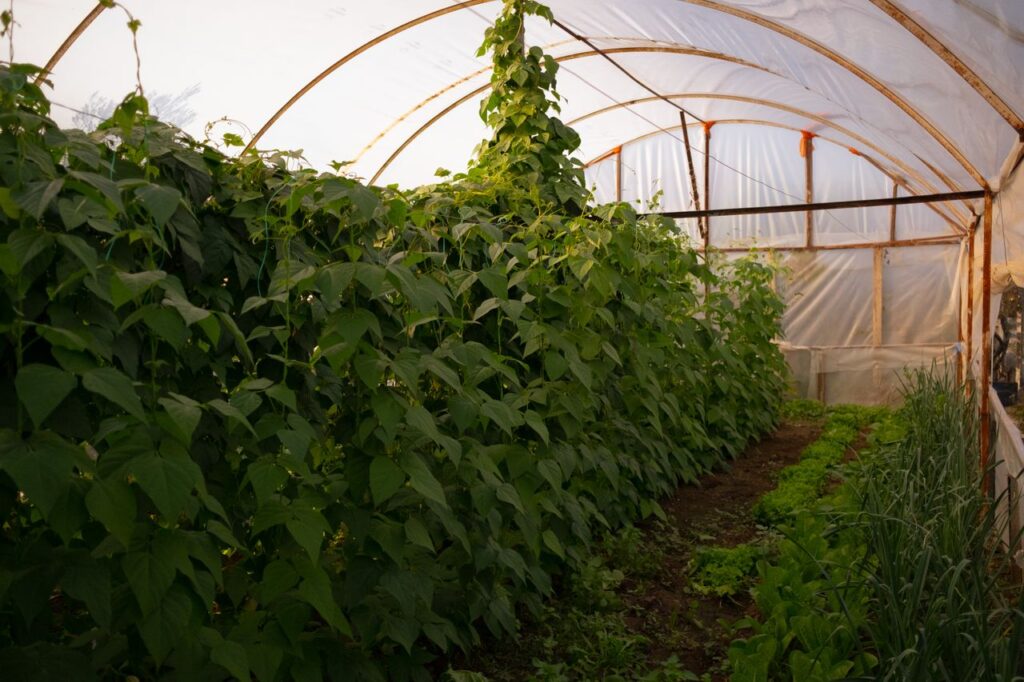
If your entire garden is planted on the same weekend, there is a good chance a large part of it will also become ready around the same time.
For a few days, you may have more sawi, bayam, cucumber, or okra than you can use.
Then the plants finish — and suddenly there is almost nothing to harvest.
The solution is to stop thinking of the garden as one planting event.
A productive edible garden should contain plants at different stages all the time: some newly sown, some developing, some producing heavily, and some approaching the end of their useful life.
That is how you turn occasional harvests into a more continuous supply.
Plant Smaller Batches Instead of the Whole Packet
One of the simplest changes is also one of the most effective.
Do not sow every seed at once.
If your household only eats a few bunches of leafy vegetables each week, there is little benefit in planting enough for twenty bunches to mature together.
Sow a smaller batch.
Then sow another a week or two later.
Then another after that.
This staggered approach works particularly well with quick-growing crops such as:
bayam,
sawi,
kailan,
radish,
lettuce-type greens,
and other short-duration vegetables.
The exact interval depends on how fast the crop grows and how much your household uses.
Start the Next Crop Before the Current One Finishes
A common mistake is waiting until a bed is completely empty before planting again.
By then, the garden may need several more weeks before the next harvest arrives.
Instead, think ahead.
If your current sawi will probably be harvested in two weeks, start the replacement batch now.
If your cucumber vines are still producing but clearly beginning to age, begin the next plants before the old vines collapse.
This creates overlap.
The old crop continues feeding the kitchen while the new crop gets established.
Use a Small Seedling Area as Your Backup Supply
A tray of seedlings can dramatically reduce gaps between harvests.
While one crop occupies the main bed, the next generation can already be germinating elsewhere.
Once the old crop comes out, the replacement plants are ready.
For crops that transplant well, this is much faster than waiting for seeds to germinate in an empty bed.
A small shelf, nursery corner, or sheltered section of a balcony can become your replacement-plant area.
Think of it as the garden’s waiting room.
Mix Fast and Slow Crops
A garden planted entirely with long-term crops can take a long time to produce food.
A garden planted entirely with fast crops can give you a sudden burst of harvest and then become empty.
Mix both.
For example, you might grow:
bayam and sawi for quicker harvests,
okra and cucumber for medium-term production,
and chillies and brinjal for longer-lasting harvests.
This creates different harvest windows.
While chillies are still developing, you can already be eating leafy vegetables.
When the leafy crops finish, the okra may be producing.
Later, the chillies and brinjal take over.
Choose Crops That Keep Producing
Not every vegetable is a one-time harvest.
Some plants can continue producing for weeks or months when harvested correctly.
Examples include:
chillies,
okra,
brinjal,
cucumber,
beans,
basil,
mint,
and some leafy vegetables harvested progressively.
These repeat-producing crops are extremely useful for creating continuity.
You do not need to replace them after every harvest.
Instead, regular picking encourages the plant to keep producing while replacement crops develop elsewhere.
Harvest Regularly
Leaving mature produce on the plant can reduce productivity in some crops.
Okra is a good example.
Pods mature quickly.
If you leave them until they become large and fibrous, the plant begins directing more energy toward seed production.
Regular harvesting keeps you eating tender pods and can help keep the plant productive.
The same principle applies to many beans and cucumbers.
Pick at the appropriate stage instead of waiting for everything to become oversized.
Harvest Herbs in a Way That Encourages Regrowth
Herbs can provide some of the most consistent harvests in a small garden.
Basil, mint, curry leaf, pandan, and other herbs can often be harvested repeatedly when managed properly.
For basil, harvesting above suitable nodes encourages branching.
Mint responds well to regular trimming.
With curry leaf, avoid stripping a young plant so heavily that it cannot recover.
The goal is not simply to take the largest possible harvest today.
It is to leave enough healthy growth for tomorrow.
Use Cut-and-Come-Again Harvesting Where Appropriate
Some leafy crops can be harvested without removing the entire plant.
Instead of cutting everything at soil level, you may take outer leaves or cut the plant in a way that allows fresh growth to continue, depending on the species.
This is sometimes called cut-and-come-again harvesting.
It does not work equally well for every crop.
Some vegetables are better harvested as whole plants.
But where regrowth is reliable, this method can stretch one planting across a longer period.
Grow More Than One Variety
Different varieties of the same crop may mature at different speeds.
If you grow only one variety, many plants may reach harvest at roughly the same time.
Mixing an earlier variety with a later one can sometimes spread the harvest naturally.
This can be particularly useful with crops such as:
tomatoes,
chillies,
beans,
cucumbers,
and certain leafy vegetables.
Check the seed packet or nursery information for expected maturity.
Treat those numbers as guidelines rather than exact promises, especially in Malaysia’s variable heat and rainfall.
Do Not Replace a Productive Plant Too Early
Continuous harvesting does not mean constantly pulling plants out.
If a chilli plant is still healthy and producing well, there may be no reason to replace it simply because it is several months old.
The same applies to brinjal, herbs, and other longer-lived crops.
Keep productive plants.
Replace plants when yield drops significantly, disease becomes severe, or the plant is clearly reaching the end of its useful cycle.
This allows established crops to provide stability while quicker vegetables rotate around them.
But Do Not Keep Exhausted Plants Forever
The opposite mistake is keeping an unproductive plant simply because it is still alive.
A weak old cucumber vine may occupy valuable trellis space while producing almost nothing.
An ageing leafy crop may become tough or begin flowering instead of making useful leaves.
If a plant is taking up productive space without giving much back, replacing it may improve the total harvest.
A home edible garden is not a plant hospital.
Sometimes the best decision is to clear the space and restart.
Use Empty Spaces Quickly
When a crop comes out, avoid leaving productive garden space empty for weeks.
Remove old roots and debris where appropriate.
Check for pest or disease problems.
Refresh the growing medium if needed.
Then plant the next crop.
In Malaysia’s warm climate, many edible gardens can keep growing through much of the year.
An empty bed is therefore a missed opportunity unless you are deliberately resting or repairing it.
Plan Around the Kitchen, Not Just the Garden
Continuous harvesting only makes sense if the harvest is useful.
If your household uses five chillies a week, growing twenty chilli plants may not be the best use of space.
If your family eats leafy vegetables constantly, devote more succession space to them.
Look at what you actually cook.
Then design the garden around realistic consumption.
The most productive garden is not necessarily the garden producing the highest number of kilograms.
It is the garden producing food you actually use.
Use Long-Term Edibles as Anchors
Some edible plants can stay in the garden for years.
Examples may include:
curry leaf,
pandan,
lemongrass,
mint in controlled containers,
fruit trees,
and certain perennial herbs.
These plants form a stable background supply.
Around them, you can cycle shorter crops such as bayam, sawi, cucumber, beans, or okra.
This combination reduces the chance that the entire garden becomes empty at once.
Malaysian Weather Will Affect Your Schedule
A planting interval that works perfectly during one month may shift during another.
Heavy rain can slow establishment or increase disease pressure.
Hot, dry weeks can make leafy vegetables mature differently or require more frequent watering.
Cloudy periods can reduce growth.
Do not treat your planting calendar as fixed.
Use it as a guide, then watch the plants.
If a batch is developing slowly, delay the next planting slightly.
If growth is unusually fast, shorten the gap.
Keep Basic Harvest Records
You do not need complicated software.
Write down:
when you sowed,
when you transplanted,
when harvesting started,
how long the crop kept producing,
and roughly how much you harvested.
After several cycles, you may discover that your okra gives a useful harvest for a certain number of weeks before declining.
Or that sowing six sawi plants every two weeks suits your household better than planting twenty at once.
Your own garden records eventually become more valuable than generic planting calendars.
Think in Overlapping Waves
A continuous edible garden might look something like this:
Wave 1: Mature bayam ready for harvest.
Wave 2: Younger bayam halfway through growth.
Wave 3: Newly germinated seedlings.
At the same time:
one cucumber vine may be producing,
another may be flowering,
and a young replacement vine may already be growing.
Your chillies may be fruiting for months in the background.
That overlap is what creates continuity.
You are no longer waiting for one crop to finish before thinking about the next one.
A Simple System to Start With
Choose three crop types.
One quick crop, such as sawi.
One medium crop, such as okra.
One longer-term crop, such as chilli.
Plant the chilli first.
Then start a small batch of okra.
Then sow a few sawi.
Two weeks later, sow the next sawi batch.
Later, start another small group of okra before the oldest plants decline.
Keep the chilli producing in the background.
You now have several harvest timelines operating at once.
Once that feels manageable, add more crops.
At the end of the day, keeping harvests coming is about overlap rather than abundance. Instead of planting everything together and dealing with one huge harvest, stagger your sowing, start replacements early, keep productive plants for longer, harvest regularly, and mix quick crops with longer-term ones. In Malaysia’s tropical growing conditions, that can turn even a modest terrace-house garden or balcony into a much steadier source of home-grown food throughout the year.
Does your garden currently give you everything at once — or are you already building overlapping harvests? Tag @projectharvest.my on Instagram and show us your mature crops, younger replacements, seedling trays, or weekly harvests. We would love to see how Malaysian home gardeners are turning one-off harvests into a garden that keeps giving.