
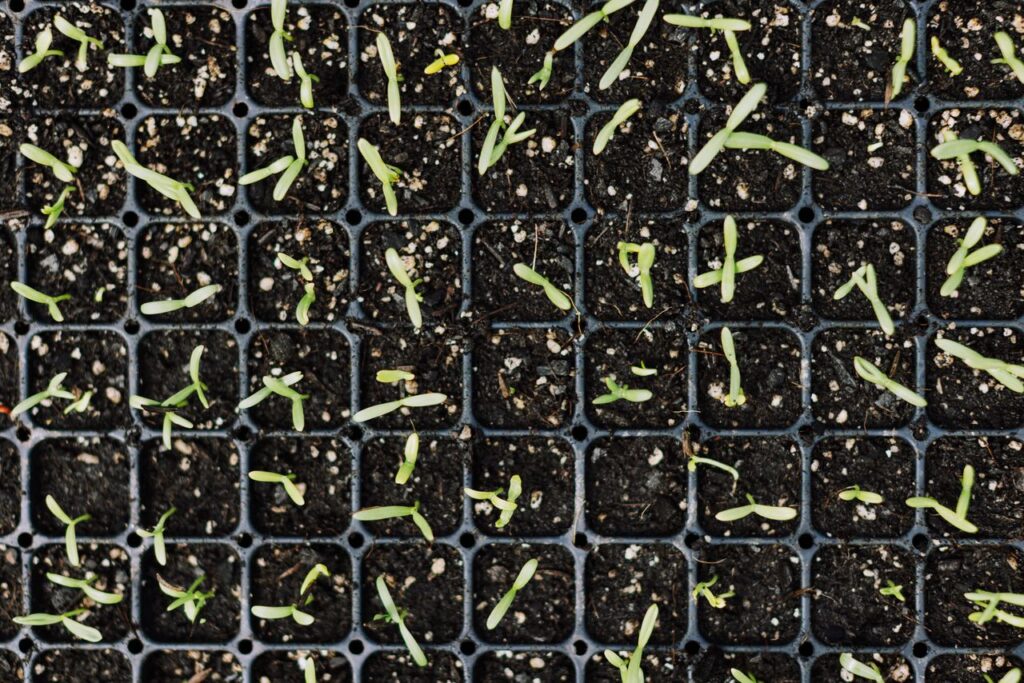
Some vegetables are happiest when you sow the seed exactly where the plant will grow.
Others benefit from spending their first few weeks protected in a seed tray before being moved into the garden.
This is the difference between direct sowing and transplanting.
Direct sowing means planting seeds straight into the final pot, raised bed, or garden soil.
Transplanting means germinating the seeds somewhere else — usually in a seedling tray or small pot — and moving the young plant into its final growing position later.
Neither method is universally better.
The right choice depends mostly on the crop.
Why Direct Sow Some Crops?
Direct sowing avoids disturbing the roots.
That matters for vegetables that develop sensitive taproots or dislike having their root systems handled.
It can also be simpler.
There is no seed tray to manage, no transplanting session, and no adjustment period after the plant is moved.
Large, fast-germinating seeds are often especially convenient to sow directly.
The disadvantage is that you have less control.
Seeds outside are exposed immediately to:
heavy Malaysian rain,
hot sun,
drying soil,
snails and slugs,
birds,
insects,
and uneven moisture.
A sudden tropical downpour can even wash tiny seeds out of position.
Why Start Seeds in Trays?
Seed trays give gardeners more control during the most vulnerable stage of a plant’s life.
You can place the tray somewhere protected from extreme rain and harsh afternoon sun while carefully managing moisture.
It also allows you to select the strongest seedlings before planting them into valuable garden space.
This is particularly useful with slower-germinating crops such as chillies.
Instead of leaving an empty spot in a raised bed waiting to see whether one chilli seed eventually germinates, you can start several seeds in a tray and transplant the healthiest seedlings later.
Chillies: Usually Better Transplanted
Chillies are excellent candidates for seed trays.
They can take time to germinate, and young chilli seedlings are easier to manage in a protected location.
Start them in cells or small containers.
Once they have developed several true leaves and a healthy root system, they can be moved into larger pots or garden beds.
Because chilli seedlings tolerate transplanting reasonably well when handled carefully, there is usually little advantage to sowing every seed directly into its final large container.
Tomatoes: Usually Better Transplanted
Tomatoes also respond well to transplanting.
Starting them in trays allows you to control moisture and light during germination and select vigorous seedlings later.
Tomatoes have another useful characteristic: their stems can produce additional roots when buried.
When transplanting a slightly leggy tomato seedling, gardeners can often plant part of the stem deeper than its previous level, helping the plant develop a larger root system.
This is unusual, so do not automatically bury the stems of other vegetable seedlings in the same way.
Brinjal: Usually Better Transplanted
Brinjal, or eggplant, behaves similarly to chillies.
It is generally practical to start seeds in trays, allow seedlings to develop, and then transplant the strongest plants.
This makes good use of garden space because brinjal plants eventually become quite large.
You can decide exactly where each healthy plant belongs instead of sowing several seeds directly and thinning them later.
Okra: Usually Direct Sow
Okra grows quickly and generally does well when sown directly into its final position.
Its roots can become quite substantial, and there is usually little need to put the plant through an additional transplanting stage.
Plant seeds directly into a sufficiently large pot or garden bed.
If several seeds are planted in one spot and more than one germinates, keep the strongest plant and remove or carefully manage the extras.
Okra can be transplanted when very young, particularly if grown in individual cells with minimal root disturbance, but direct sowing is often the simpler option.
Carrots: Direct Sow
Carrots are one of the clearest examples of a crop that should normally be direct sown.
The part you are harvesting is the enlarged taproot itself.
Disturbing or bending that root during transplanting can produce forked, twisted, or poorly shaped carrots.
Sow carrot seeds directly into loose, stone-free soil where they will mature.
Once they germinate, thin crowded seedlings carefully.
Trying to transplant ordinary carrot seedlings usually creates unnecessary problems.
Radishes: Direct Sow
Radishes also develop quickly and are grown for their swollen roots.
They are usually ready so fast that starting them in trays would add unnecessary work.
Sow them directly into the final growing area.
Give them appropriate spacing and maintain reasonably consistent moisture.
For quick crops such as radish, direct sowing keeps the entire growing cycle simple.
Cucumbers: Usually Direct Sow, but Transplanting Can Work
Cucumbers belong to the cucurbit family, along with pumpkins, melons, and many gourds.
These plants can dislike major root disturbance.
For home gardeners, sowing cucumber seeds directly into the final bed or large container is often easiest.
However, cucumbers can also be started in individual cells and transplanted while still young.
The key is not to leave them in small trays until the roots become heavily tangled.
Move the entire root ball without breaking it apart.
Pumpkins and Gourds: Usually Direct Sow
Pumpkins, bottle gourds, bitter gourds, and similar vigorous vines generally do well when direct sown.
Their seeds are relatively large, and seedlings develop quickly.
If you need to protect them from pests or extremely wet weather during germination, starting them individually in larger cells or small pots can work.
But transplant them young and handle the roots gently.
Do not tease apart a dense mass of cucurbit roots as you might with some hardier seedlings.
Beans: Usually Direct Sow
Beans are another easy direct-sown crop.
The seeds are large, germinate quickly under warm conditions, and establish well when planted directly.
Pole beans can be sown beside the trellis they will eventually climb.
Bush beans can be planted at their final spacing.
Starting beans in trays generally creates extra work without providing much benefit unless outdoor conditions are temporarily unsuitable.
Peas: Usually Direct Sow
Where peas are being attempted in suitable conditions, direct sowing is generally preferable.
Like beans, they establish readily from relatively large seeds and do not usually need a nursery stage.
Malaysia’s heat can make many temperate pea varieties challenging, however, so crop selection and local microclimate may matter more than the sowing method itself.
Leafy Greens: Either Method Can Work
Leafy vegetables are much more flexible.
Sawi, kailan, lettuce-type greens, and similar crops can often be either:
direct sown,
or started in trays and transplanted.
Direct sowing is convenient if you want a dense row of baby leaves.
Transplanting is useful when you want individual plants spaced evenly for larger harvests.
For example, you might sow sawi directly for baby-leaf harvesting but transplant individual seedlings if you want larger mature heads.
Bayam: Usually Direct Sow
Bayam, or amaranth, is easy to grow from seed and is commonly direct sown.
The small seeds can be scattered relatively evenly across a prepared growing area and later thinned if necessary.
Because bayam grows quickly, there is usually little reason to give every plant its own seedling cell.
For organised spacing or small container gardens, transplanting is still possible, but direct sowing is usually simpler.
Herbs Depend on the Species
There is no single rule for herbs.
Basil handles transplanting well and is easily started in trays.
Coriander often performs better when direct sown because of its taproot and tendency to dislike root disturbance.
Mint is more commonly propagated from cuttings or existing plants rather than seed.
Pandan is usually propagated vegetatively rather than being part of a typical seed-starting system.
Always consider the specific herb rather than treating “herbs” as one plant type.
What About Tiny Seeds?
Seed size alone does not determine the method, but tiny seeds can be difficult to manage outdoors.
Heavy Malaysian rain can wash them away.
They can dry quickly near the surface.
They can also be difficult to distinguish from weeds after germination.
Starting tiny seeds in a tray sometimes gives you better control even when the plant itself can tolerate direct sowing.
Alternatively, protect a direct-sown bed from strong rain until the seedlings become established.
Direct Sowing Works Best When the Final Growing Area Is Ready
If you sow directly, prepare the location before planting.
The soil should be:
loose enough for roots,
properly drained,
already moist,
and reasonably free of large weeds.
Do not direct sow into bone-dry soil and then blast it with a hose.
Water gently so seeds remain where you placed them.
For tiny seeds, the upper soil layer needs particularly careful moisture management because their young roots cannot yet reach deeper water.
Transplants Need an Adjustment Period
Moving a seedling from a protected tray into full Malaysian sun can be a shock.
The plant suddenly faces stronger light, more wind, higher temperatures, and faster moisture loss.
Before transplanting, gradually expose seedlings to outdoor conditions.
This process is commonly called hardening off.
Even in a tropical climate, seedlings grown under sheltered conditions can benefit from this transition.
Move them gradually towards brighter and more exposed conditions rather than placing delicate seedlings directly into intense afternoon sun on day one.
Avoid Transplanting in the Hottest Part of the Day
When possible, transplant during the cooler part of the day.
Late afternoon can work well because the seedling has the evening and night to begin adjusting before the next period of strong sun.
Water the growing area before or immediately after planting so the root ball has access to moisture.
Do not leave newly transplanted seedlings sitting in dry soil.
Protect Young Transplants from Heavy Rain
Malaysia presents another challenge: the newly transplanted seedling may not face drought at all.
Instead, it may encounter a thunderstorm.
Very young plants can be battered by heavy rain, and poorly draining soil can become saturated.
If particularly heavy weather is expected, temporary rain protection can be useful as long as the plants still receive light and airflow.
Do not permanently seal seedlings inside a humid enclosure.
A Quick Guide to Which Method to Use
As a practical starting point:
Usually direct sow:
carrots,
radishes,
okra,
beans,
coriander,
pumpkins,
gourds,
and many cucumbers.
Usually transplant:
chillies,
tomatoes,
brinjal,
basil,
and many individually spaced leafy vegetables.
Either method can work:
sawi,
kailan,
lettuce-type greens,
some cucumbers,
and several other fast-growing vegetables.
These are useful starting categories rather than absolute laws.
Gardeners sometimes successfully transplant traditionally direct-sown plants and direct sow traditionally transplanted crops.
The question is whether the extra effort gives you an advantage.
How to Decide When You Are Unsure
Ask four questions.
Does the crop dislike root disturbance?
If yes, lean towards direct sowing.
Is germination slow or unreliable?
If yes, trays can give you more control.
Are the seeds or seedlings vulnerable to heavy rain or pests?
Starting under protection may help.
Does the crop grow so quickly that transplanting would only create extra work?
Direct sow it.
That simple decision process covers most vegetables.
At the end of the day, direct sowing and transplanting are not competing techniques. They are two tools for different crops. Root vegetables and fast-growing, root-sensitive plants often perform best when they stay where they were sown, while chillies, tomatoes, brinjal, and other slower seedlings benefit from a protected start before moving into the garden. Once you match the method to the crop — and to Malaysia’s combination of heat, humidity, pests, and sudden rain — seed starting becomes much more predictable.
Do you usually sow everything straight into the garden, or are your seedling trays permanently full? Tag @projectharvest.my on Instagram and show us what you are direct sowing, what you are transplanting, and which method has worked best for your Malaysian home garden. We would love to see those tiny seeds make the journey from germination to harvest.