
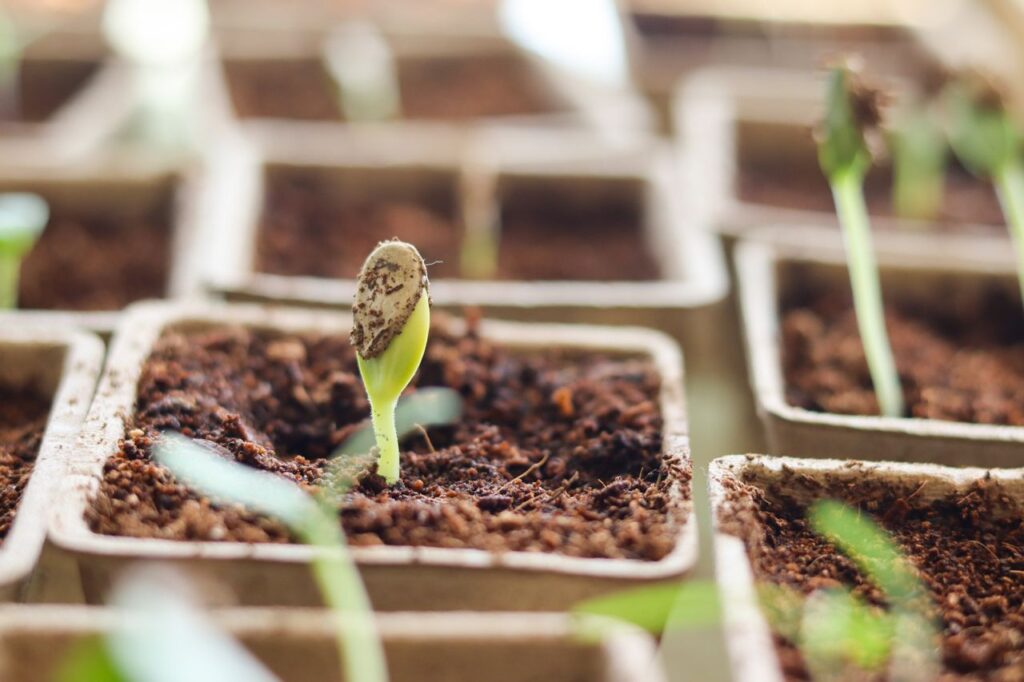
A useful rule for many seeds is to plant them at a depth of roughly two to three times the thickness of the seed.
Tiny seeds are usually planted very shallowly, sometimes barely covered at all, while larger seeds such as beans, okra, cucumbers, and pumpkins can usually be planted deeper.
This is only a general guideline. If the seed packet provides a recommended planting depth, follow that first.
The reason depth matters is simple: a germinating seed has only a limited amount of stored energy. If it is buried too deeply, the young shoot may use up that energy before reaching the surface.
Why Seed Size Matters
Seeds contain stored energy that supports the young plant before it can photosynthesise properly.
Large seeds contain more reserves.
That gives them enough energy to push through a thicker layer of soil.
Small seeds have much less stored energy.
If you bury a tiny basil or lettuce seed several centimetres deep, the seedling may never reach the surface.
This is why seed depth should usually increase with seed size.
Tiny Seeds Need Very Little Cover
Very small seeds are often best sown on or just below the surface.
Examples include:
basil,
lettuce-type greens,
some herbs,
and many tiny flower seeds.
After sowing, press them gently into the surface so they make good contact with the moist growing medium.
Then add only a very thin covering of fine seed-starting mix if the crop benefits from being covered.
Do not bury them deeply.
In Malaysia, shallow-sown seeds can dry quickly during hot weather, so maintaining even moisture is especially important.
Medium-Sized Seeds Can Go Slightly Deeper
Chilli, tomato, and brinjal seeds are larger than many herbs but still relatively small.
A planting depth of around 0.5 to 1 cm is often a practical starting point for these crops.
Cover them lightly with fine growing mix and water gently.
Do not compact the surface heavily.
The young shoot still needs to push upward through the medium.
Large Seeds Can Be Planted Deeper
Beans, okra, cucumbers, pumpkins, gourds, and similar crops produce much larger seeds.
These can generally be planted around 2 to 3 cm deep, depending on the seed size and soil conditions.
Very large bean or pumpkin seeds may tolerate slightly deeper planting than smaller seeds.
Again, the seed packet should take priority where specific instructions are available.
What Happens If You Plant Too Deep?
Planting seeds too deep can cause several problems.
The seedling may not have enough stored energy to reach the surface.
The soil may remain wetter and contain less oxygen at depth.
Seeds may rot before germinating.
Emerging seedlings may become weak and elongated as they struggle upward.
If germination seems very poor even though the seeds are fresh and moisture is good, excessive planting depth is one possible cause.
What Happens If You Plant Too Shallow?
Shallow planting can also create problems.
The seed may dry out before germination finishes.
Heavy Malaysian rain may wash it away.
Birds or insects may find exposed seeds more easily.
Roots may also struggle to anchor the young plant properly if the seed is sitting almost completely above the soil.
The ideal depth gives the seed enough moisture and protection without creating a difficult journey to the surface.
Malaysian Rain Can Shift Seeds Around
Direct sowing presents a particular challenge in Malaysia.
A short but intense thunderstorm can disturb the upper soil layer and move shallow seeds.
Tiny seeds may wash into one corner of the bed.
Larger seeds may become exposed.
If you direct sow during a rainy period, consider protecting the bed temporarily with suitable shade netting, a light cover, or another structure that reduces the force of heavy rain while maintaining airflow.
Do not cover the bed so tightly that heat and humidity become trapped.
Loose Soil Makes Germination Easier
Seedlings emerge more easily through a light, fine-textured growing medium than through compacted soil.
After sowing, cover seeds gently.
Do not press the soil down firmly with your hand.
You want good contact between the seed and moist soil, but you also want air spaces.
This is especially important for seed trays.
A compacted seed-starting mix can stay too wet and make it harder for delicate roots and shoots to grow.
Water Carefully After Sowing
Strong watering can change planting depth.
A powerful hose or watering-can stream may wash soil away from large seeds or bury tiny seeds more deeply.
After sowing, use a fine rose on a watering can, a gentle spray, or careful bottom watering where appropriate.
The goal is to moisten the growing medium without rearranging everything you just planted.
Should Seeds Be Planted Pointed End Up?
For most home-garden seeds, orientation is much less important than proper depth and moisture.
Seeds naturally respond to gravity as roots grow downward and shoots grow upward.
If a large seed has an obvious shape, you can follow crop-specific advice where available, but beginners generally do not need to worry about perfectly positioning every seed.
Plant it at the correct depth and let the seedling do the rest.
What About Seeds That Need Light to Germinate?
Some seeds germinate better when exposed to light or only very lightly covered.
This is another reason the “two to three times the seed thickness” rule should not be treated as absolute.
If the seed packet says:
surface sow,
do not cover,
or
light required for germination,
follow those instructions.
For these seeds, simply press them gently into moist growing medium.
Planting Depth in Heavy Soil vs Light Mix
Soil texture can also influence depth.
In a loose seed-starting mix, a seedling can push upward relatively easily.
In dense clay-heavy soil, emerging through the same depth may be much harder.
When direct sowing into heavier soil, avoid planting unnecessarily deep.
You may also improve the upper sowing layer with a finer, looser material where appropriate.
Do not simply bury seeds deeper because the soil surface dries quickly.
Instead, manage moisture with gentle watering or mulch around established seedlings later.
A Practical Guide for Common Home-Garden Crops
As a rough starting point:
Basil: surface to very shallow covering
Lettuce-type greens: very shallow, roughly a few millimetres
Chillies: around 0.5–1 cm
Tomatoes: around 0.5–1 cm
Brinjal: around 0.5–1 cm
Bayam: shallow sowing
Carrots: shallow, usually around 0.5–1 cm
Okra: around 2–3 cm
Beans: around 2–3 cm
Cucumber: around 2–3 cm
Pumpkin and gourds: around 2–3 cm
These are practical starting ranges, not rigid measurements.
Seed variety, soil texture, moisture, and packet instructions may justify small adjustments.
How to Judge Depth Without a Ruler
You do not need to measure every seed hole precisely.
Use the seed itself as your guide.
For tiny seeds, think of barely covering the surface.
For medium seeds, use roughly the depth of your fingertip.
For larger seeds, make a small hole with your finger and place the seed a couple of centimetres below the surface.
Consistency matters more than perfect millimetres.
Do Not Keep Digging Seeds Up to Check Them
Once seeds are planted, resist the temptation to dig them up every day.
Germination often begins below the surface before you see anything happening above it.
Repeatedly disturbing the soil can damage emerging roots.
Instead, maintain suitable moisture and wait for the expected germination period.
If nothing emerges after a reasonable time, then investigate possible causes such as seed age, temperature, moisture, depth, or rot.
At the end of the day, planting depth is really about matching the seed’s size and strength to the distance it has to travel. Tiny seeds belong near the surface, medium seeds need only a light covering, and larger seeds can usually be planted deeper. In Malaysia, where heavy rain and rapid surface drying can both affect germination, good moisture management is just as important as getting the depth right. When in doubt, follow the seed packet — and remember that burying a seed deeper does not make it safer or stronger.
Starting a new tray or direct-sowing vegetables this week? Tag @projectharvest.my on Instagram and show us what you are planting, how deep you sowed the seeds, or the germination results you get. We would love to see which crops emerge fastest in Malaysian home gardens and help troubleshoot the ones that decide to stay underground a little longer.