
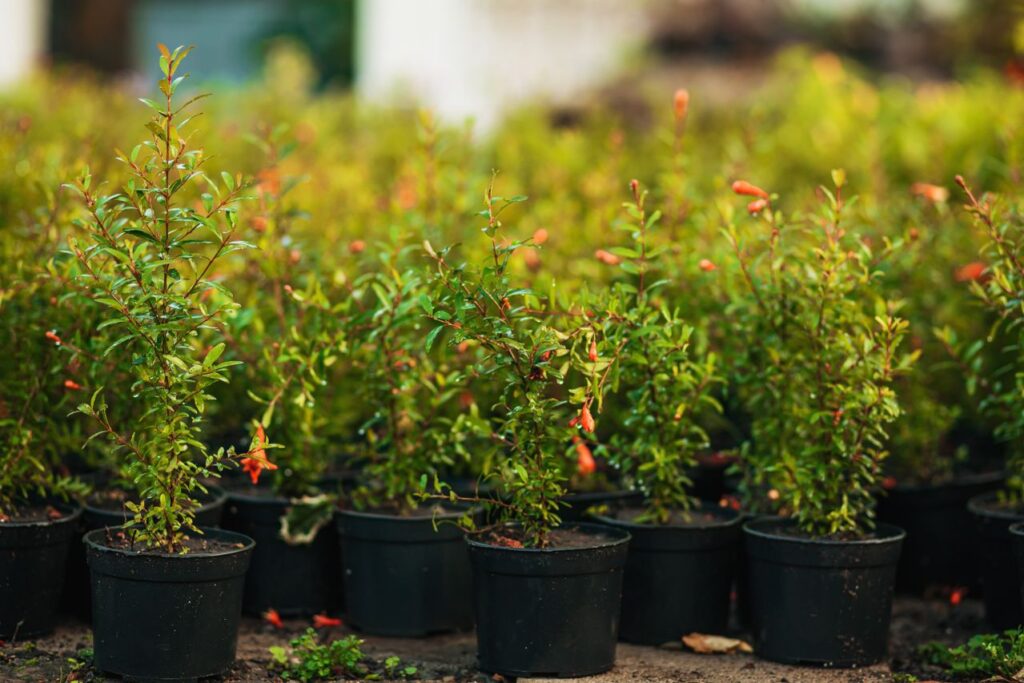
To feed container plants without causing salt buildup, use fertiliser at the correct rate, allow excess water to drain from the pot, avoid stacking multiple fertiliser products, and occasionally allow enough clean water to move through the growing medium when conditions make that appropriate.
Container plants are especially vulnerable because their roots live in a limited volume of soil or potting mix.
Unlike plants growing in open ground, excess dissolved minerals cannot disperse through a large surrounding soil area.
Over time, fertiliser salts can accumulate around the roots.
That can eventually cause:
brown leaf tips,
scorched margins,
poor growth,
wilting despite moist soil,
and root stress.
The goal is not to avoid fertiliser.
It is to maintain a balance between nutrients entering the pot and excess soluble salts leaving it.
What Does “Salt Buildup” Actually Mean?
In gardening, salt does not only mean table salt.
Many fertilisers dissolve into electrically charged mineral ions when mixed with water.
These may include forms of:
nitrogen,
potassium,
calcium,
magnesium,
and other nutrients.
Plants need these dissolved minerals.
Problems begin when their concentration becomes too high in the growing medium.
As water evaporates or is taken up by the plant, some dissolved minerals remain behind.
Repeated fertilising can gradually increase their concentration.
Why Containers Are More Vulnerable
A chilli growing in the ground may explore a relatively large area of soil.
A chilli growing in a 20-litre pot cannot.
Everything happens inside that limited container:
watering,
fertilising,
root growth,
nutrient uptake,
and salt accumulation.
This makes container gardening convenient, but less forgiving.
Small pots are particularly sensitive because changes happen quickly.
Malaysia’s Heat Can Concentrate Salts Faster
During hot Malaysian weather, containers can lose water rapidly.
Water evaporates from the soil surface and is also taken up by the plant.
But most dissolved minerals do not evaporate with the water.
As moisture decreases, their concentration around the roots increases.
This means a pot that repeatedly becomes very dry can temporarily expose roots to much higher salt concentrations.
Consistent watering therefore helps with nutrient management as well as hydration.
What Does Salt Buildup Look Like?
One visible clue is a white or pale crust appearing on:
the soil surface,
the inside or outside of the pot,
or around drainage holes.
This can be mineral residue left behind as water evaporates.
But visible crusting is not always present.
Plants may show symptoms first.
Possible signs include:
brown leaf tips,
scorched leaf margins,
wilting,
yellowing,
slow growth,
and poor root health.
These symptoms can resemble nutrient deficiencies or drought.
That is why fertiliser history matters.
Do Not Assume Brown Tips Mean the Plant Needs More Fertiliser
This is a common mistake.
A plant develops brown leaf tips.
The gardener assumes:
“Maybe it needs more potassium.”
Another dose is added.
If the real problem is excessive salt concentration, that extra fertiliser makes conditions worse.
Before feeding a struggling container plant, ask:
What have I already applied?
How often?
How well does the pot drain?
Is there visible mineral crust?
Does the pot regularly dry severely?
Start with the Correct Fertiliser Rate
The simplest way to reduce salt buildup is not to overfeed in the first place.
Read the label carefully.
If the product recommends:
5 g per pot,
do not apply 15 g because the plant is fruiting.
If a liquid fertiliser says:
5 ml per litre,
do not make it twice as strong for “better results.”
Plants can only use nutrients up to their actual requirements.
The excess remains in the system or is eventually washed out.
Higher NPK Numbers Mean Higher Concentration
A fertiliser labelled:
20-20-20
contains more concentrated nutrients than one labelled:
5-5-5.
That means the amount applied matters greatly.
Do not transfer the dosage from one fertiliser to another simply because both are described as vegetable fertilisers.
Read each label separately.
Avoid Stacking Fertilisers
Salt problems often happen because gardeners use several products at once.
A container may already contain:
controlled-release fertiliser,
granular NPK,
and compost.
Then the gardener adds:
liquid fertiliser,
calcium,
magnesium,
micronutrients,
and foliar feeds.
Each application may seem reasonable on its own.
Together, they may greatly exceed the plant’s needs.
Count Everything Going into the Pot
Make a simple list.
For example:
slow-release fertiliser already mixed into the potting mix,
liquid NPK every two weeks,
occasional calcium,
plus organic pellets.
Once everything is written down, you may realise the plant is receiving much more nutrition than expected.
Simpler programmes are usually easier to control.
Drainage Is Essential
Every container should allow excess water to escape.
If water cannot drain, dissolved salts remain trapped in the root zone.
Poor drainage also increases the risk of:
waterlogging,
root rot,
and low oxygen around roots.
Make sure drainage holes are:
open,
large enough,
and not blocked by compacted material.
Do not rely on a decorative pot with no drainage for long-term vegetable growing.
Avoid Leaving Pots Sitting in Fertiliser-Rich Drainage Water
If a pot drains into a saucer, do not routinely leave the root ball sitting in nutrient-rich runoff for long periods.
Otherwise, dissolved minerals can move back into the growing medium as water is reabsorbed.
For most edible container plants, allowing excess drainage water to leave the root zone is safer.
At the same time, do not waste water unnecessarily.
The goal is sensible drainage, not constant flushing.
What Is Leaching?
In container gardening, leaching means using water to carry soluble salts downward and out through the drainage holes.
This can help prevent or reduce excessive salt accumulation.
A properly watered pot should occasionally allow some water to move through the full root zone rather than receiving only tiny surface splashes.
However, leaching should not be confused with constantly flooding the pot.
When Should You Flush a Container?
Occasional flushing may be useful when:
fertiliser has been used regularly,
visible crusting appears,
salt buildup is suspected,
or a controlled feeding programme has been running for a long period.
It may also be useful after accidental over-fertilisation if the container drains well.
But flushing should have a reason.
It is not something every pot necessarily needs every week.
How to Flush a Container Properly
Use clean water.
Water the pot thoroughly so that water moves through the entire growing medium and drains freely from the bottom.
The aim is to dissolve and carry some accumulated salts away.
Then allow the pot to drain normally.
Do not leave the roots submerged afterwards.
Do Not Turn Flushing into Waterlogging
This matters especially in Malaysia.
If the potting mix is already saturated after several days of heavy rain, adding more water just to “flush salts” may damage roots.
Wait until drainage and root-zone oxygen improve.
The correct timing depends on the actual moisture condition of the pot.
Malaysian Rain Can Naturally Leach Containers
Pots exposed to heavy tropical rain may receive considerable natural leaching.
That means outdoor containers under open sky can behave very differently from containers under:
roofing,
balconies,
or rain shelters.
An exposed pot may lose nutrients more quickly.
A covered pot may accumulate salts more easily because rainfall never flushes the growing medium.
Covered Balconies Need Extra Attention
A container grown under a roof can receive fertiliser month after month without any natural rainwater passing through it.
If the gardener also waters only in small amounts, salts can gradually accumulate.
For these pots, occasional deep watering with good drainage can be especially useful.
The pot should not remain permanently wet.
The idea is simply to ensure the entire root zone is refreshed periodically.
Frequent Light Watering Can Encourage Salt Accumulation
Imagine watering only enough to wet the top few centimetres every day.
The upper soil becomes damp.
But very little water moves through the entire container.
Salts remain behind and may become concentrated in particular areas.
A better approach is usually to water deeply enough to wet the active root zone, then allow excess to drain.
Water again when the crop and growing medium actually require it.
Do Not Let the Pot Dry Severely Between Feedings
Extreme drying concentrates salts.
This can make an otherwise reasonable fertiliser rate harsher on roots.
For fruiting vegetables such as:
chillies,
tomatoes,
brinjal,
and cucumbers,
maintaining reasonably stable soil moisture is particularly useful.
That also helps reduce other physiological problems such as blossom-end rot.
Pot Size Matters
Very small pots are less forgiving.
They have:
less soil,
less water storage,
less nutrient buffering,
and less root space.
A large plant growing in a tiny pot may need frequent watering and feeding, yet remain at high risk of salt stress.
Moving to a suitably larger container can make nutrient management much easier.
Growing Medium Matters Too
Some potting mixes hold nutrients better than others.
A highly porous mix may drain and leach quickly.
A dense mix may retain water and salts for longer.
Materials such as:
compost,
coco-based media,
bark,
perlite,
and mineral soil
all behave differently.
There is no universal fertiliser schedule that fits every container medium.
Liquid Fertiliser Can Be Easier to Control
Liquid fertiliser allows precise adjustment.
You can measure:
concentration,
application frequency,
and timing.
If the plant is stressed or weather is unsuitable, you can skip the next application.
That makes liquid feeding useful for gardeners who monitor plants closely.
But it also makes overfeeding easy if the solution is mixed too strongly.
Slow-Release Fertiliser Can Reduce Feeding Frequency
Controlled-release fertiliser can provide a more gradual nutrient supply.
This may reduce the need for frequent liquid feeding.
But slow-release does not mean salt-free.
Nutrients are still released into the growing medium.
Using slow-release fertiliser plus frequent full-strength liquid feeds can still create excessive nutrient levels.
Organic Fertilisers Can Contribute Salts Too
“Organic” does not automatically mean impossible to overapply.
Organic fertilisers contain minerals and nutrients.
Some may release them more gradually, but excessive application can still create nutritional imbalance or salt-related problems.
Do not assume an organic product can be applied without measurement.
Follow the product guidance.
Compost Does Not Eliminate the Need for Careful Feeding
Compost can improve:
soil structure,
water retention,
and nutrient-holding capacity.
That can make containers more resilient.
But too much compost can create its own problems depending on the material.
Some composts are nutrient-rich or relatively high in soluble salts.
Use mature, good-quality compost at sensible proportions.
Watch High-Fertiliser Crops More Closely
Fast-growing vegetables and long-lived fruiting crops may receive frequent feeding because they remove substantial nutrients over time.
Examples include:
tomatoes,
chillies,
brinjal,
and cucumbers.
These crops can perform well with regular fertilisation, but they also make it easy to fall into a cycle of constant feeding.
Record what you apply.
Keep a Simple Fertiliser Record
Write down:
fertiliser product,
NPK,
rate,
date,
and plant.
This is especially useful when growing several containers.
Without records, it is easy to accidentally fertilise the same pot twice or forget that slow-release granules are already present.
Do Not Fertilise Every Time You Water
Some growing systems use carefully calculated fertigation, where nutrients are supplied with irrigation water.
That is a managed system.
It is different from casually adding fertiliser to every watering can.
For ordinary home containers, repeatedly feeding at full strength can quickly increase salt concentration.
Follow the fertiliser programme you intentionally chose.
Watch EC If You Are Growing More Technically
Experienced growers may use an electrical conductivity, or EC, meter.
EC gives an indication of the concentration of dissolved salts in water or nutrient solution.
It is widely used in:
hydroponics,
fertigation,
and more technical container growing.
A higher EC generally means more dissolved ions are present.
But EC does not tell you which individual nutrient is present.
For most home gardeners, an EC meter is optional.
Good fertiliser records, drainage, and plant observation are usually enough.
Signs That You May Be Feeding Too Heavily
Consider reducing fertiliser if you notice:
persistent leaf-tip burn,
increasing white crusting,
very dark excessive foliage,
poor root health,
wilting despite moist soil,
or symptoms appearing after repeated feeding.
Do not assume every symptom is caused by salts, but investigate the possibility.
If Salt Buildup Is Already Serious
Stop fertilising temporarily.
Check drainage.
If the growing medium is not waterlogged, flush the pot appropriately with clean water.
Allow it to drain.
Then watch for healthy new growth.
Do not immediately restart the same fertiliser programme at the same intensity.
Work out why the buildup happened first.
Severely Damaged Leaves Will Not Recover
Brown leaf tips and dead margins will stay damaged.
Judge recovery by:
new growth,
new leaf quality,
and whether symptoms stop spreading.
Do not continue flushing or adding products because old damaged leaves still look bad.
When Should You Resume Feeding?
Resume when:
the plant has stabilised,
roots appear functional,
and healthy new growth is developing.
Then return to an appropriate feeding rate.
Do not attempt to “replace” nutrients lost during flushing with one large dose.
That simply restarts the cycle.
A Simple Low-Salt Feeding Routine
For an ordinary Malaysian container vegetable garden:
1. Use an appropriate fertiliser at the label rate.
2. Record when you apply it.
3. Avoid overlapping several fertilisers unnecessarily.
4. Water the full root zone rather than only wetting the surface.
5. Ensure excess water can drain freely.
6. Avoid repeated severe drying.
7. Monitor pots protected from rain for gradual salt accumulation.
8. Allow occasional appropriate leaching where needed.
9. Pause feeding when roots are stressed.
10. Adjust based on plant growth rather than automatically increasing fertiliser.
That system is usually more useful than looking for a special “low-salt” fertiliser.
Feed What the Plant Can Actually Use
Container gardening creates a temptation to manage every problem by adding something.
But a pot has limits.
The roots can only absorb nutrients at a certain rate.
Anything beyond what the plant needs either:
remains in the growing medium,
washes away,
or contributes to imbalance.
Efficient feeding means matching nutrient supply to plant demand.
At the end of the day, preventing salt buildup in container plants comes down to measured fertiliser, healthy drainage, consistent watering, and avoiding unnecessary overlap between products. Malaysia’s hot weather can concentrate salts as pots dry, while heavy rain can leach nutrients from exposed containers; covered balconies may have the opposite problem because they receive little natural flushing. Pay attention to how your particular pots behave, allow soluble salts to leave the root zone when appropriate, and remember that feeding more often only helps when the plant can actually use what you are adding.
Growing chillies, tomatoes, brinjal, herbs, or other crops in pots and noticing white crusting or burnt leaf tips? Share your container size, fertiliser routine, watering method, and photos by tagging @projectharvest.my on Instagram. Comparing how salt buildup behaves in Malaysian balconies, terrace-house gardens, and rain-exposed containers can help all of us build better feeding routines for long-term potted plants.