
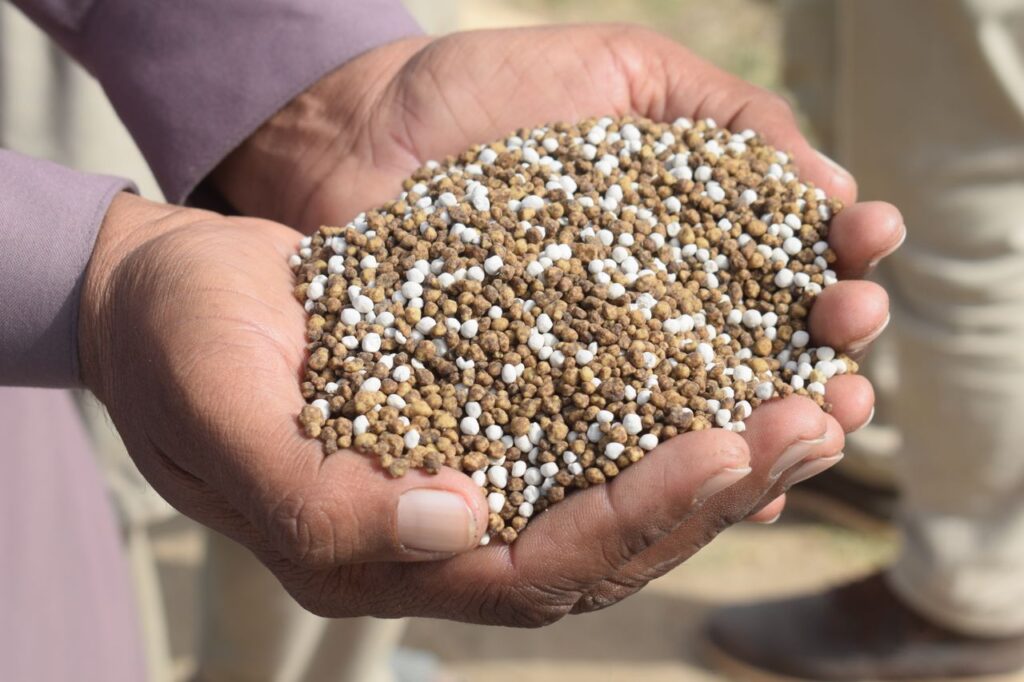
The three numbers on a fertiliser label — such as 15-15-15, 12-12-17, or 10-5-20 — tell you the concentration of the three primary plant nutrients represented by N, P, and K.
N stands for nitrogen.
P refers to phosphorus.
K stands for potassium.
But those three numbers do not tell you whether the fertiliser is automatically good for your plant, how often you should use it, or how much to apply.
To choose fertiliser properly, you need to understand both the numbers and the rest of the label.
What Does NPK Actually Mean?
NPK represents the three primary macronutrients plants require in relatively large amounts.
N — Nitrogen
Nitrogen is strongly associated with:
leaf growth,
shoot development,
chlorophyll,
and general vegetative growth.
Leafy vegetables generally have a relatively strong demand for nitrogen.
Too little may lead to pale, weak growth.
Too much can produce excessive leafy growth at the expense of flowering and fruiting in some crops.
P — Phosphorus
Phosphorus plays important roles in:
energy transfer,
root development,
cellular processes,
flowering,
and reproduction.
However, phosphorus should not simply be treated as a “flower booster.”
Plants need it, but adding excessive phosphorus does not automatically create more flowers or fruit.
K — Potassium
Potassium is important for:
water regulation,
enzyme activity,
stress tolerance,
and fruit development.
Fruiting crops such as tomatoes, chillies, brinjal, and cucumbers require adequate potassium, but adding large amounts does not guarantee larger fruit.
The plant still needs balanced nutrition, sunlight, water, healthy roots, and suitable growing conditions.
What Do Numbers Like 15-15-15 Mean?
A fertiliser labelled:
15-15-15
contains 15 percent of each of the three declared primary nutrient components by weight under the conventional fertiliser analysis used on the product.
For example, in 1 kilogram of a 15-15-15 fertiliser, the declared analysis would represent approximately:
150 g nitrogen,
150 g of the labelled phosphorus component,
and
150 g of the labelled potassium component.
The rest of the material consists of carriers, fillers, other nutrients, coating materials, or other ingredients depending on the fertiliser.
This is why a fertiliser bag does not contain 100 percent NPK.
One Important Detail About P and K
Fertiliser labels commonly express phosphorus and potassium using conventional chemical equivalents rather than simply as elemental phosphorus and elemental potassium.
You may see phosphorus declared as P₂O₅ and potassium as K₂O.
So, for example, a conventional 15-15-15 analysis commonly means:
15% nitrogen,
15% phosphate expressed as P₂O₅,
15% potash expressed as K₂O.
It does not necessarily mean the product contains 15% pure elemental phosphorus and 15% pure elemental potassium.
For ordinary home-garden use, you usually do not need to convert these numbers into elemental P and K.
Follow the analysis and application instructions on the actual product.
Higher Numbers Mean a More Concentrated Fertiliser
Compare:
5-5-5
with
15-15-15.
Both have the same nutrient ratio of:
1:1:1.
But 15-15-15 is three times more concentrated in its declared NPK nutrients.
That means you cannot simply apply the same handful of both products and expect the same result.
The 15-15-15 would deliver much more nutrient.
This is one of the most important things to understand when changing fertilisers.
Ratio and Concentration Are Different
Consider:
10-5-20
and
20-10-40.
Both have the same N:P ratio:
2:1:4.
But the second fertiliser is twice as concentrated.
So the ratio tells you the relative balance between nutrients.
The actual numbers tell you the concentration.
Both matter.
Do Not Choose Fertiliser Only by Looking for the Biggest Numbers
A 20-20-20 fertiliser is not automatically better than 10-10-10.
Higher numbers simply mean higher concentration.
Using too much can increase the risk of:
fertiliser burn,
salt buildup,
root damage,
and nutrient imbalance.
A lower-concentration fertiliser applied appropriately can be perfectly suitable.
The correct rate matters more than chasing the biggest number.
Read the Application Rate
The NPK numbers tell you what the product contains.
The application instructions tell you how much to use.
This section may give recommendations based on:
grams per plant,
grams per square metre,
grams per pot,
amount per litre of water,
or application frequency.
Follow these instructions carefully.
Do not replace measured rates with “one handful” unless the product itself specifically uses that measurement.
One gardener’s handful may be twice the size of another’s.
Granular and Liquid Fertilisers Are Used Differently
A granular fertiliser may be:
spread around plants,
incorporated into soil,
or applied as a top dressing.
A soluble fertiliser may need to be:
dissolved in water,
then applied to the root zone.
Some products are designed specifically for foliar application.
Others are not.
Do not assume every fertiliser can simply be mixed into water or sprayed onto leaves.
Read the instructions.
Check Whether It Is Fast-Release or Slow-Release
Two fertilisers with similar NPK numbers can behave very differently.
A fast-release fertiliser may make nutrients available relatively quickly.
A slow- or controlled-release fertiliser releases nutrients over a longer period.
That affects:
application frequency,
risk of overfeeding,
and how the product fits your garden routine.
Controlled-release fertilisers can be convenient for containers, but they still need to be used at the correct rate.
“Slow-release” does not mean impossible to overapply.
Look Beyond the Main Three Numbers
Plants need more than N, P, and K.
A fertiliser label may also list secondary nutrients such as:
calcium,
magnesium,
and sulphur.
You may see something like:
12-12-17 + 2MgO
The additional part indicates that the fertiliser also supplies a declared magnesium component.
This can be useful, especially for long-term container growing where nutrient management becomes more important.
But extra nutrients should still have a purpose.
More ingredients do not automatically make a fertiliser better.
Look for Micronutrients
Some fertilisers also include micronutrients such as:
iron,
manganese,
zinc,
boron,
copper,
or molybdenum.
Plants need these nutrients in much smaller amounts than NPK.
That means micronutrients should not be added casually.
A deficiency may harm the plant, but excessive amounts of certain micronutrients can also become toxic.
If the fertiliser already contains micronutrients, avoid automatically adding separate micronutrient products on top of it.
What Does “Complete Fertiliser” Mean?
A fertiliser may be described as complete when it contains the three primary macronutrients:
nitrogen,
phosphorus,
and potassium.
That does not necessarily mean it contains every nutrient a plant could ever need.
Always read the full guaranteed analysis or nutrient declaration.
Does Equal NPK Mean Balanced Fertiliser?
A fertiliser such as 15-15-15 is often described as balanced because the three numbers are equal.
But “balanced” does not mean perfect for every crop at every stage.
A young leafy vegetable and a mature fruiting chilli do not necessarily have identical nutrient demands.
Neither does a curry leaf plant compared with a cucumber.
Equal numbers simply mean the fertiliser contains equal declared proportions of N, P, and K.
It does not mean every plant needs those nutrients in equal quantities.
Leafy Crops May Need a Different Balance
Vegetables grown mainly for leaves, such as bayam or sawi, need enough nitrogen to develop healthy foliage.
But that still does not mean you should continuously apply the highest-nitrogen fertiliser available.
Excessive nitrogen can produce:
soft growth,
weak plants,
and unnecessary nutrient losses.
Use an appropriate rate rather than maximising nitrogen.
Fruiting Crops Still Need Nitrogen
Another common misunderstanding is that fruiting crops should receive almost no nitrogen.
That is incorrect.
Tomatoes, chillies, brinjal, cucumber, and okra still need nitrogen to maintain healthy leaves.
Those leaves produce the carbohydrates that support fruit development.
The goal is balanced nutrition, not eliminating nitrogen once flowers appear.
A “Flowering Fertiliser” Is Not a Guarantee of More Fruit
Products marketed for flowering or fruiting often contain nutrient ratios designed around those stages.
They may be useful.
But fruit production still depends on:
pollination,
sunlight,
water,
temperature,
root health,
plant age,
and crop genetics.
If a cucumber flower is not being pollinated, switching to a higher-potassium fertiliser does not solve the pollination problem.
Always diagnose first.
Organic Fertiliser NPK Numbers May Look Lower
Organic fertilisers often show lower NPK numbers than concentrated mineral fertilisers.
For example, an organic product might have an analysis of only a few percent of each nutrient.
That does not automatically mean it is useless.
Organic fertilisers may also contribute:
organic matter,
slow nutrient release,
or other soil benefits depending on the product.
But they are not automatically superior either.
Compare products according to:
nutrient concentration,
release pattern,
crop needs,
soil condition,
and application rate.
“Organic” describes the source or production approach, not automatic safety or effectiveness.
Compost Is Not the Same as NPK Fertiliser
Mature compost can contribute nutrients, but its main value often comes from improving:
soil organic matter,
structure,
water retention,
and biological activity.
Its nutrient concentration is usually much lower and more variable than formulated fertiliser.
Do not assume a handful of compost supplies the same nutrients as a measured dose of granular NPK fertiliser.
They perform different roles.
Check the Product Weight
Understanding percentage lets you compare products.
Suppose a 1 kg bag contains 15-15-15.
It contains 15% declared nitrogen.
That means:
1,000 g × 0.15 = 150 g nitrogen.
A 500 g bag of the same fertiliser contains:
500 g × 0.15 = 75 g nitrogen.
You do not normally need to calculate this every time you fertilise, but understanding the mathematics helps you compare products correctly.
Do Not Confuse Product Weight with Nutrient Weight
If the label tells you to apply 20 g of a 15-15-15 fertiliser, you are not applying 20 g of nitrogen.
You are applying 20 g of product.
The nitrogen portion would be:
20 g × 15% = 3 g nitrogen.
The same principle applies to the other declared nutrients.
This is why application rates matter so much.
More Fertiliser Does Not Mean Faster Results
Doubling the label rate does not mean the plant grows twice as well.
Plants can only use nutrients within physiological limits.
Excess nutrients may:
accumulate in soil,
wash away,
damage roots,
or interfere with other nutrients.
In containers, this risk can be even greater because salts are concentrated within a limited root volume.
Watch for Salt Buildup in Containers
Repeated fertiliser use can leave soluble salts in potting media.
Possible signs include:
white crusting on the soil surface or pot,
leaf-tip burn,
root stress,
or declining plant performance.
Good drainage and appropriate watering help manage salts.
Do not continuously add fertiliser without considering what previous applications have left behind.
Never Fertilise a Severely Dry Plant Heavily
Applying concentrated fertiliser to very dry roots can increase the risk of damage.
If the plant is badly dehydrated, correct the moisture problem first.
Follow the product’s instructions about watering before or after application.
Malaysia’s Rainfall Changes Fertiliser Management
Heavy tropical rain can wash soluble nutrients through pots and raised beds.
But this does not mean you should automatically fertilise after every storm.
Repeated unnecessary replacement can lead to overfeeding.
Instead, use:
the plant’s growth,
fertiliser schedule,
soil condition,
and product instructions
to guide applications.
For containers exposed directly to rain, drainage and nutrient management need to be considered together.
Compare Fertilisers by More Than NPK
When choosing between two products, read:
NPK analysis,
secondary nutrients,
micronutrients,
release type,
application rate,
application method,
crop recommendations,
and safety instructions.
One product may have lower NPK but include useful magnesium and micronutrients.
Another may be a high-concentration fertiliser intended for small measured doses.
The front of the packet rarely tells the whole story.
A Simple Label-Reading Routine
When you pick up a fertiliser, read it in this order.
1. Find the NPK analysis.
For example, 15-15-15.
2. Look at the nutrient ratio.
Is it relatively even, nitrogen-heavy, or potassium-heavy?
3. Check the concentration.
Higher numbers mean more concentrated nutrients.
4. Look for secondary nutrients and micronutrients.
Check whether calcium, magnesium, sulphur, iron, boron, or others are included.
5. Check the release type.
Fast-release, soluble, slow-release, or controlled-release?
6. Read the application rate.
How many grams or millilitres should actually be applied?
7. Check the application method.
Soil application, fertigation, foliar spray, or another method?
8. Check frequency.
Weekly? Monthly? Once every few months?
9. Look for crop-specific instructions.
Vegetables, fruit trees, ornamentals, containers, or general use?
10. Follow safety and storage directions.
These instructions are part of using fertiliser properly.
Do Not Build a Fertiliser Collection Without a Plan
Home gardeners sometimes accumulate:
15-15-15,
fruiting fertiliser,
flowering fertiliser,
calcium,
magnesium,
Epsom salt,
micronutrients,
seaweed,
and several organic feeds.
Then everything gets applied because it is available.
That makes nutrient management harder, not better.
A simple programme using one suitable base fertiliser and targeted supplements only when genuinely needed is usually easier to control.
Keep Fertiliser Records
Write down:
product,
NPK,
rate,
date applied,
and plant response.
For example:
15 October — Chilli Pot 3 — 12-12-17 — applied at label rate
If the plant later develops problems, you can see what has already been used.
This is especially useful when managing long-lived chillies, brinjal, fruit trees, or multiple raised beds.
The Label Tells You What Is in the Bag — Not What Your Plant Is Missing
This may be the most important point.
A 15-15-15 label tells you what the fertiliser contains.
It does not tell you that your plant needs 15-15-15.
To decide what the plant needs, consider:
the crop,
growth stage,
soil,
previous fertilisation,
root health,
watering,
and actual symptoms.
The best fertiliser is not the one with the most impressive numbers.
It is the one that supplies what the crop needs at an appropriate rate.
At the end of the day, reading an NPK label properly means understanding both what the three numbers represent and how concentrated the product actually is. A 15-15-15 fertiliser contains equal declared proportions of N, P, and K components, but that does not make it ideal for every crop or justify applying it heavily. Read the complete label, including secondary nutrients, micronutrients, release type, dosage, and application method. In Malaysian home gardens, where heavy rain, hot containers, frequent watering, and long growing seasons can all affect nutrient behaviour, careful measurement and observation will take you much further than simply choosing the fertiliser with the biggest numbers.
Got two fertiliser packets with completely different NPK numbers and not sure which one actually suits your chilli, vegetables, herbs, or fruit trees? Share a clear photo of the labels and tag @projectharvest.my on Instagram. Tell us what you are growing too — learning to read the numbers instead of choosing fertiliser by guesswork is one of the best steps Malaysian home gardeners can take toward feeding plants more confidently.