
Malaysia’s humid climate can make rooting cuttings easier in one way and more difficult in another.
High humidity slows water loss from leaves, which helps freshly cut stems survive before they grow new roots. But the same humid conditions can also keep stems and growing media too wet, encouraging rot, fungal growth, and poor airflow.
The key is not to create even more humidity.
It is to give cuttings a moist, airy rooting environment with gentle light and enough ventilation to prevent stagnation.
For Malaysian gardeners, successful propagation often depends more on managing excess moisture than on trying to trap it.
Why Humidity Helps Cuttings
A fresh cutting has leaves but little or no functioning root system.
That creates a problem.
The leaves continue losing water through transpiration, but the cutting cannot yet replace that water through roots.
Higher humidity slows this moisture loss.
This gives the cutting more time to form roots before it wilts severely.
That is why propagation guides from drier climates often recommend clear plastic covers or humidity domes.
But Malaysia is already humid.
In many home-garden conditions, adding a completely sealed dome can create too much moisture.
Why Too Much Humidity Becomes a Problem
Warm temperatures, wet growing media, and stagnant humid air create ideal conditions for many fungal and bacterial problems.
You may see:
blackened stem bases,
soft or mushy tissue,
yellowing leaves,
white fungal growth,
or cuttings collapsing before roots develop.
This is often mistaken for “not enough humidity.”
In reality, the cutting may be staying too wet.
The goal is not maximum humidity.
The goal is enough humidity to slow water loss while still allowing air movement.
Start with a Healthy Cutting
Good rooting starts before the stem ever enters water or growing medium.
Choose a healthy parent plant.
Avoid stems showing:
pest damage,
yellowing,
fungal spots,
rot,
severe wilting,
or general weakness.
Young, actively growing stems often root more easily than old, heavily woody growth.
For many herbs and soft-stemmed plants, a cutting around 8 to 15 cm long is practical.
Choose a section with several nodes and avoid flowering stems where possible.
Make the Cut Cleanly
Use clean, sharp scissors or secateurs.
Make the cut just below a node.
A node is the point where leaves or side shoots emerge from the stem.
Many plants readily produce new roots from tissue around these areas.
Remove lower leaves from the section that will be inserted into water or growing medium.
Keep a few healthy leaves at the top.
Do not leave lower leaves buried in wet soil because they can rot.
Use a Light Propagation Medium
In humid Malaysian conditions, drainage and aeration become especially important.
A good propagation mix should hold some moisture while allowing plenty of air around the developing roots.
A simple mix may include:
cocopeat or another moisture-retentive material,
combined with perlite or another aeration component.
Avoid heavy garden soil.
Avoid dense clay.
Avoid packing rich compost tightly around fresh cuttings.
The medium should feel light and open.
If you squeeze it when damp, it should not behave like sticky mud.
Cocopeat Needs Careful Watering
Cocopeat is useful in Malaysia because it is widely available and holds water well.
But that can also be its weakness.
If pure cocopeat is kept constantly wet in a humid environment, cuttings may stay too damp.
Adding perlite or another coarse aerating material can improve the balance.
You want the cutting to have access to moisture without sitting in a saturated root zone.
Pre-Moisten the Medium
Before inserting the cuttings, moisten the propagation mix.
It should feel evenly damp.
Not dry.
Not dripping wet.
Pre-moistening prevents you from having to heavily water the pot immediately after inserting delicate cuttings.
It also creates more consistent moisture around the lower stem.
Make the Hole Before Inserting the Cutting
Use a pencil, chopstick, or finger to create a planting hole first.
Then insert the prepared cutting.
This prevents the growing medium from scraping the stem or removing rooting hormone if one is being used.
Place at least one node below the surface.
Firm the mix gently around the stem so the cutting stands upright.
Do not compress the medium tightly.
New roots need oxygen.
Do You Need a Humidity Dome in Malaysia?
Often, no.
Easy-rooting plants such as mint, basil, and many ornamentals may root perfectly well in bright shade without any cover.
If a cutting repeatedly wilts badly despite moist soil, a loose humidity cover can help.
But do not seal it completely.
Provide ventilation.
Open the cover regularly.
Watch for condensation.
If water is constantly dripping from the inside of the cover and the growing medium stays wet for days, conditions may be too humid.
In Malaysia, the question is often not “How do I increase humidity?”
It is “How do I stop the cutting from sitting in stagnant humid air?”
Airflow Matters
Gentle airflow reduces fungal risk and helps moisture evaporate at a manageable rate.
Place cuttings somewhere sheltered but not sealed off.
A shaded porch, bright balcony corner, protected nursery shelf, or similar area can work well.
Avoid blasting fresh cuttings with strong wind.
They have limited ability to replace lost water.
Think gentle ventilation, not constant drying airflow.
Give Bright Light Without Harsh Sun
Cuttings need light for photosynthesis.
But strong direct sunlight can cause rapid moisture loss before roots form.
Bright indirect light or gentle morning sun is usually safer during the early stage.
Avoid intense Malaysian afternoon sun.
Once cuttings are rooted and producing new growth, gradually expose them to the amount of light appropriate for that plant.
Do Not Overwater
This is probably the most important rule for Malaysian conditions.
A cutting does not need a constantly saturated medium.
The propagation mix should stay lightly and evenly moist.
If the top begins to dry slightly, check deeper before watering again.
Do not assume daily watering is necessary.
During cloudy or rainy weather, the mix may stay moist much longer.
A rigid schedule often causes more problems than it solves.
Water at the Base
Avoid repeatedly spraying the leaves unless the plant genuinely benefits from occasional misting.
Leaves that remain wet for long periods can develop fungal problems.
Water the growing medium directly.
For small propagation pots, use a gentle flow so you do not disturb the cutting.
Bottom watering can also work, provided the pot is removed from the water once the medium has absorbed enough moisture.
Do not leave propagation pots sitting permanently in trays of water.
Watch for Stem Rot
The first warning sign is often darkening at the base of the cutting.
A healthy stem should remain firm.
If the base becomes:
brown,
black,
soft,
slimy,
or foul-smelling,
rot is likely.
Remove affected cuttings.
Do not leave rotting material beside healthy ones.
Then review your setup.
The medium may be too wet.
Airflow may be too low.
The humidity cover may be trapping too much moisture.
Or the cutting may have been unhealthy from the beginning.
Do Not Crowd the Cuttings
A tray packed with dozens of cuttings may look efficient, but overcrowding reduces airflow.
Leaves touch each other.
Humidity becomes trapped between plants.
Disease can spread more easily.
Space cuttings so leaves are not constantly overlapping.
You can still propagate many plants in a small area without turning the tray into a dense canopy.
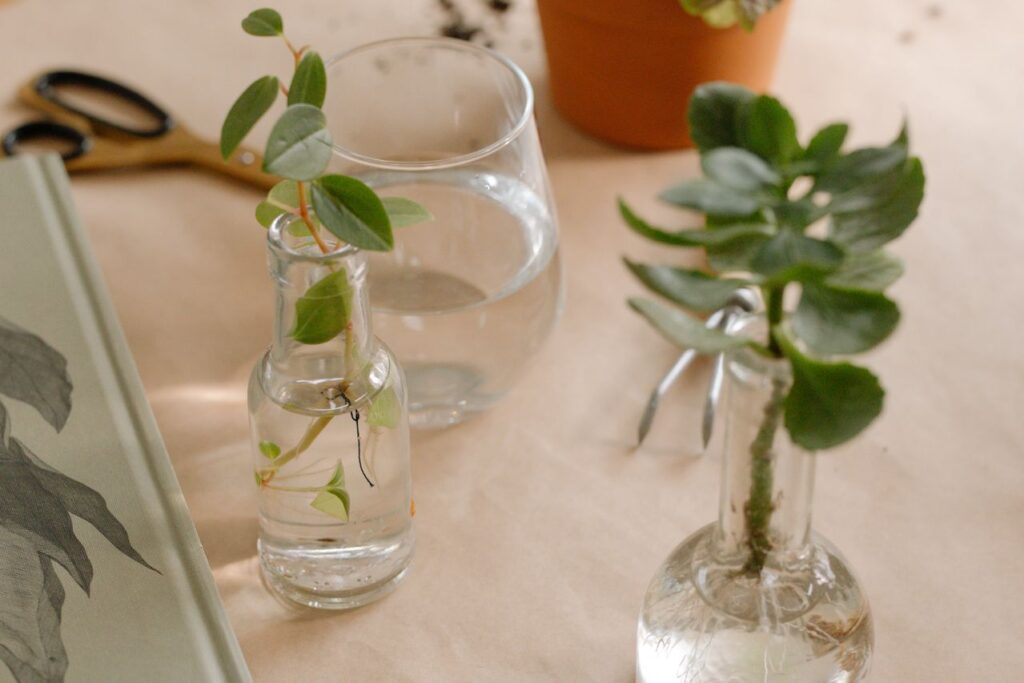
Rooting in Water Can Be Easier to Monitor
Water propagation works well for some species.
Mint, basil, pothos, and several other easy-rooting plants can form roots in clean water.
Keep leaves above the waterline and submerge one or more bare nodes.
Place the container in bright, indirect light.
Change or refresh the water if it becomes cloudy or develops odour.
Water propagation makes it easy to see root development, but it does not eliminate the risk of rot.
If the stem becomes soft or black, discard that cutting.
Do Not Wait Forever Before Potting Up
Water-rooted cuttings do not need extremely long roots before moving into potting mix.
Once they have formed a healthy network of roots, they can usually be transplanted.
Very long, tangled water roots can be harder to handle.
For soil-rooted cuttings, look for fresh growth or gentle resistance when the stem is lightly moved.
Do not pull the cutting out just to check whether roots exist.
You may damage them.
Use Rooting Hormone Only When Needed
Many easy-rooting plants do not require rooting hormone.
Mint and basil often root without it.
For harder-to-root species, a properly labelled rooting hormone may improve success.
Follow the product instructions.
Using more than recommended does not automatically produce more roots.
Homemade alternatives such as honey, cinnamon, or aloe are often promoted online, but they should not be assumed to work like commercial rooting hormones.
For easy plants, you may not need any special treatment at all.
Warmth Helps, but Excessive Heat Does Not
Malaysia already provides warm temperatures that suit many tropical and subtropical cuttings.
You usually do not need heated propagation equipment.
Avoid placing propagation containers on hot concrete or in enclosed spaces that heat up dramatically during the day.
A warm sheltered location is enough.
Heat combined with saturated media can accelerate rot.
Reduce Leaf Area When Necessary
Cuttings with large leaves lose more water.
For some plants, trimming part of the leaf area can reduce moisture stress.
Do not remove all leaves.
The cutting still needs photosynthesis.
For small-leaved herbs, major trimming is usually unnecessary.
The goal is to reduce excessive water loss while keeping enough healthy leaf area to support rooting.
Do Not Fertilise Too Early
Fresh cuttings do not need strong fertiliser.
They have little or no root system capable of using it.
Concentrated fertiliser can also increase salt levels around developing roots.
Wait until the cutting has rooted and begun producing healthy new growth.
Then begin feeding appropriately for the plant.
How Long Will Rooting Take?
There is no universal answer.
Easy herbs may root relatively quickly.
Semi-woody or woody plants may take weeks or longer.
Species, stem age, temperature, light, humidity, and propagation method all affect rooting speed.
Do not assume failure simply because another plant rooted faster.
Judge each species on its own.
Signs a Cutting Is Rooting Successfully
Look for:
new leaf growth,
new shoots,
healthy stem colour,
firm leaves,
and gentle resistance when the cutting is lightly moved.
Fresh growth is especially encouraging because it suggests the cutting is beginning to support itself.
However, do not confuse temporary growth from stored stem energy with a fully developed root system.
Give the plant enough time before transplanting.
Transition Rooted Cuttings Gradually
Once rooted, the new plant is still young.
Move it into suitable potting mix if necessary.
Water it well.
Then gradually increase light exposure.
If it was rooted under shade, do not move it straight into full afternoon sun.
A rooted cutting can still suffer transplant shock.
Treat it as a young plant.
A Simple Malaysian Propagation Setup
For many easy-to-root plants, you can keep things very simple.
Use healthy cuttings.
Remove lower leaves.
Insert one or two nodes into a light, airy medium.
Keep the medium lightly moist.
Place the pot in bright shade.
Allow gentle airflow.
Skip the humidity dome unless the cutting actually needs one.
Check for rot.
Wait for new growth.
Then pot up once roots are established.
That is often enough.
At the end of the day, Malaysia’s humidity can be a major advantage for rooting cuttings — as long as you do not turn that advantage into permanently wet, stagnant conditions. Fresh cuttings need enough humidity to avoid drying out, but they also need oxygen, drainage, airflow, and clean growing media. Keep the setup simple, resist the urge to overwater, and let the plant focus on building roots. In our climate, successful propagation is often less about adding more moisture and more about knowing when enough is enough.
Trying to root mint, basil, rosemary, ornamentals, or another favourite plant from cuttings? Tag @projectharvest.my on Instagram and show us your propagation setup, new roots, failed experiments, or the first fresh growth that tells you the cutting has taken. We would love to see how Malaysian gardeners are using our humid climate to multiply more plants at home.