
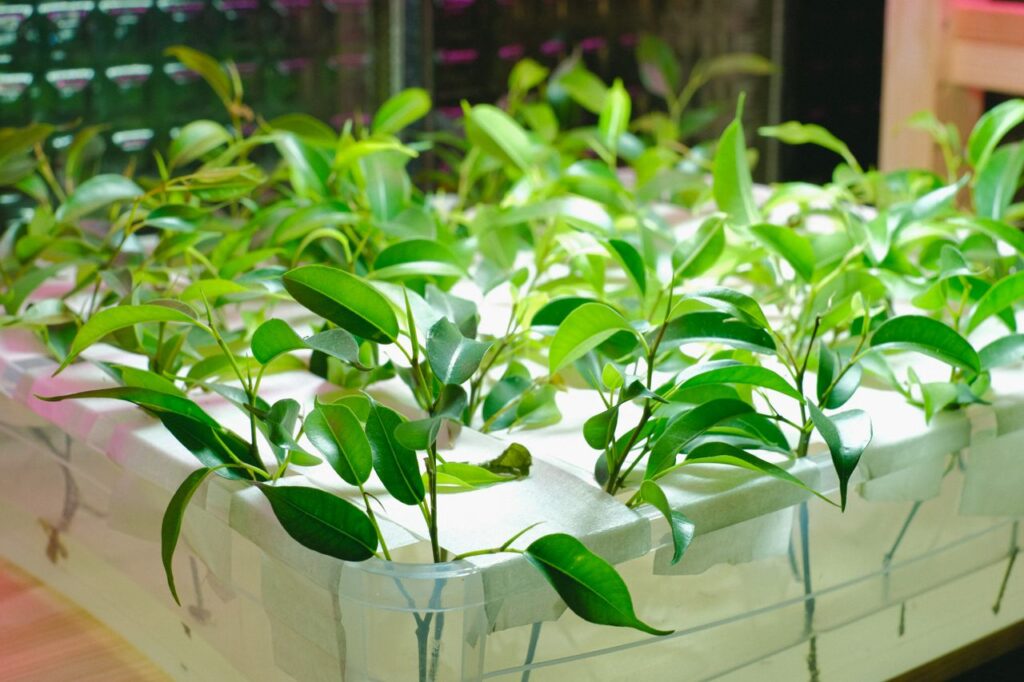
Neither water propagation nor soil propagation is universally better.
Water propagation is easier to monitor because you can see roots developing, while soil propagation often produces a cutting that is already adapted to growing in a solid, oxygen-filled medium.
For easy-rooting plants such as mint, basil, pothos, and many common ornamentals, either method may work.
For more difficult plants, the better choice depends on the species.
The most useful question is therefore not simply, “Which method is best?”
It is:
Which method suits this particular plant and how I plan to grow it afterwards?
What Is Water Propagation?
Water propagation means placing a prepared stem cutting into a container of water until roots form.
Usually, one or more bare nodes are placed below the waterline while the leaves remain above it.
The container is then kept somewhere with bright but gentle light.
Once enough roots develop, the cutting is transferred into potting mix.
The biggest advantage is obvious: you can watch the entire rooting process.
For beginners, this makes propagation feel much less mysterious.
What Is Soil Propagation?
Soil propagation means placing the cutting directly into a growing medium rather than water.
The medium might contain materials such as cocopeat and perlite or another light mixture that provides both moisture and air.
The cutting produces roots directly inside this medium.
Once established, it may simply be moved into a larger pot without going through the additional transition from water into soil.
Technically, gardeners often say “soil propagation” even when the propagation mix contains little or no actual garden soil.
The important point is that the cutting is rooting in a solid, airy growing medium.
Water Propagation Is Easier to Observe
This is probably its biggest advantage.
With a clear glass or container, you can see:
when the first root appears,
how quickly roots grow,
whether the stem begins rotting,
and when the root system seems large enough for transplanting.
This makes water propagation excellent for learning.
It can also be satisfying.
Watching an ordinary stem suddenly produce white roots is one of those gardening moments that makes propagation addictive.
Soil Propagation Requires More Patience
When a cutting is rooting inside a pot, you cannot see what is happening underground.
That can tempt gardeners to pull it up for inspection.
Do not.
Fresh roots are extremely delicate.
Repeatedly removing the cutting to check whether roots have formed can damage them.
Instead, look for signs above the soil:
new leaves,
fresh shoots,
a firmer stem,
and gentle resistance when the cutting is very lightly moved.
Soil propagation requires a little more trust.
Water Roots and Soil Roots Are Not Exactly the Same
A cutting rooted in water develops roots suited to an aquatic environment.
These roots may be relatively delicate and adapted to constant water availability.
Once transferred into potting mix, the plant must adjust to a completely different environment containing:
air spaces,
variable moisture,
physical resistance,
and different oxygen conditions.
The cutting can successfully make this transition, but it may temporarily slow down or wilt.
This is one reason soil propagation can sometimes provide a smoother long-term establishment.
The roots develop in the type of environment where the plant will continue growing.
Does That Mean Water Roots Are Bad?
No.
Water propagation is a perfectly legitimate propagation method for many plants.
The existence of a transition period does not make water-grown roots defective.
Plenty of plants successfully move from water into potting mix.
The key is handling that transition carefully.
Once roots have developed sufficiently, transfer the cutting into a light, suitable potting medium and keep that medium consistently moist during the first several days.
Do not let it suddenly become bone dry.
As the plant establishes, gradually return to a normal watering cycle.
Water Propagation Can Be Very Simple
For easy plants, the setup may require nothing more than:
a clean glass or jar,
water,
a cutting,
and a bright location.
There is no propagation medium to prepare.
There is very little mess.
That can make water propagation especially attractive for apartment or condominium gardeners.
You can even keep a small propagation station on a suitable indoor shelf.
Just make sure the plant receives enough light.
But Standing Water Needs Attention in Malaysia
This is especially important in our climate.
Any open container holding water can become a mosquito concern if mosquitoes can access it and the water sits long enough.
Propagation jars should therefore be monitored closely.
Do not leave forgotten containers of stagnant water around balconies, patios, or outdoor growing areas.
You can cover the opening around the cutting with an appropriate barrier where practical, refresh the water regularly, and keep the setup somewhere you actively monitor.
If propagation containers start becoming neglected, soil propagation may be the safer and easier option.
Water Can Become Stagnant
Cuttings release small amounts of organic material into the water.
Leaves may fall in.
Microorganisms can multiply.
If the water becomes cloudy, slimy, or develops an unpleasant smell, refresh it.
Clean containers between propagation batches.
If one cutting develops a black, mushy stem, remove it so decaying tissue does not remain in shared water with healthy cuttings.
Water propagation is simple, but it is not maintenance-free.
Soil Propagation Avoids the Water-to-Soil Transition
A cutting rooted directly in a good propagation mix begins developing roots suited to that medium.
Once it is established, you may simply transfer the root ball into a larger pot.
This can reduce the adjustment period associated with moving water-grown roots into potting mix.
For gardeners who already know how to manage moisture well, this makes soil propagation very efficient.
The Challenge with Soil Propagation Is Moisture
Fresh cuttings need moisture, but they also need oxygen.
If the propagation mix becomes waterlogged, the base of the stem may rot before roots develop.
If it dries too much, the cutting may wilt.
The ideal condition is:
evenly moist but airy.
This is especially important in Malaysia’s humidity.
Because evaporation can be slower during wet or cloudy weather, a propagation pot may stay moist for much longer than expected.
Do not water automatically every morning.
Check first.
Cocopeat Can Work Well — With Aeration
Cocopeat is commonly available in Malaysia and retains water very well.
For propagation, that can be useful.
But pure cocopeat can remain excessively wet if heavily watered.
Mixing it with an aeration material such as perlite can create a better balance.
The cutting needs access to moisture without having the stem permanently surrounded by saturated material.
Think of propagation medium as a mix of water-holding spaces and air-holding spaces.
Both matter.
Which Method Is Better for Mint?
Mint is one of the easiest examples for water propagation.
Place a healthy cutting with a node in water and roots often develop readily.
Because it roots so easily, it is excellent for beginners.
Soil propagation also works.
If your goal is simply to make many mint plants quickly, try both methods and see which works better in your conditions.
Mint is forgiving enough to teach you the differences.
What About Basil?
Basil also roots readily in water.
It is particularly convenient if you have healthy stems from pruning or harvesting.
Once roots form, transfer the cuttings into potting mix and keep them appropriately moist during establishment.
Basil can also root directly in propagation medium, so neither approach is wrong.
For a kitchen gardener, water propagation may simply be more convenient.
What About Rosemary?
Rosemary can be more temperamental than mint or basil.
Cuttings may rot if kept too wet.
A well-draining propagation medium may offer better control than leaving stems in water for long periods.
Success also depends on the type of cutting and the health of the parent plant.
This is a good example of why one propagation method should not be applied blindly to every species.
Woody Plants Often Prefer More Controlled Media
Semi-woody and woody cuttings often benefit from propagation mixes with excellent aeration.
Some species may also respond well to properly used rooting hormone.
Water propagation may work for certain woody plants, but it is not always the easiest or most reliable choice.
For more difficult species, researching the specific plant becomes more important.
Which Method Is Faster?
There is no universal winner.
Water may appear faster because you can see the roots the moment they emerge.
In soil, rooting may already be happening without any visible sign above ground.
Different plants also respond differently.
A mint cutting may root rapidly in water.
Another species may root more successfully in propagation mix.
Do not choose a method purely because someone online produced roots in five days.
Propagation speed varies with:
species,
stem maturity,
temperature,
light,
humidity,
and parent-plant health.
Which Method Has Less Risk of Rot?
Either method can cause rot if badly managed.
In water, stagnant conditions and unhealthy stems can lead to decay.
In soil propagation, saturated growing media and poor airflow can do the same.
The solution is not simply choosing one method.
It is maintaining clean, appropriate conditions.
For water propagation, keep the container and water reasonably clean.
For soil propagation, avoid waterlogging and ensure drainage.
Which Method Is Better for Malaysian Humidity?
For many plants, soil propagation can work extremely well in Malaysia because our naturally high humidity reduces the risk that fresh cuttings will immediately dry out.
You may not need elaborate humidity domes.
However, that humidity also increases the need for good airflow and careful watering.
Water propagation remains very practical for easy-rooting herbs and indoor plants, provided standing water is managed responsibly.
So the Malaysian climate does not automatically favour one method.
It simply changes what you need to watch.
Try Both on the Same Plant
One of the best ways to learn is to run your own experiment.
Take six similar cuttings from the same healthy parent plant.
Place three in water.
Place three in propagation mix.
Keep them under similar light and temperature conditions.
Record:
how long rooting takes,
how many survive,
how developed the roots become,
and how well each group grows after potting up.
This can tell you far more about your own growing conditions than a generic recommendation online.
When Water Propagation Makes More Sense
Water propagation is especially useful when:
you are a beginner,
you want to observe rooting,
the plant roots readily in water,
you only have a few cuttings,
or you want a clean indoor setup.
It is also excellent for educational purposes because you can literally watch propagation happening.
When Soil Propagation Makes More Sense
Direct propagation into growing medium may be better when:
you want to avoid the water-to-soil transition,
you are propagating many cuttings,
the plant is prone to water rot,
you are working with semi-woody stems,
or you already have a good propagation setup.
It can also be more practical for nurseries or gardeners producing larger numbers of plants.
A Simple Rule for Beginners
If you are unsure, start with the plant.
For mint, basil, pothos, and other easy-rooting species, water propagation is a great learning method.
For plants known to dislike long periods in water or for more woody cuttings, start with a light propagation mix.
If both methods are known to work, try both.
Gardening does not always require choosing one permanent technique.
The Best Method Is the One That Produces a Healthy Plant
A jar full of impressive roots is not the final goal.
Neither is a cutting that survives for months in a propagation pot without growing.
The real goal is a healthy, independent plant that eventually establishes in its permanent growing environment.
Judge the propagation method by what happens after rooting, not only by how quickly roots first appear.
At the end of the day, water propagation and soil propagation are both useful tools. Water makes root development easy to observe and works brilliantly for many beginner-friendly plants, while soil propagation allows roots to develop directly in the type of environment where they will continue growing. In Malaysia, our humidity can favour both methods — provided you control excess moisture, maintain airflow, and never forget that open water can become a mosquito problem. Instead of asking which method is universally better, match the method to the plant and the way you want to grow it.
Want to run your own propagation experiment? Take cuttings from the same mint, basil, herb, or ornamental plant and try half in water and half in propagation mix. Then tag @projectharvest.my on Instagram and show us which rooted first, which produced stronger plants, and what surprised you along the way. We would love to compare real Malaysian results and see whether Team Water or Team Soil wins in your garden.