
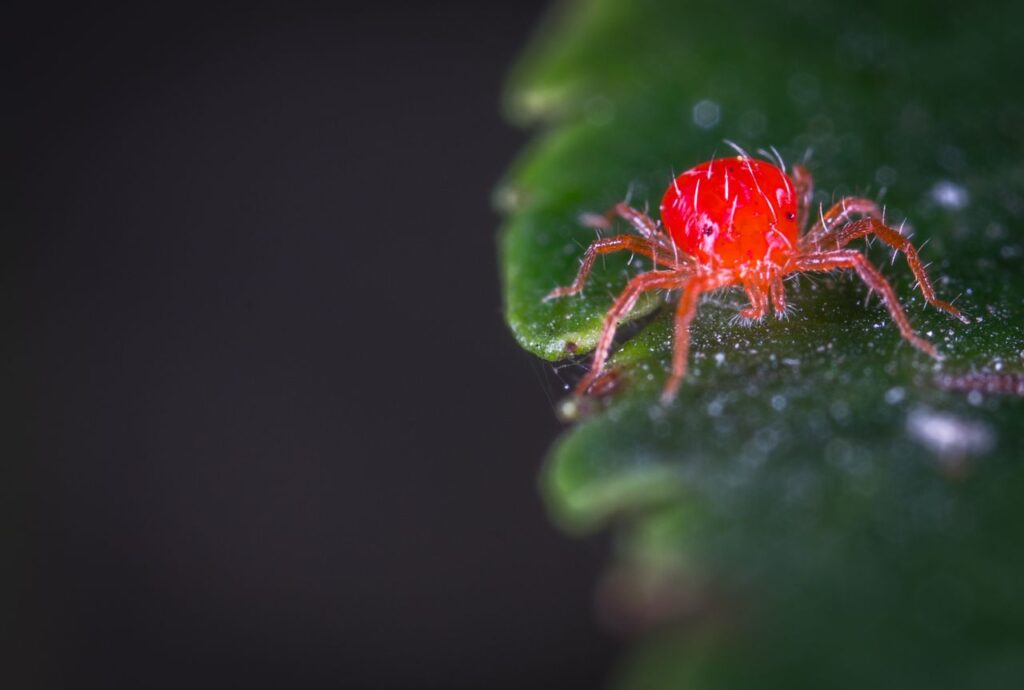
Spider mites often become more troublesome during hot, relatively dry weather, especially on stressed plants growing in containers, balconies, sheltered areas, or heat-reflecting urban spaces.
The earliest signs are usually not the mites themselves.
Look for:
fine pale speckling on leaves,
a dusty or bronzed appearance,
tiny moving dots underneath leaves,
and eventually very fine webbing.
By the time a plant is covered in obvious webbing, the infestation is usually already serious.
The best strategy is to inspect vulnerable plants early, reduce mite numbers before populations explode, and use a combination of physical, cultural, and carefully selected treatments rather than relying on one spray.
What Are Spider Mites?
Spider mites are tiny plant-feeding arachnids.
That means they are more closely related to spiders and ticks than to insects.
They feed by piercing plant cells and removing their contents.
Because individual feeding spots are tiny, the first symptom often looks like hundreds of little pale dots scattered across the leaf.
This is called stippling.
Why Are They Worse in Hot Weather?
Many spider mite species reproduce very quickly under warm conditions.
Hot, dry weather can shorten their life cycle and allow populations to increase rapidly.
In a Malaysian home garden, this can become especially noticeable on plants growing:
against hot walls,
on sunny balconies,
under roofed areas,
or in containers that dry quickly.
A small population that goes unnoticed can become a major infestation within a relatively short period.
What Does Early Spider Mite Damage Look Like?
The first clue is often a leaf that no longer looks evenly green.
Instead, it develops:
tiny pale dots,
fine yellow speckling,
or a slightly faded appearance.
As feeding increases, the leaf may become:
bronzed,
grey-green,
yellow,
or dry-looking.
This damage can easily be mistaken for:
nutrient deficiency,
drought stress,
or general heat damage.
The underside of the leaf usually provides better evidence.
Always Check Leaf Undersides
Spider mites often feed and reproduce on the underside of leaves.
Turn the leaf over.
Look carefully near:
the main veins,
leaf edges,
and sheltered areas.
You may see tiny moving dots that are:
yellowish,
greenish,
reddish,
brown,
or nearly translucent,
depending on species and life stage.
A magnifying glass can help enormously.
Use the White-Paper Test
A simple home-garden test is to hold a sheet of white paper under an affected leaf.
Tap or shake the leaf gently.
If tiny mites fall onto the paper, you may see very small dots beginning to move.
This does not identify the exact species, but it can help confirm that a mite population is present.
What Does Spider Mite Webbing Look Like?
As populations increase, some spider mites produce fine silk.
You may notice delicate webbing:
between leaves,
around growing tips,
along stems,
or across leaf undersides.
This webbing is much finer than the webs produced by normal garden spiders.
Heavy webbing usually means the infestation is no longer at an early stage.
Do Not Wait for Webbing Before Acting
This is one of the biggest mistakes gardeners make.
Webbing is a late warning sign.
The plant may already have suffered extensive feeding damage by the time it becomes obvious.
Regularly inspect plants that are prone to mite problems during hot weather.
Finding early stippling is much better than finding a web-covered plant.
Which Plants Are Commonly Affected?
Spider mites can attack many crops.
Home gardeners may notice them on:
chillies,
brinjal,
beans,
cucumbers,
tomatoes,
herbs,
ornamentals,
and various fruiting plants.
Plants under heat or water stress often show damage more severely.
Spider Mites vs Thrips
These two pests are easy to confuse.
Both can cause pale or damaged leaves.
Spider mites commonly cause:
fine stippling,
bronzing,
dry-looking foliage,
tiny mites under leaves,
and fine webbing.
Thrips commonly cause:
silvery streaks,
surface scarring,
distorted young growth,
flower damage,
and tiny black droppings.
Thrips are also slender insects, while spider mites appear more like tiny moving dots.
Spider Mites vs Nutrient Deficiency
Nutrient deficiencies tend to follow more predictable patterns.
For example:
nitrogen deficiency usually affects older leaves more uniformly,
magnesium deficiency creates yellowing between older leaf veins,
and iron chlorosis affects young leaves between green veins.
Spider mite feeding is usually more irregular and speckled.
A magnifying glass or white-paper test can prevent unnecessary fertiliser applications.
Heat-Stressed Plants Can Be More Vulnerable
Spider mites often become a bigger problem when plants are already stressed.
A chilli plant that repeatedly dries until it wilts may:
lose vigour,
produce weaker foliage,
and tolerate mite feeding poorly.
Good watering does not eliminate spider mites.
But maintaining stable plant health can improve the plant’s ability to cope with low pest numbers.
Avoid Repeated Severe Drying
Container plants are especially vulnerable during Malaysian hot spells.
Pots beside:
concrete walls,
metal railings,
rooftops,
and paved areas
can become extremely hot.
Keep the root zone reasonably stable.
Mulch where appropriate and use adequately sized containers.
Do not interpret heat-stressed foliage as proof that the plant needs more fertiliser.
Increase Inspection Frequency During Hot Dry Periods
When weather becomes especially hot and relatively dry, check vulnerable plants more often.
Focus on:
older leaves,
leaf undersides,
and areas showing pale stippling.
Catching ten mites is easier than managing thousands.
Remove Severely Infested Leaves
If only a few leaves are heavily covered with mites or webbing, removing them can immediately reduce part of the population.
Do not remove so many leaves that the plant is left unable to photosynthesise.
Remove selectively.
Dispose of heavily infested material away from the growing area.
A Strong Water Spray Can Help
For sturdy plants, a firm but plant-safe stream of water can physically remove many spider mites.
Pay particular attention to the undersides of leaves.
This can be surprisingly useful for light infestations.
However, one wash usually will not eliminate every mite or egg.
Monitoring must continue.
Be Careful with Repeated Leaf Wetting
Malaysia’s high humidity creates an important trade-off.
Water sprays can knock mites off plants, but repeatedly soaking dense foliage may increase the risk of fungal or bacterial problems.
Use physical washing strategically.
Make sure the plant has:
good airflow,
reasonable spacing,
and time for leaves to dry.
Insecticidal Soap May Help
Products specifically labelled as insecticidal soap can be useful against exposed mites.
They work mainly by direct contact.
Coverage matters.
Spray needs to reach the pest, particularly on leaf undersides.
Follow label instructions carefully for:
dilution,
crop suitability,
application interval,
and edible-crop use.
Do not substitute ordinary household dishwashing liquid.
Dish detergents are not formulated as horticultural pesticides and can injure leaves.
Horticultural Oils Can Also Be Useful
Horticultural oils can suppress mites by coating exposed pests and eggs.
Neem-based horticultural products may also be used where the product is labelled appropriately.
Coverage is critical.
A light spray only on the upper leaf surface may miss much of the population underneath.
Always follow the label.
Avoid Oils During Extreme Heat
Oil-based sprays can cause leaf injury when applied under unsuitable conditions.
Malaysia’s strong sun and high afternoon temperatures make timing important.
Do not spray oil products onto hot, heat-stressed foliage unless the label specifically allows those conditions.
Cooler periods, often early morning, may be more appropriate.
Also check whether rain is expected soon after application.
Do Not Mix Sprays Randomly
Avoid creating homemade mixtures containing:
oil,
soap,
fertiliser,
fungicide,
and pesticide
all in one bottle.
Products may be incompatible or become more phytotoxic when combined.
Phytotoxic means damaging to plant tissue.
Only mix products when the label specifically permits it.
One Treatment Is Rarely Enough
Spider mites have a rapid life cycle.
Even if a treatment kills many adults and young mites, eggs may remain.
New mites can hatch afterwards.
This is why populations sometimes seem to “come back.”
Repeated treatment may be necessary, but follow the product’s labelled interval rather than spraying every day.
Check the Plant Again After Treatment
After treatment, inspect the plant rather than assuming the problem is solved.
Look for:
new stippling,
living mites,
fresh webbing,
and healthier new leaves.
Old damage will remain.
A leaf that was already bronzed will not turn perfect again.
Judge treatment by whether new damage stops appearing.
Beneficial Mites and Predators Can Help
Spider mites have natural enemies, including predatory mites and other small beneficial arthropods.
In larger biological-control systems, predatory mites can be used deliberately.
Even in an ordinary home garden, avoiding unnecessary broad-spectrum pesticides helps preserve natural predators.
A garden with some beneficial life is often more stable than one sprayed indiscriminately.
Broad-Spectrum Insecticides Can Make Mite Problems Worse
This surprises many gardeners.
Some broad-spectrum insecticides can kill predatory insects and mites more effectively than they control spider mites.
The spider mite population may then rebound without natural enemies keeping it in check.
Some insecticides can also contribute to mite flare-ups under certain conditions.
Do not reach automatically for the strongest insecticide available.
Resistance Is Another Concern
Spider mites can develop resistance to repeatedly used pesticides.
If a product is failing despite correct application, spraying it more frequently is not necessarily the answer.
Where specific miticides or pesticides are necessary, use products legally labelled for the crop and pest and follow resistance-management guidance.
For home gardeners, early intervention and non-chemical methods can reduce the need to reach that stage.
Edible Crops Require Label-Approved Products
When treating:
chillies,
brinjal,
beans,
cucumber,
tomatoes,
or herbs,
use only products suitable for the crop and intended use.
Follow:
application rate,
protective instructions,
maximum frequency,
and pre-harvest interval where stated.
Do not assume a product is safe on vegetables simply because it kills mites on ornamental plants.
Keep the Garden Clean — But Not Sterile
Remove:
heavily infested fallen leaves,
dead crop material,
and declining plants that are acting as major pest reservoirs.
But spider mite management does not require stripping every leaf or eliminating all garden life.
The goal is to reduce pest pressure while maintaining a functional garden ecosystem.
Check New Plants Before Introducing Them
Spider mites can arrive on nursery plants.
Before adding a new plant to your garden, inspect:
leaf undersides,
older foliage,
and growing tips.
Look for:
stippling,
tiny mites,
and fine webbing.
If practical, keep new plants slightly separated while observing them.
When Should You Remove the Whole Plant?
Sometimes an old or severely infested plant is not worth saving.
Consider removal when:
the plant is heavily webbed,
much of its foliage is damaged,
it is already near the end of its productive life,
and it is spreading mites to healthier plants.
Removing one badly infested chilli may protect ten better plants nearby.
A Simple Spider Mite Management Plan
When you confirm spider mites:
1. Inspect the whole plant and nearby plants.
2. Remove a limited number of badly infested leaves.
3. Use water to physically dislodge mites where suitable.
4. Improve watering and reduce severe plant stress.
5. Use insecticidal soap or horticultural oil if needed and labelled appropriately.
6. Cover leaf undersides properly.
7. Repeat only according to label instructions.
8. Avoid unnecessary broad-spectrum insecticides.
9. Monitor new growth for fresh damage.
10. Remove severely declining pest reservoirs if control is no longer practical.
How Do You Know the Plant Is Recovering?
You should begin seeing:
less fresh stippling,
fewer mites during inspections,
little or no new webbing,
and healthy new foliage.
Old leaves may stay:
bronzed,
scarred,
or partially yellow.
That is normal.
The important question is whether the next leaves are healthier.
Prevention Is Mostly About Early Detection
You cannot guarantee spider mites will never appear.
But you can make outbreaks easier to manage by:
inspecting plants regularly,
avoiding severe drought stress,
checking new nursery plants,
preserving beneficial predators,
and acting while populations are still small.
In hot weather, waiting another two weeks can make a major difference.
At the end of the day, spider mites are easiest to manage before fine stippling turns into bronzed leaves and heavy webbing. Malaysian gardeners should inspect leaf undersides closely during hot dry periods, particularly on chillies and other container vegetables exposed to intense heat. Physical washing, selective leaf removal, good plant care, insecticidal soaps, horticultural oils, and conservation of beneficial predators can all form part of an effective management programme. Avoid indiscriminate spraying, monitor after every treatment, and judge success by the health of the new growth rather than expecting old damaged leaves to recover.
Seeing tiny pale dots, bronzed foliage, or suspicious fine webbing on your chillies, brinjal, beans, or other vegetables? Share close-up photos of the top and underside of the affected leaves, along with your growing conditions, and tag @projectharvest.my on Instagram. Real Malaysian hot-weather mite cases can help other home gardeners learn to recognise the problem while it is still small enough to control.