
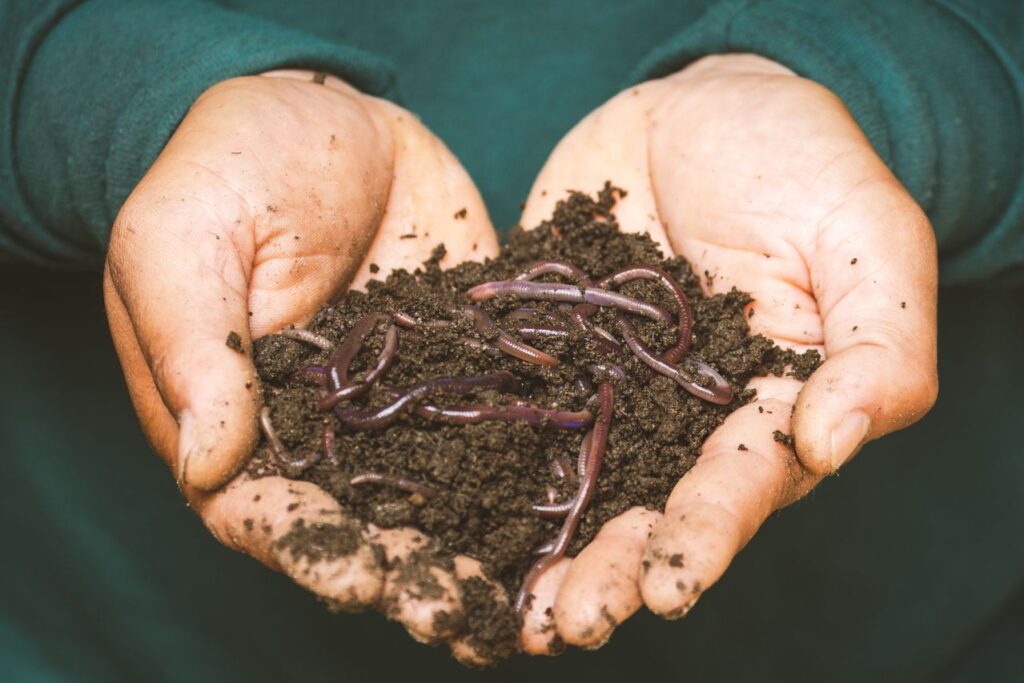
Vermicompost may look like ordinary dark compost, but it is produced in a very different way. Instead of relying only on microorganisms to break down organic material, vermicomposting uses composting worms — commonly red wigglers — together with microorganisms to transform food scraps and other suitable materials into a fine, nutrient-rich soil amendment.
The finished material is commonly called vermicompost or worm castings, and it can be used in containers, raised beds, vegetable gardens, herbs, flowers, and around established plants.
The important thing to understand is that you usually do not need huge quantities. Vermicompost works best as part of a healthy growing system, rather than as the entire growing medium.
What Makes Vermicompost Useful?
Vermicompost contains organic matter, plant nutrients, and biologically active material created during the decomposition process.
Adding it to soil can improve properties such as porosity and water-holding capacity while supplying nutrients gradually. University extension guidance describes worm castings as useful both as a soil amendment and a slow-release nutrient source.
That makes it particularly useful for Malaysian home gardeners growing in containers, where soil volume is limited and nutrients can gradually be lost through frequent watering.
However, vermicompost should not be treated as a magic fertiliser.
Its nutrient content varies depending on what the worms were fed and how the vermicompost was produced. A handful from one worm farm may not contain exactly the same nutrients as another product.
How to Use Vermicompost in Potting Mix
When preparing a new container, mix vermicompost with a proper potting medium rather than filling the entire pot with worm castings.
A practical starting point is roughly one part vermicompost to four parts potting mix, or around 20% of the overall mixture. University of California Master Gardener guidance recommends this type of ratio, while Oregon State University notes that worm compost can make up roughly a quarter of a container growing mix.
The remaining mix still needs to provide good drainage and aeration.
For Malaysian container gardens, this matters because pots can receive both intense heat and sudden heavy rain. A healthy growing medium needs to hold enough moisture for roots while allowing excess water to drain.
Vermicompost should therefore complement ingredients such as quality potting mix, cocopeat, composted bark, perlite, pumice, or other suitable components depending on the plants you are growing.
Do not use pure vermicompost as the only potting medium simply because it looks rich and healthy.
How to Top-Dress Existing Pots
You do not have to repot an established plant every time you want to use vermicompost.
Instead, it can be applied as a top dressing.
Move any mulch aside, spread a thin layer of vermicompost over the soil surface, gently scratch it into the uppermost layer if possible, and water normally.
Keep the material slightly away from the main stem or trunk rather than piling it directly against the plant.
As you water the pot, nutrients and organic compounds gradually move into the root zone.
This method works particularly well for established Malaysian favourites such as chillies, curry leaf, pandan, herbs, brinjal, tomatoes, and container-grown fruit plants.
For small pots, you only need a modest amount. Larger containers can naturally take more.
You are feeding the soil — not trying to bury the plant in worm castings.
Using Vermicompost in Garden Beds
Vermicompost can also be incorporated into vegetable beds before planting.
Spread it across the bed and gently work it into the upper soil layer rather than concentrating everything in one small hole.
This helps distribute organic matter throughout the root zone.
For established plants, vermicompost can be spread around the surrounding soil as a top dressing and watered in.
Research-based guidance allows for fairly generous surface applications around vegetables and flowers, but vermicompost can be expensive compared with ordinary compost, so Malaysian home gardeners do not necessarily need to cover an entire large bed with a thick layer.
A practical approach is to use ordinary finished compost for bulk organic matter and reserve vermicompost as a richer amendment around actively growing plants.
Vermicompost and Regular Compost Are Not Competitors
You do not have to choose between traditional compost and vermicompost.
They work very well together.
Regular compost is excellent for adding larger quantities of organic matter, improving soil structure, covering garden beds, and recycling garden material.
Vermicompost is usually finer and can be used more selectively around plants, in potting mixes, or when establishing seedlings.
Think of regular compost as the bulk soil builder and vermicompost as a more concentrated addition.
For example, if you are preparing a raised bed, you might use finished compost to improve the entire bed and then add smaller quantities of vermicompost around the areas where vegetables will actually be growing.
That is often much more economical than trying to fill the whole bed with worm castings.
Can You Use Vermicompost for Seedlings?
Yes, but moderation matters.
Seedlings need moisture, nutrients, and good aeration, but their young roots are delicate.
Vermicompost can form one component of a seed-starting or transplanting mix, but it should normally be mixed with lighter growing-medium ingredients rather than used alone.
When transplanting a young chilli, tomato, brinjal, or herb seedling, you can also mix a modest amount of vermicompost into the surrounding planting medium.
Avoid placing seedlings into a dense pocket of one amendment.
Roots establish better when the entire surrounding medium has reasonably consistent texture, moisture, and aeration.
When Should You Apply It?
There is no need to add vermicompost every week.
Useful times include when preparing a new potting mix, establishing a vegetable bed, transplanting seedlings, refreshing the soil between crop cycles, or top-dressing plants during active growth.
After application, observe the plant.
If growth is healthy and productive, continually adding more simply because vermicompost is “natural” is unnecessary.
Organic amendments can still contribute nutrients, and excessive nutrient accumulation is possible when many different composts and fertilisers are repeatedly added to the same soil.
More is not always better.
Does Vermicompost Replace Fertiliser?
Not necessarily.
Vermicompost supplies nutrients, but its composition is variable and it may not provide every crop with everything it needs throughout an entire growing season.
A heavily fruiting chilli or tomato plant, for example, may have greater nutrient demands than a small herb.
Use plant performance, crop requirements, and ideally soil information to decide whether additional fertiliser is required.
Do not assume that because vermicompost is organic, you can apply unlimited quantities without considering the nutrient balance.
Be Careful with Unfinished Vermicompost
Good finished vermicompost should be dark, crumbly, earthy-smelling, and contain relatively little recognisable food waste.
If you can still see large amounts of undecomposed kitchen scraps, the material may not be ready to use extensively around plants.
Unfinished food material can attract flies and other pests — something especially worth considering in warm Malaysian homes.
If you maintain your own worm bin, separate finished material from active feeding areas before using it in pots.
You may occasionally find small worms or cocoons in harvested vermicompost. That is not necessarily a problem, but most of the composting worms should remain in the bin so they can continue producing the next batch.
Store Vermicompost Properly
If you buy or harvest more vermicompost than you immediately need, do not leave it baking under the Malaysian afternoon sun.
Store it somewhere shaded and protected from excessive heat and drying.
The material should remain reasonably moist rather than becoming completely dry and dusty.
At the same time, avoid sealing soaking-wet vermicompost inside an airtight container for long periods.
You are dealing with biologically active organic material, so sensible moisture and airflow help preserve its quality.
Do You Need Vermicompost in Every Garden?
No.
A garden already producing healthy plants in fertile, well-managed soil does not suddenly require vermicompost.
It is another useful tool.
It can be particularly valuable for container gardeners, gardeners trying to build soil organic matter, people producing their own compost from kitchen waste, or anyone wanting to improve the biological and physical condition of their growing medium.
But compost, mulch, drainage, appropriate fertilisation, good watering, and healthy soil structure still matter.
Vermicompost works best with those practices, not instead of them.
At the end of the day, using vermicompost is surprisingly simple. Mix a moderate amount into potting media, top-dress established containers, add it to garden beds before planting, or combine it with regular compost as part of your ongoing soil-care routine. You do not need to use huge quantities, and you certainly do not need to replace all your soil with worm castings. A little vermicompost used thoughtfully can become a valuable part of a healthier, more productive Malaysian home garden.
Using vermicompost in your garden — or producing your own worm castings at home? Show us how you are using it. Tag @projectharvest.my on Instagram and share your worm bin, potting mix, vegetable beds, plant growth, or before-and-after results with us. Your little bucket of worm castings might just inspire another Malaysian gardener to start looking at kitchen waste as something their garden can use instead of something that has to be thrown away.