
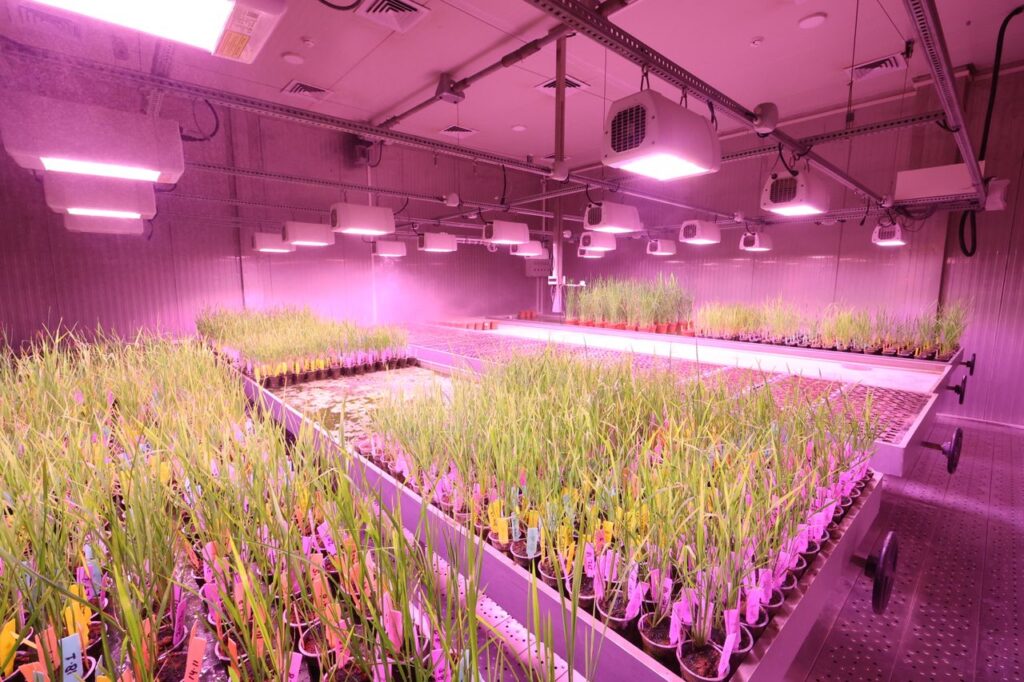
Hydroponic nutrient solution is the water that supplies a plant with the mineral nutrients it would normally obtain through soil.
For a beginner, the most important rules are simple:
use a fertiliser designed for hydroponics, mix it at the correct concentration, keep the pH within a suitable range, protect the reservoir from excessive heat and light, and do not keep adding nutrients just because the plant is growing quickly.
Hydroponics gives you excellent control over plant nutrition.
But because the roots depend directly on the solution you prepare, mistakes can affect plants more quickly than they might in soil.
Why Ordinary Water Is Not Enough
Plants do not survive on water and sunlight alone.
They also need essential mineral nutrients.
These include major nutrients such as:
nitrogen,
phosphorus,
potassium,
calcium,
magnesium,
and sulphur.
They also require smaller quantities of micronutrients such as:
iron,
manganese,
zinc,
boron,
copper,
molybdenum,
chloride,
and nickel.
In soil, many of these nutrients are stored or released gradually.
In hydroponics, the nutrient solution must provide them in forms the roots can absorb.
Use a Proper Hydroponic Nutrient Formula
For beginner growers, the easiest approach is to use a complete hydroponic fertiliser.
These products are designed to dissolve in water and supply the range of nutrients required for hydroponic growth.
Some are sold as:
one-part nutrients,
two-part A and B nutrients,
or multi-part systems.
A and B nutrient systems are common because certain concentrated minerals can react with each other if stored together in the same bottle.
Separating them helps keep those nutrients soluble until they are diluted into the reservoir.
Never Mix Concentrated A and B Nutrients Together Directly
This is an important rule.
If your hydroponic fertiliser comes as Part A and Part B, do not pour the two concentrated solutions together before adding them to water.
Doing so can cause some nutrients to react and form insoluble deposits.
That means nutrients may fall out of solution and become less available to plants.
Instead:
fill the reservoir with water,
add the correct amount of Part A,
mix thoroughly,
then add Part B,
and mix again.
Always follow the manufacturer’s instructions.
NPK Is Only Part of the Story
A hydroponic nutrient may display NPK numbers, just like ordinary fertiliser.
But hydroponic plants need more than nitrogen, phosphorus, and potassium.
A complete nutrient programme should also provide:
calcium,
magnesium,
sulphur,
and essential micronutrients.
This is why using a random garden NPK fertiliser in hydroponics may lead to problems.
It may not contain everything the plant needs, or it may not dissolve appropriately.
More Nutrients Do Not Mean Faster Growth
A common beginner mistake is making the solution stronger because the plant looks hungry or is growing quickly.
This can create excessive dissolved salts around the roots.
When nutrient concentration becomes too high, roots can have difficulty taking up water.
The plant may then show:
brown leaf tips,
wilting,
slow growth,
or root stress.
Follow the recommended concentration instead of assuming stronger is better.
What Is EC?
EC stands for electrical conductivity.
It is a way of estimating how many dissolved ions are present in the water.
In practical hydroponics, EC gives you an indication of nutrient solution strength.
A higher EC usually means the solution contains more dissolved minerals.
A lower EC usually means it contains fewer.
An EC meter does not tell you which nutrient is present or missing.
It only measures the overall conductivity of the solution.
Do Beginners Need an EC Meter?
You can start a simple hydroponic system by carefully following the nutrient manufacturer’s instructions.
But an EC meter becomes very useful if you plan to continue with hydroponics.
It can help you see whether the nutrient solution is:
too concentrated,
too weak,
or changing over time.
This becomes especially useful in Malaysia because hot weather can increase water use and evaporation.
As water disappears, the remaining nutrient solution may become more concentrated.
EC Requirements Vary by Crop
There is no single EC value that is perfect for every plant.
Leafy vegetables generally tolerate a different nutrient concentration from mature fruiting crops such as:
chillies,
tomatoes,
and cucumbers.
Young seedlings also usually require gentler feeding than established plants.
Use crop-specific guidance from a reliable hydroponic nutrient manufacturer or growing reference rather than applying one universal number to everything.
What Is pH?
pH measures how acidic or alkaline the nutrient solution is.
In hydroponics, pH is important because it affects how easily roots can absorb different nutrients.
For many hydroponic crops, a mildly acidic root-zone pH — roughly around 5.5 to 6.5 — is commonly used.
Different crops and systems may perform best at slightly different points within that range.
The important thing is avoiding large or persistent pH extremes.
Why Can the Plant Look Deficient Even When Nutrients Are Present?
If pH becomes unsuitable, certain nutrients can become less available to the roots.
This may create deficiency-like symptoms even though those nutrients are physically present in the reservoir.
The gardener then adds more fertiliser.
The solution becomes even stronger.
But the original pH problem remains.
This is why hydroponic growers should not treat every yellow leaf by adding more nutrients.
Check:
pH,
EC,
root condition,
temperature,
and plant age
before changing the feeding programme.
Measure After Mixing
A useful routine is:
prepare the water,
add nutrients according to instructions,
mix thoroughly,
then measure EC and pH.
This tells you what the final nutrient solution actually looks like.
If adjustment is necessary, use products designed for hydroponic pH correction and follow their instructions.
Avoid repeatedly adding random household acids or alkaline materials because they can make the solution difficult to control.
Water Quality Matters
The water you start with already contains dissolved minerals.
Malaysian municipal water quality varies depending on location and supply.
For many home growers, ordinary tap water can be perfectly usable.
But if your starting water already has a relatively high EC, you have less room before adding fertiliser pushes the final solution much higher.
This becomes more important in technical systems where precise nutrient management matters.
Do You Need Distilled or RO Water?
Usually not for a beginner.
Reverse-osmosis, or RO, water can provide a cleaner starting point for advanced growers, but it adds:
equipment,
cost,
maintenance,
and water waste.
If your ordinary tap water produces healthy plants and manageable EC and pH, there may be no reason to complicate the system.
Start simple.
Investigate water quality only if you repeatedly experience unexplained problems.
Let Chlorinated Tap Water Sit Before Use?
You may often hear that tap water must always be left overnight before hydroponic use.
That is not a universal requirement.
Municipal treatment methods vary, and simply allowing water to stand does not remove every type of disinfectant used in water supplies.
For most beginner systems, the more important questions are:
Is the water suitable for plants?
What is its starting EC?
What happens to pH after nutrients are added?
Avoid turning water preparation into a ritual without understanding the reason.
Malaysia’s Heat Can Change the Reservoir Quickly
One of the biggest local considerations is nutrient-solution temperature.
A reservoir sitting in direct afternoon sun may become very warm.
Warm solution can:
hold less dissolved oxygen,
increase root stress,
encourage algae or microbial problems,
and make plants less resilient.
Keep reservoirs:
shaded,
opaque,
and protected from heat-reflecting walls or floors where possible.
The plant needs light.
The nutrient solution does not.
Keep Light Out of the Reservoir
Nutrient-rich water exposed to light can quickly develop algae.
Algae may:
consume nutrients,
affect oxygen conditions,
coat surfaces,
and make the system harder to maintain.
Use:
opaque reservoirs,
proper lids,
and covered openings.
Transparent containers should be completely shielded from light if they are used.
Mosquito Protection Is Essential in Malaysia
Any hydroponic reservoir containing standing water must be designed so mosquitoes cannot access it.
Keep:
lids closed,
unused openings sealed,
and net-pot gaps appropriately covered.
Inspect the system regularly.
This is particularly important for passive systems such as Kratky, where water may remain in the same reservoir for long periods.
Should You Fill the Reservoir Right to the Top?
That depends on the hydroponic system.
In Kratky systems, an air gap develops as plants consume solution.
That air gap is an essential part of the system.
Constantly refilling the reservoir to its original full level can submerge roots that have adapted to the humid air zone.
Other systems, such as NFT or aerated deep-water culture, manage roots differently.
Follow the design principles of your particular system.
Should You Keep Adding Nutrients Whenever the Water Level Drops?
Not automatically.
Plants consume water and nutrients at different rates.
Evaporation also removes water but leaves most dissolved minerals behind.
If you repeatedly replace every litre lost with full-strength nutrient solution, EC may gradually rise.
Sometimes the plant mainly needs water.
Sometimes both water and nutrients need replenishing.
Monitoring EC helps you make that distinction.
What Does a Rising EC Suggest?
If water level falls while EC rises, the solution is becoming more concentrated.
This can happen when the plant or environment removes water faster than nutrients are being removed.
Adding more full-strength nutrient solution would make the concentration even higher.
Depending on the system, adding plain water may be more appropriate.
What Does a Falling EC Suggest?
If EC falls significantly while the plant is growing actively, the plant may be taking up nutrients faster than water.
That can indicate the solution is becoming weaker.
But do not adjust based on one reading alone.
Check:
water level,
plant health,
meter accuracy,
and recent reservoir changes.
Hydroponic management works best when you look at trends.
Keep Your Meters Clean and Calibrated
pH and EC meters are only useful when their readings are reliable.
Follow the manufacturer’s instructions for:
cleaning,
storage,
and calibration.
A badly maintained pH meter can confidently give you the wrong answer.
For beginners, inexpensive meters can still be useful, but treat them as measuring instruments rather than gadgets that never require maintenance.
When Should Nutrient Solution Be Replaced?
There is no universal schedule for every hydroponic system.
It depends on:
reservoir size,
crop,
system type,
plant age,
water quality,
and how stable the solution remains.
A short-cycle Kratky crop may use most of its original reservoir during one crop cycle.
A recirculating system may require periodic reservoir changes and adjustments.
Replace or reset the solution sooner if you notice:
severe imbalance,
bad odour,
root disease,
heavy contamination,
or persistent problems that cannot be corrected through normal management.
Do Not Keep “Fixing” the Reservoir With More Products
Another beginner trap is adding one product after another.
The plant looks pale, so you add iron.
Then magnesium.
Then calcium.
Then extra NPK.
Eventually, the nutrient solution becomes a complicated mixture that is difficult to diagnose.
Start with a complete hydroponic nutrient.
Measure accurately.
Adjust only when you have a reason.
Simple, controlled systems are much easier to troubleshoot.
Seedlings Need Gentler Nutrition
Very young plants usually need less concentrated nutrient solution than mature plants.
Their roots are small and sensitive.
Starting them immediately in a strong fruiting-crop solution can cause stress.
Follow crop- and stage-specific guidance from your nutrient supplier.
As the root system develops, nutrient strength can be adjusted appropriately.
Fruiting Plants Need More Management
Chillies, tomatoes, brinjal, and cucumbers remain in the system much longer than leafy vegetables.
Their nutrient and water demands also change as they move through:
vegetative growth,
flowering,
fruit set,
and harvest.
These crops are possible hydroponically, but they require more attention than a short-cycle pak choi or sawi crop.
Learn basic nutrient management on leafy vegetables first.
A Simple Beginner Nutrient Routine
For your first hydroponic crop:
1. Start with suitable water.
Know your starting conditions where practical.
2. Use a complete hydroponic nutrient.
Do not improvise with kitchen fertilisers.
3. Follow the manufacturer’s mixing rate.
Measure accurately.
4. If using A and B nutrients, add them separately to the water.
Never combine concentrates directly.
5. Mix thoroughly.
Then check the final solution.
6. Measure EC if you have a meter.
Compare with crop-specific guidance.
7. Measure pH.
For many hydroponic crops, mildly acidic conditions around 5.5–6.5 are commonly used.
8. Protect the reservoir from heat and light.
Especially in Malaysian outdoor conditions.
9. Monitor water level, roots, EC, pH, and plant growth.
Look for trends.
10. Keep notes.
Record what you mixed and how the plant responded.
What Should Healthy Nutrient Management Look Like?
A well-managed hydroponic plant should show:
steady new growth,
healthy roots,
normal leaf colour,
and appropriate water use.
The goal is not to keep EC or pH at one exact number every minute.
Small changes happen naturally.
The goal is to keep the root environment within a reasonable range and correct meaningful trends before they become serious.
Learn the Principles Before Chasing Perfect Numbers
Hydroponics can become very technical.
You can measure:
EC,
pH,
water temperature,
dissolved oxygen,
and individual nutrient concentrations.
Those tools are valuable.
But beginners do not need to become laboratory technicians on day one.
First understand:
what the nutrients do,
why concentration matters,
why pH matters,
and how the reservoir changes as plants grow.
Once those principles make sense, the numbers become far easier to use.
At the end of the day, successful hydroponic nutrient management is about giving plants a complete but correctly concentrated mineral solution while maintaining a root environment where those nutrients remain available. Malaysian home growers should pay particular attention to reservoir heat, evaporation, algae, mosquitoes, and rapid water use during hot weather. Start with a complete hydroponic nutrient, follow the correct mixing instructions, learn basic pH and EC monitoring, and resist the temptation to keep adding products whenever a leaf looks unusual. A simple nutrient solution that you understand is much more useful than a complicated one you cannot diagnose.
Mixing your first hydroponic nutrient solution for pak choi, sawi, basil, kangkung, or another crop? Share the nutrient system you are using, your pH and EC experience, plant photos, and any confusing readings by tagging @projectharvest.my on Instagram. Seeing how nutrient solutions behave in real Malaysian home setups can help other beginner growers become confident with the part of hydroponics that often looks far more complicated than it really is.