
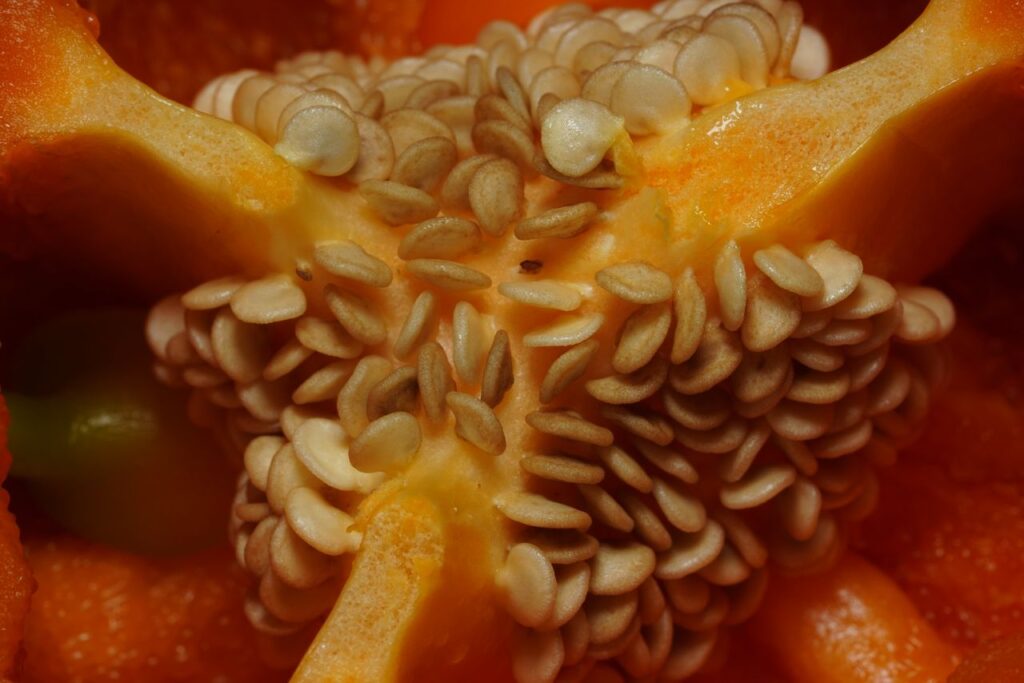
Yes, you can collect and plant seeds from many hybrid vegetables.
The seeds may germinate perfectly well.
The surprise usually comes later.
Plants grown from saved hybrid seed may not look, grow, taste, or produce exactly like the hybrid plant you originally bought.
You might get different fruit sizes, colours, plant heights, yields, flavours, or disease resistance — sometimes even among seedlings from the same batch of saved seed.
This happens because an F1 hybrid is a specific genetic combination, and saving its seeds produces a new generation in which those genetics can separate into many different combinations.
What Does F1 Hybrid Mean?
When you see F1 on a seed packet, the “F” refers to filial generation, while the “1” means it is the first generation produced from a particular cross.
Seed breeders create an F1 hybrid by crossing two selected parent lines.
The resulting F1 plants are usually relatively uniform because they all come from the same planned parent combination.
Breeders may create hybrids to combine useful characteristics such as:
high yield,
uniform fruit,
disease resistance,
vigorous growth,
particular colours,
or specific harvest qualities.
This is why a packet of F1 chilli or tomato seed may produce plants that look remarkably similar to one another.
What Happens When the F1 Plant Makes Seeds?
When that F1 plant flowers and produces seeds, those seeds represent the next generation, often called the F2 generation.
The F2 plants inherit genetic material from the original parent lines, but those genes can recombine in many different ways.
Instead of producing a field of nearly identical plants, you may start seeing variation.
One plant may resemble the F1.
Another may resemble one of the original parent lines.
Another may show an entirely different combination of characteristics.
This process is called genetic segregation.
Hybrid Seeds Are Not Automatically Sterile
One of the most common gardening myths is that hybrid seeds cannot be saved because hybrids are always sterile.
That is not generally true.
Many F1 vegetable hybrids produce perfectly viable seed.
Those seeds may germinate and grow normally.
The issue is usually predictability, not fertility.
There are exceptions. Certain breeding systems can involve male sterility or other reproductive characteristics, and some interspecific hybrids may have fertility problems.
But for many common vegetable hybrids, saved seed can grow.
It simply may not reproduce the original variety accurately.
Your Chilli Might Still Be a Chilli
If you save seed from a hybrid chilli, the next generation does not suddenly become a completely unrelated plant.
It is still genetically related to the chilli parents used to create the hybrid.
However, individual plants may differ in:
heat level,
fruit size,
fruit shape,
ripening colour,
plant height,
yield,
or disease response.
For a Malaysian home gardener growing a few plants for fun, that variation can actually be interesting.
For someone wanting consistent chilli packets or predictable commercial production, it can be a problem.
Tomatoes Can Show Plenty of Variation Too
Suppose you save seeds from a high-yielding F1 tomato with beautifully uniform fruit.
The offspring may not reproduce all those traits together.
One plant may give smaller fruit.
Another may grow more vigorously but produce fewer tomatoes.
Another may taste excellent but crack more easily.
Some may look reasonably similar to the original hybrid.
The important point is that you cannot assume the label characteristics of the F1 packet will still apply to its saved offspring.
Why Did the Original Hybrid Look So Uniform?
The breeder controlled the parent lines.
When those two selected parents were crossed, their offspring received a particular combination of genetics.
That combination produced the F1 variety you purchased.
Once the F1 plant reproduces, those genes are reshuffled.
The carefully created combination starts separating.
This is why seed companies produce fresh F1 seed by recreating the original parent cross rather than simply harvesting seed from F1 plants generation after generation.
Can Saved Hybrid Seeds Produce Something Better?
Potentially.
Genetic variation is not automatically bad.
You could grow an F2 plant that produces:
excellent-tasting fruit,
strong growth,
unusual colour,
better performance in your particular garden,
or another characteristic you really like.
This is part of how plant breeding works.
But one good plant does not immediately become a stable variety.
If you save seed from that plant and grow another generation, its offspring may still vary.
Developing a stable seed line usually takes repeated selection over several generations.
You Can Turn It Into a Gardening Experiment
For home gardeners, hybrid seed saving can be great fun if you approach it with the right expectations.
Suppose you save seeds from your favourite F1 chilli.
Plant 10 or 20 seedlings.
Label them.
Then compare:
plant height,
flowering time,
fruit size,
fruit colour,
heat level,
yield,
and resistance to common problems.
You may discover noticeable differences.
Select the plant you like best and save seed from it again.
Over time, you can learn a lot about plant genetics simply by observing what changes from generation to generation.
But Do Not Call the Offspring by the Original F1 Name
This is important if you share seeds with other gardeners.
If you saved seed from an F1 hybrid, the next generation should not automatically be represented as the original named hybrid.
For example, if the packet was labelled Variety X F1, its F2 offspring are no longer genetically equivalent to commercial Variety X F1 seed.
A more honest label would be something like:
Variety X F1 – Saved Seed, F2
or
F2 selection from Variety X hybrid
This tells future growers to expect variation.
Open-Pollinated Seeds Behave Differently
Open-pollinated varieties are generally more suitable when your goal is to save seed and reproduce similar plants from generation to generation.
Provided the crop has not crossed with another compatible variety, saved open-pollinated seed is much more likely to remain true to type.
This is one reason many seed savers prefer:
open-pollinated varieties,
heirloom varieties,
or locally maintained seed lines.
It gives them more control over what they will grow next season.
Cross-Pollination Can Add Even More Variation
Hybrid genetics are not the only source of uncertainty.
If your F1 plant was also cross-pollinated by another compatible variety in your garden, the saved seeds may contain even more genetic combinations.
For instance, two compatible chilli varieties flowering near each other may exchange pollen through insects.
The chilli fruit you harvest still looks like the mother plant’s normal fruit.
But seeds inside may produce offspring influenced by the pollen donor.
That extra cross can make the next generation even less predictable.
What About Seedless Hybrid Fruits?
Some hybrid fruits produce few or no viable seeds because of the way they were bred.
Seedless watermelon is a familiar example.
In such cases, there may simply be little useful seed to save.
Again, this is different from saying all hybrids are sterile.
Different crops use different breeding techniques.
Should You Save Hybrid Seeds If Garden Space Is Limited?
It depends on what you want.
If you have room for only two chilli plants and need predictable harvest characteristics, buying fresh seed of the known F1 variety is usually the safer choice.
If you have extra space and enjoy experiments, saved hybrid seeds can be worth growing.
Think of them as an experiment rather than a guaranteed replacement for the original packet.
That distinction prevents disappointment.
Hybrid Seeds Can Still Be Useful in a Home Seed Library
You do not necessarily need to throw away saved hybrid seed.
Store it properly.
Label it clearly.
Record the parent hybrid.
Then decide later whether you want to experiment.
For example:
Red Chilli F1 – Saved 2026 – F2 generation expected
That tells you exactly what you are planting next time.
Good records become especially useful once several generations are involved.
Could You Eventually Create Your Own Stable Line?
Yes, in principle.
If you grow a population of hybrid descendants, select plants with characteristics you like, and save seeds repeatedly over multiple generations, the population may gradually become more consistent.
This is essentially a form of plant breeding.
However, stabilising a line takes:
space,
multiple plants,
careful selection,
record keeping,
and patience across several generations.
For most casual gardeners, it is an enjoyable experiment rather than a quick way to recreate the original hybrid.
Do Not Confuse “Hybrid” with “Genetically Modified”
Hybrid breeding and genetic engineering are different things.
F1 hybrids are typically produced by crossing compatible parent plants through controlled pollination.
Gardeners have used forms of selective breeding and hybridisation for generations.
The fact that a seed packet says F1 hybrid does not mean the plant is genetically modified.
So Should You Save the Seeds?
Save them if:
you enjoy experimentation,
you have garden space,
you do not mind variation,
or you want to practise plant selection.
Buy fresh seed if:
you need predictable fruit,
consistent yield,
specific disease resistance,
uniform plants,
or the exact characteristics advertised for the F1 variety.
Both choices are reasonable.
They simply serve different goals.
At the end of the day, saving seeds from a hybrid plant is not a gardening mistake — it is just the beginning of a genetic experiment. Many of those seeds can germinate and grow, but the next generation may separate into plants with noticeably different characteristics. If you want consistency, buy fresh F1 seed or grow an open-pollinated variety for seed saving. If you enjoy surprises, label those saved hybrid seeds carefully and see what appears. Sometimes the most interesting plant in the garden is the one that was never supposed to look exactly like its parent.
Ever saved seeds from an F1 chilli, tomato, cucumber, or another hybrid and ended up with something completely unexpected? Tag @projectharvest.my on Instagram and show us the parent plant, the next generation, and any differences in fruit, colour, size, flavour, or yield. We would love to see the genetic surprises Malaysian home gardeners discover when an F1 becomes an F2.