
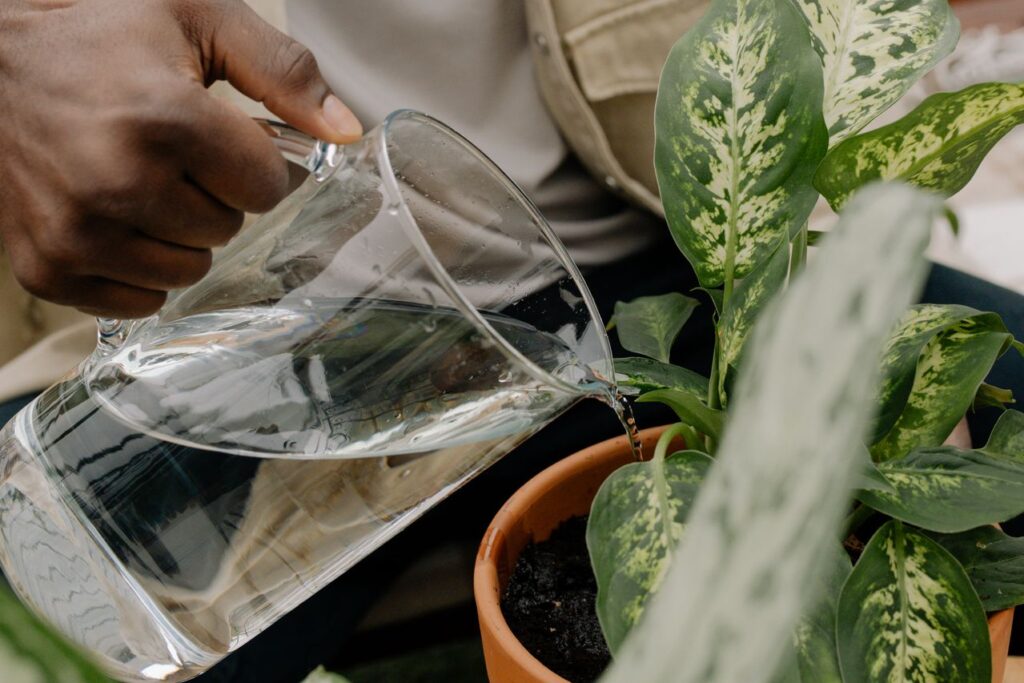
You water your plant thoroughly, see water pouring from the drainage holes, and assume the entire pot is wet. But when you push a finger into the growing mix, the centre is still dry.
If this happens, your potting mix may have become hydrophobic, meaning it has dried so severely that it temporarily resists absorbing water.
The solution is usually not to pour even more water into the pot as quickly as possible. Hydrophobic potting mix needs to be rehydrated gradually, giving water enough time to penetrate the dry material instead of escaping through cracks around it.
First, Confirm That the Mix Is Actually Dry
Before trying to fix the problem, check deeper into the pot.
The surface can sometimes look dry while the root zone underneath is still moist.
Push your finger several centimetres into the mix, use a wooden stick, or carefully inspect the soil near the side of the container.
If the growing medium feels dusty, hard, and dry throughout — especially if it has shrunk away from the pot wall — rehydration is probably necessary.
If the centre is already wet, adding more water may instead create overwatering problems.
Why Does Water Run Straight Through?
When some organic ingredients in potting mixes dry excessively, they can become difficult to wet again.
At the same time, severely dry potting mix often shrinks.
This creates gaps between the growing medium and the sides of the pot.
When you pour water onto the surface, the water finds the easiest route. Instead of soaking through the dry root ball, it moves along those gaps and exits through the drainage holes.
This means fast drainage does not always mean the plant was watered properly.
Sometimes it means the water barely touched the roots.
Method 1: Water Slowly in Several Rounds
For mildly hydrophobic potting mix, start with the simplest method.
Apply a small amount of water slowly across the surface.
Do not flood the pot.
Wait several minutes.
Then apply another small amount.
Repeat the process until the growing medium begins accepting water more evenly.
The first application softens and moistens the driest outer material. Later applications can then penetrate further into the root ball.
For Malaysian gardeners accustomed to quickly watering many pots before work or in the evening, this may feel slow — but it is much more effective than pouring several litres through a pot in one go.
Water the Whole Surface
Do not pour all the water into one spot.
Move around the container and wet the surface evenly.
If you always water beside the stem, some sections of the root ball may remain permanently dry.
This is particularly important in wide containers and grow bags.
Apply water around the entire root zone so moisture can gradually spread through the mix.
Break Up a Hard Surface Gently
If the top layer has formed a hard crust, gently loosen only the upper surface with your fingers, a small fork, or a hand cultivator.
Be careful not to damage shallow roots.
You do not need to dig deeply through an established plant.
The aim is simply to break the surface enough that water has more entry points.
If the entire root ball has become solid or badly compacted, however, the problem may be bigger than hydrophobicity alone. The plant may need refreshing or repotting.
Method 2: Bottom-Water the Pot
For more stubborn dry pots, bottom watering can be very effective.
Place the container inside a tray, basin, or bucket containing water.
Allow the bottom portion of the pot to sit in the water temporarily.
Moisture will gradually move upward through the drainage holes and into the potting mix through capillary action.
Check the surface periodically.
Once the root ball feels evenly moist, remove the container and allow excess water to drain completely.
Do not leave the plant permanently sitting in water.
Depending on the pot size and how dry the mix is, rehydration may take anywhere from several minutes to much longer.
The goal is not to follow an exact timer. Check the growing medium itself.
Large Pots May Need a Different Approach
You obviously cannot place a 50-litre fruit-tree pot inside your kitchen basin.
For large containers, gradual top watering is usually more practical.
Apply water slowly in several stages.
If there is a large gap between the root ball and container wall, you can gently press or loosen the upper edges of the mix so water does not immediately disappear down the sides.
Continue applying small amounts until the centre begins retaining moisture.
A drip system running slowly can also help large dry containers rehydrate more evenly than a powerful hose.
What About Adding Dish Soap?
You may come across gardening advice recommending a few drops of household dishwashing liquid to help water penetrate hydrophobic soil.
Be cautious.
Household detergents are not formulated for plant roots and may contain fragrances, salts, surfactants, or other ingredients that are unnecessary in your growing medium.
If a commercial wetting agent is genuinely required, use a product specifically labelled for horticultural use and follow its directions carefully.
For most home containers, patient watering or bottom watering should be attempted first.
Do Not Fertilise While the Plant Is Severely Dry
If a plant is wilted in extremely dry potting mix, focus on restoring moisture before feeding it.
Applying concentrated liquid fertiliser to a severely dry root zone can increase stress and potentially expose roots to excessive salts.
Rehydrate the soil first.
Allow the plant to recover.
Then return to its normal feeding schedule if fertiliser is actually needed.
Wilted leaves do not automatically mean the plant is hungry.
Check Whether the Plant Is Root-Bound
If water continually refuses to soak in even after rehydration, inspect whether roots have filled the entire container.
A root-bound plant may contain very little actual potting mix.
Water then travels unevenly through dense masses of roots.
If you can safely remove the plant and see thick roots circling the outside of the root ball, it may be time to repot into a larger container or perform appropriate root management.
No amount of careful watering can permanently compensate for a plant that has completely outgrown its pot.
Hydrophobic Mix May Also Need Refreshing
If the growing medium repeatedly becomes hard, shrinks badly, and refuses to absorb water, the mix itself may have degraded.
Organic ingredients break down over time, reducing the air spaces that originally made the potting medium suitable for containers.
In this situation, consider refreshing the mix with fresh potting medium and suitable structural ingredients.
A little finished compost or vermicompost can restore organic matter and nutrients, but avoid simply adding large amounts of fine compost because this may make an already dense medium even heavier.
Prevent the Problem from Coming Back
The easiest way to deal with hydrophobic potting mix is to prevent extreme drying.
That does not mean keeping every plant constantly wet.
Instead, check moisture before the entire root ball reaches the bone-dry stage.
This is especially important for small containers exposed to Malaysian afternoon sun.
Container size matters too.
A large chilli plant growing in a tiny pot may use available moisture extremely quickly. Moving it into a more suitable container can make watering much easier.
A thin layer of suitable mulch can also help larger outdoor pots lose moisture more slowly, provided the mulch is kept away from the main stem.
Be Extra Careful During Malaysian Hot Spells
Plants in containers can dry much faster than plants growing in the ground.
Pots have limited soil volume, and their sides are exposed directly to warm air and sunlight.
Dark-coloured containers can heat up even more quickly.
During unusually hot and dry periods, check smaller pots more frequently rather than automatically following the same watering schedule all year.
You may discover that a plant requiring watering every three days during a wet week needs much more frequent attention during hot weather.
Let the plant and soil conditions guide you.
Know When Rehydration Is Complete
After watering, check several parts of the pot.
The centre should feel moist.
The edges should be moist.
The surface may still be slightly drier than underneath, which is fine.
The pot should also feel noticeably heavier than it did when completely dry.
If you water again and the water now moves gradually through the growing medium rather than immediately running down the sides, the mix has likely been successfully rehydrated.
From there, return to normal watering rather than keeping it permanently saturated.
At the end of the day, hydrophobic potting mix is usually recoverable. Water slowly in several rounds, wet the entire surface, use bottom watering for stubborn smaller pots, and give the dry medium enough time to absorb moisture. Once the root ball is evenly hydrated again, investigate why it became so dry in the first place. Better watering habits, larger containers, refreshed potting mix, and protection from extreme Malaysian heat can prevent the same problem from happening repeatedly.
Ever watered a plant only to find the middle of the pot was still completely dry? Tag @projectharvest.my on Instagram and share your rehydration experiment, bottom-watering setup, stubborn dry potting mix, or before-and-after plant recovery with us. Your experience might help another Malaysian gardener realise that sometimes a plant does not need more water — it needs water delivered in a way the soil can actually absorb.