
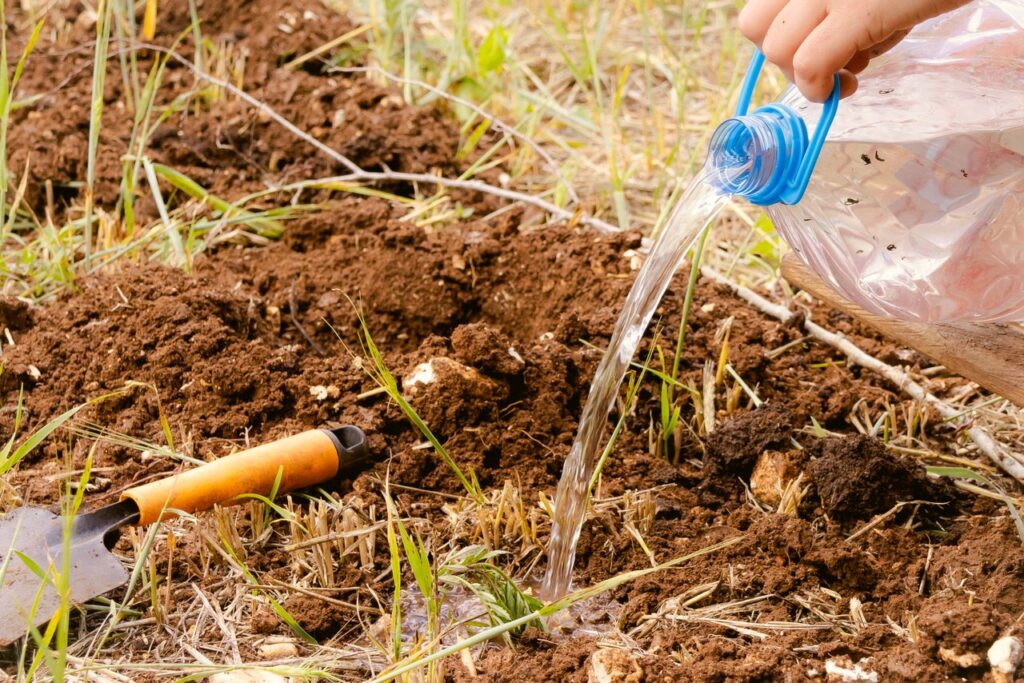
You water a pot and something strange happens: instead of soaking into the soil, the water sits on top, runs straight down the sides of the container, or pours out of the drainage holes almost immediately.
Then you push a finger into the pot and discover that the centre is still completely dry.
This is a common problem in older container gardens. Potting mix can gradually become dense, compacted, shrunken, or hydrophobic, meaning it starts resisting water rather than absorbing it easily.
For Malaysian gardeners, the problem can become especially obvious after a pot has dried severely during several hot days.
Understanding why it happens makes it much easier to prevent.
Potting Mix Is Not Permanent
Commercial potting mix is deliberately designed to provide a balance of:
water retention,
drainage,
air spaces,
and root support.
It may contain ingredients such as cocopeat, peat, composted bark, perlite, rice-husk-based materials, compost, or other organic and mineral components.
When the mix is fresh, these ingredients create plenty of spaces between particles.
But potting mix changes as it ages.
Organic ingredients decompose.
Fine particles settle downward.
Roots fill available spaces.
Repeated watering moves material around.
Eventually, the mix may lose some of the open structure that originally made it suitable for container growing.
Why Does Potting Mix Become Hard?
One major reason is structural breakdown.
As organic components decompose, large particles gradually become smaller.
Smaller particles fit more closely together, reducing the spaces that once held air.
Repeated watering and gravity also cause the mix to settle.
Over time, what was once a fluffy growing medium can become a much denser mass.
This is especially noticeable in large containers that have not been repotted for several years.
You may also notice the soil level slowly dropping lower inside the pot.
The missing volume has not necessarily washed away. Much of the organic material has simply decomposed and collapsed.
Roots Can Make the Pot Feel Solid Too
Sometimes the potting mix itself is not the only problem.
A mature plant may become root-bound, meaning its roots have filled most of the available container.
The dense root network can make the entire pot feel hard.
Water may struggle to penetrate evenly because there is very little loose growing medium remaining.
If you remove the plant and see roots circling around the outside of the root ball or forming a thick mat at the bottom, the plant may simply have outgrown its container.
Refreshing the surface soil alone will not completely solve that problem.
The plant may need root management or a larger pot.
Why Does Dry Potting Mix Repel Water?
Some organic growing-medium ingredients become difficult to re-wet after they have dried excessively.
This behaviour is called hydrophobicity.
Instead of attracting water, the dry material temporarily resists it.
Peat-based growing media are particularly well known for becoming difficult to rehydrate after severe drying, although other organic materials can also develop water-repellent behaviour.
This creates one of the most confusing situations in container gardening.
You water heavily.
Water comes out of the bottom.
So you assume the plant has been watered thoroughly.
But when you dig into the centre, the root ball may still be dry.
The water simply found easier pathways around the hydrophobic material.
Shrinking Creates Channels Around the Pot
Very dry potting mix may also shrink away from the sides of the container.
This creates gaps between the root ball and the pot wall.
When you water, the water follows those gaps because they offer less resistance than the dry growing medium.
Within seconds, water may pour from the bottom.
This creates the illusion of excellent drainage when the opposite problem is happening: the root zone is barely getting wet.
If water rushes through unusually quickly, check the moisture in the centre before assuming the plant has received enough.
Heat Makes the Problem Worse
Malaysia’s climate can push container soil from slightly dry to severely dry very quickly.
Small dark-coloured pots exposed to afternoon sun can become extremely warm.
A chilli, herb, tomato, or flowering plant with a large root system may use water rapidly during a hot day.
If the entire root ball dries repeatedly, water repellency becomes more likely.
This is why regular moisture checks matter more than simply following a rule such as “water every two days.”
Different pots dry at different rates.
Too Much Fine Compost Can Contribute to Density
Compost is useful, but excessive amounts of very fine compost can make a container mix denser over time.
As compost continues decomposing, it loses volume and can contribute more fine particles.
This is one reason Project HARVEST recommends treating compost as one ingredient in a potting mix, rather than filling containers entirely with compost.
Roots need nutrients, but they also need oxygen.
A dark, rich-looking pot can still be physically unsuitable if there are not enough air spaces.
Fertiliser Salts Can Create Additional Problems
Repeated fertiliser use can cause soluble salts to accumulate in container soil, particularly if the pot receives frequent feeding but little water ever drains through the bottom.
You may sometimes notice a pale or whitish crust on the soil surface or around the pot rim.
Salt accumulation is not the same thing as hydrophobicity, but both can occur in an old container at the same time.
High salt levels can interfere with the plant’s ability to absorb water even when moisture is physically present.
That is another reason to avoid assuming that a struggling plant simply needs more fertiliser.
How Can You Tell If Your Potting Mix Is Water-Repellent?
Try watering the pot slowly.
Watch what happens.
If the water immediately forms beads on the surface, runs towards the edges, or disappears down cracks without wetting the middle, the mix may have become hydrophobic.
Wait several minutes and push a finger or wooden stick deeper into the root zone.
If the surface looks wet but the centre remains dry, you have found the problem.
Another sign is uneven moisture.
One section may be soaking wet while another section only a few centimetres away remains dusty.
Healthy potting mix should generally absorb water more evenly.
Hard Soil Does Not Always Mean Compaction
It is worth distinguishing between several different problems.
A pot may feel hard because:
the mix has physically compacted,
organic materials have decomposed,
the plant is severely root-bound,
the medium is completely dry,
or several of these problems are happening together.
Identifying the cause matters because the solution will be different.
A root-bound plant may need repotting.
Degraded mix may need refreshing.
Hydrophobic mix may simply need careful rehydration first.
Do Not Keep Pouring Water Faster
When water refuses to soak in, gardeners often respond by pouring even more water into the pot.
That may simply send more water down the sides and out of the drainage holes.
Instead, water slowly and in stages.
Apply a small amount.
Wait.
Allow the surface to begin absorbing it.
Then add more.
For severely dried pots, this process may need to be repeated several times.
Another option for suitable containers is bottom watering, where part of the pot is temporarily placed in water so moisture can gradually move upward through the mix.
Do not leave the pot permanently standing in water.
The goal is to rehydrate the root ball, not create waterlogging.
Prevention Is Easier Than Rehydration
Avoid allowing moisture-loving container plants to reach the point where the entire root ball becomes completely dry.
This does not mean keeping every pot constantly wet.
Instead, learn how quickly different containers dry.
Check deeper than the surface.
Mulch may help larger outdoor containers retain moisture during hot weather, provided it is used appropriately and kept away from stems.
Using a good-quality potting mix with durable structural ingredients also makes a difference.
Refresh Old Mix Before It Completely Collapses
After several growing cycles, inspect the potting mix.
If it has become noticeably finer, denser, or much lower in the container, refresh it rather than waiting for severe problems.
Remove old roots where appropriate and mix in fresh potting medium.
If drainage and aeration have deteriorated, add suitable coarse structural ingredients.
A modest amount of finished compost or vermicompost can restore organic matter and nutrients, but remember that structure matters just as much as fertility.
Sometimes Repotting Is the Real Solution
If the mix is several years old, badly collapsed, filled almost entirely with roots, or repeatedly becomes waterlogged and hydrophobic, partial refreshing may no longer be enough.
Repotting allows you to remove degraded medium, inspect the roots, and rebuild a healthier growing environment.
Healthy old mix can often be reused elsewhere after refreshing rather than automatically being thrown away.
Container gardening is an ongoing system.
The growing medium needs maintenance just like the plant above it.
At the end of the day, hard and water-repellent potting mix is usually the result of age, decomposition, severe drying, root growth, and loss of soil structure rather than one single mistake. If water suddenly rushes through your pots without actually wetting the roots, slow down and investigate before watering even more. Keep potting mixes from drying excessively, refresh ageing media, maintain good aeration, and repot plants when roots have taken over the container. A pot may look perfectly normal from above while the real water problem is hidden several centimetres below the surface.
Ever watered a pot only to discover the soil inside was still bone-dry? Tag @projectharvest.my on Instagram and show us your hard potting mix, water-repellent root ball, rehydration experiment, or refreshed container setup. Your before-and-after could help another Malaysian gardener realise why water sometimes seems to go straight through a pot without ever reaching the plant.