
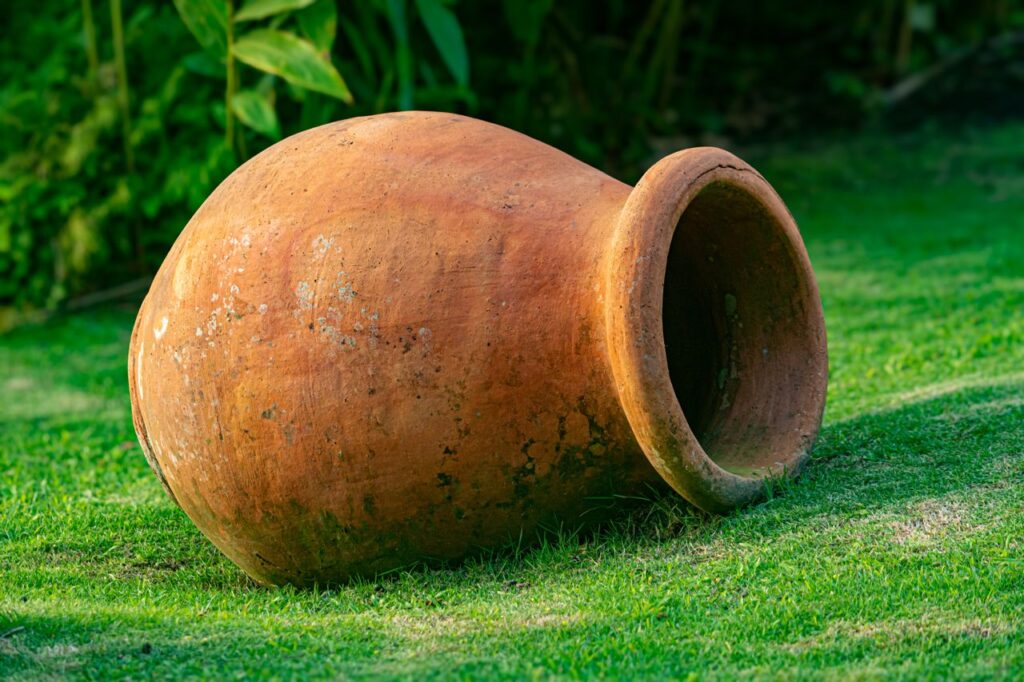
An olla is one of the simplest irrigation tools you can put into a garden bed.
It is usually an unglazed clay pot or vessel buried in the soil and filled with water. Because the clay is porous, water slowly moves through the walls of the vessel and into the surrounding soil.
Instead of pouring water across the surface and hoping enough reaches the roots, an olla releases moisture underground close to where plants can actually use it.
For Malaysian gardeners dealing with hot weather, fast-drying raised beds, or the inconvenience of daily hand watering, ollas can provide a surprisingly low-tech way to keep soil moisture more consistent.
How Does an Olla Work?
Unglazed clay contains tiny pores.
When the olla is filled with water and surrounded by drier soil, moisture gradually moves through those pores into the soil.
This movement is influenced by the moisture difference between the water inside the olla and the soil outside it.
As the surrounding soil becomes drier, more water is drawn outward.
When the soil is already moist, movement slows.
In simple terms, the soil takes water from the olla as it needs it.
This is what makes olla irrigation different from simply pouring a bucket of water into the garden.
Use Unglazed Clay
The olla must be porous.
A fully glazed ceramic pot will hold water inside rather than allowing it to move through the walls.
Traditional ollas are specifically made for irrigation, but Malaysian gardeners can also experiment with suitable unglazed terracotta pots.
If using an ordinary flowerpot, the drainage hole at the bottom must be sealed securely so water does not simply escape downward.
Two terracotta pots are sometimes joined together to create a larger DIY reservoir, although the join needs to be watertight.
Whichever method you use, test the vessel before burying it.
Fill it with water and make sure it slowly dampens on the outside rather than leaking rapidly through cracks or seams.
Where Should You Place It?
The olla should sit close enough to the plants that roots can reach the moist zone around it.
For a small group of vegetables, place the olla near the centre of the planting area and grow plants around it.
Chillies, brinjal, tomatoes, herbs, and leafy vegetables can all potentially benefit.
The exact distance depends on the size and porosity of the olla, soil type, plant size, and how widely moisture spreads.
A small clay pot may only influence a relatively small area.
A larger olla can support a wider group of plants.
Do not assume one tiny olla will irrigate an entire raised bed.
Bury Most of the Olla
Dig a hole deep enough to bury almost the entire vessel.
Leave only the neck or upper opening above the soil surface.
Pack the surrounding soil firmly enough that there is good contact between the earth and clay wall, but do not compact it excessively.
Good soil contact matters because water needs to move from the clay directly into the surrounding growing medium.
If large air gaps remain around the pot, wicking may become less effective.
Once installed, fill the olla with water and cover the opening.
Always Cover the Top
This is particularly important in Malaysia.
An open container of standing water can attract mosquitoes, leaves, dirt, insects, and other debris.
Use a lid, clay saucer, secure cap, or another suitable cover over the opening.
The cover should prevent mosquito access while still being easy to remove when you need to refill the olla.
Do not treat mosquito prevention as optional simply because the opening looks small.
Stored water should always be properly covered.
How Often Should You Refill It?
There is no fixed schedule.
During hot Malaysian weather with mature vegetables growing nearby, the olla may empty fairly quickly.
During cloudy or rainy periods, it may remain partly full for much longer.
Check the water level regularly when you first install it.
Over time, you will learn how quickly your particular garden uses the stored water.
A simple stick inserted through the opening can help you estimate the remaining level.
Refill when the water becomes low rather than automatically topping it up every morning.
Do Not Keep Refilling During Heavy Rain
Malaysia’s rainfall can completely change the watering requirement.
If the bed has already received heavy rain and the soil is thoroughly moist, there may be little reason to refill an empty olla immediately.
Let the garden use the available moisture first.
Remember that the olla is an irrigation tool, not a rule that says the reservoir must always be full.
If soil remains saturated for long periods, adding more stored water can contribute to unnecessary wetness around the roots.
Good drainage still matters.
Soil Type Changes How Well Ollas Work
Ollas tend to work best where the surrounding soil can spread moisture through capillary action.
In very sandy soil, water may move downward quickly and spread less effectively sideways.
The wet zone around the olla may therefore be smaller than expected.
Adding finished compost and improving organic matter can help sandy soil hold moisture better.
In extremely heavy clay, water may move differently and the soil may remain wet for longer.
This means you should observe your particular bed rather than relying on a diagram that promises an exact watering radius.
After using the olla for a few days, gently dig into the soil at different distances and see how far the moisture has travelled.
Mulch Can Make Ollas Even More Effective
A suitable organic mulch can help reduce moisture loss from the soil surface.
Once the olla has supplied water below ground, mulch helps prevent some of that moisture from evaporating rapidly under Malaysian sun.
Dry leaves, suitable plant residues, or other appropriate organic mulch can work well.
Keep mulch slightly away from plant stems.
Using an olla below the soil and mulch above it can create a much more stable moisture environment than surface watering bare soil.
Can You Use Ollas in Raised Beds?
Yes.
Raised beds are one of the easiest places to use them because you can position the vessels before planting.
For a long raised bed, you may need several ollas spaced along the growing area.
Instead of concentrating every vegetable around one large reservoir, multiple smaller ollas can distribute moisture more evenly.
This can be especially useful if you are growing different groups of herbs and vegetables along the bed.
What About Large Containers?
Ollas can also work in large pots and planters.
A small unglazed clay vessel buried beside a chilli, brinjal, or fruit plant can provide a slow water supply.
However, make sure there is still enough space for roots.
Putting an oversized olla inside a relatively small container may leave too little actual growing medium.
For ordinary small herb pots, a self-watering container may be more practical.
Ollas make the most sense in larger containers and beds where there is enough room for both the reservoir and healthy root growth.
Do Plants Still Need Surface Watering?
Sometimes.
New seedlings have shallow roots and may not yet reach the moist zone around the olla.
Water them gently from above during establishment.
After their roots spread, they can increasingly rely on moisture released underground.
You may also need surface watering when adding compost, establishing new transplants, or during unusual heat.
Ollas reduce routine watering.
They do not mean you must never use a watering can again.
Do Not Put Fertiliser Inside Without a Reason
It may be tempting to fill the olla with liquid fertiliser and turn it into a feeding system.
For a simple home setup, plain water is usually safer.
Concentrated fertiliser solutions may lead to salt accumulation around the vessel or potentially affect the porous clay.
Feed plants according to your normal soil and fertiliser plan unless the irrigation system was specifically designed for fertigation.
An olla’s main job is water delivery.
Keep it simple.
Watch for Root Growth Around the Olla
Plants naturally grow roots towards reliable moisture.
Over time, you may find fine roots concentrated around the outside of the clay vessel.
That is normal.
However, during crop changes, inspect the area and remove excessive old roots if necessary.
Permanent beds may also benefit from occasionally checking that roots have not created dense layers that affect how the system performs.
Ollas Need Occasional Cleaning
Minerals, algae, soil particles, and fertiliser salts may gradually clog the pores of the clay.
If you notice that a vessel is staying full unusually long during dry weather even though surrounding plants need water, it may have become less porous.
At the end of a crop cycle, remove the olla where practical and scrub the outside gently with water.
Avoid coating the surface with soaps, oils, or substances that could block the pores.
Keeping the clay clean helps maintain its ability to release water.
When Are Ollas Most Useful?
Ollas make the most sense when you:
have raised beds,
grow several vegetables close together,
want to reduce frequent hand watering,
prefer a system without hoses or electricity,
have limited access to an outdoor tap,
or want to experiment with a simple low-tech irrigation method.
They may be less practical for large commercial-style gardens where drip irrigation can distribute water across many rows more efficiently.
Ollas vs Drip Irrigation
Drip irrigation is easier to scale.
One main line can water dozens of plants and can be connected to a timer.
Ollas are simpler individually and require no pressure, tubing, or electronics.
However, each vessel needs to be refilled manually.
For a small raised bed, ollas may be beautifully simple.
For a garden containing 100 containers, filling dozens of buried clay pots may become more work than using drip irrigation.
Choose the system that solves your actual watering problem.
Are Ollas Worth Trying in Malaysia?
Yes, particularly as an experiment in a small edible bed.
They can reduce surface evaporation, deliver moisture close to roots, and make watering more consistent during hot spells.
But they still need good drainage, mosquito-proof covers, appropriate spacing, and regular refilling.
They also perform differently depending on your soil.
Start with one or two ollas rather than converting the whole garden immediately.
Observe how far the moisture spreads and how often you need to refill.
Let your garden tell you whether the method is worth expanding.
At the end of the day, olla irrigation is beautifully simple: bury a porous clay vessel, fill it with water, cover the opening, and let moisture slowly move into the surrounding root zone. Used properly, ollas can reduce surface watering and help keep vegetables more consistently moist during Malaysia’s hotter periods. Just remember that they are not completely automatic — check the water level, respond to rainfall, protect the reservoir from mosquitoes, and make sure the surrounding soil can actually distribute the moisture effectively.
Have you tried burying an olla or DIY terracotta watering pot in your garden? Tag @projectharvest.my on Instagram and show us your setup, refill routine, wetting pattern, raised-bed experiment, or the vegetables growing around it. We’d love to see how Malaysian gardeners adapt this ancient watering method to modern home gardens — and your experiment might inspire someone else to try irrigation without a single hose or timer.